
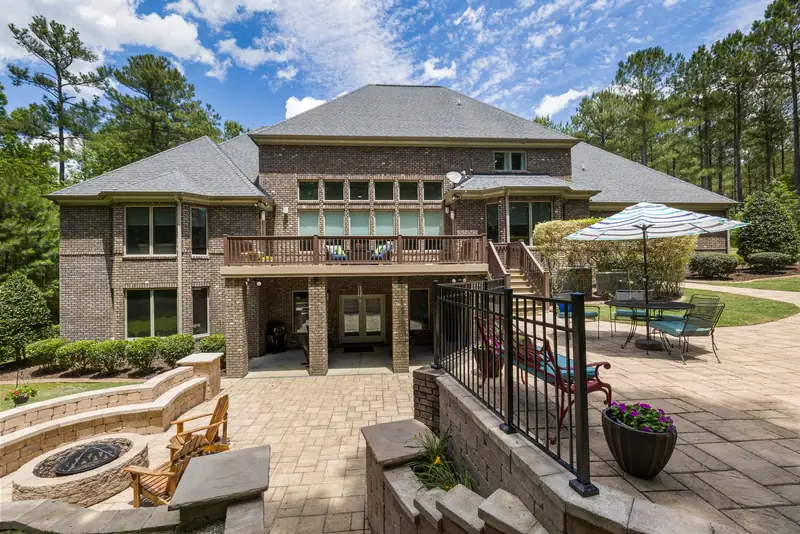
Paver Patios & Walkways · Anna Maria Island, FL
Paver Patios on Anna Maria Island
A paver patio on Anna Maria Island runs $10–$17 per sq ft installed this October. Nearly every lot on the island sits close enough to open saltwater that it matters more here than almost anywhere else we work, and Anna Maria's own code adds a specific rule for pavers that stray into the right-of-way.
By the Opera Concrete & Pavers estimating team · Updated October 1, 2026
Get a free estimate
Tell us about the project and we'll call to set up a free site visit.
Anna Maria's rule for a paver apron that reaches the right-of-way
Anna Maria's code lets a homeowner put a pervious brick paver system in the right-of-way with Building Department and Public Works sign-off, provided the pavers don't extend past the driveway's own border or 24 feet of width, whichever is less, and the owner records a non-exclusive maintenance agreement obligating perpetual upkeep Anna Maria Code §114-421. The city keeps the right to pull up or trim any paver system that turns into a hazard or blocks utility work, with no reimbursement owed for the loss Anna Maria Code §114-421.
Travertine pavers versus concrete pavers for a patio
Travertine and concrete pavers solve the same problem with different materials. Travertine is a natural stone that stays noticeably cooler underfoot in direct sun than a dark concrete paver, which matters on an uncovered Anna Maria Island patio in summer, though we won't put a number on the temperature difference since no verified measurement exists for Florida conditions. It's also more porous, so sealing matters more over time. Market ranges for installed paver patios run about $10 to $17 per square foot, and travertine typically prices above the top of that range because of material cost. Concrete pavers come in more colors and patterns and cost less to replace if one cracks.
A paver patio replacing a storm-damaged pool deck in Holmes Beach, worked out in square feet
Say a Holmes Beach cottage needs its 400 square foot paver patio replaced after 2024's flooding undermined the old base, on a lot close enough to Anna Maria Sound to sit well inside FDOT's marine-exposure line. At $10–$17 per sq ft installed, the job runs $4,000 to $6,800, narrowing to about $4,800 to $6,400 inside the typical $12–$16 band once the paver grade and sealer spec are chosen. The old base gets excavated rather than reused, since storm-driven saturation is exactly the condition that undermines a compacted base from beneath.
Why joint sand and sealer wear faster on this island than inland
FDOT's bridge engineers draw their marine-environment boundary at 2,500 feet from any chloride-heavy waterway FDOT Structures Design Guidelines, and on an island this narrow, bounded by the Gulf on one side and Anna Maria Sound or Tampa Bay on the other, that line sweeps in essentially every address Wikipedia, Anna Maria Island. The paver base spec underneath doesn't change, but a sealer coat or polymeric joint sand that would last several seasons three miles inland needs a shorter recoat interval here.
That white haze on new pavers: efflorescence
New concrete pavers can develop a whitish, chalky film called efflorescence, a calcium carbonate deposit that can appear within 60 days of installation and sometimes doesn't show at all until the paver's first wet season if it was laid during a dry stretch. It does not affect the strength or durability of the paver itself. On a Anna Maria Island patio, the bloom typically fades with normal weathering and rinsing over time, and sealing too early can sometimes trap it rather than help it wear off. It's worth knowing this before the first efflorescence shows up, because it looks alarming and almost never is.
Base under a walkway versus a full patio
A garden walkway or a run of stepping pavers from the driveway to the front door doesn't need the same base program as a 400-square-foot patio, but it still needs one. ICPI's 4-inch minimum compacted base for pedestrian areas applies to a 3-foot-wide path the same way it applies to an open patio, because a narrow walkway with no base shifts and dishes faster than a wide one, since there's less paver mass holding each course in line. On a Anna Maria Island property where a walkway crosses a soft, shaded side yard, we'll often add a touch more base depth there than the sunny, well-drained stretch of the same path.
Tying new paver work into an existing slab mid-project
When a patio extends off an existing concrete pad, the saw-cutting and elevation matching happen early, usually on day one, so every later stage, base compaction, sand screeding, paver laying, is built around a confirmed, flush transition rather than guessed at and corrected at the end. We dry-lay a row of pavers against the cut edge before compacting the final base lift, checking the finished height against the old slab with a straightedge. On a Anna Maria Island addition this extra verification step adds maybe an hour to the job and prevents the far more time-consuming fix of pulling up a finished section later.
Keeping ants and weeds out of the joints
Compacted, properly topped-off joint sand is the simplest defense against both ants nesting and weed seed germinating between pavers, since loose or thin sand gives both something to work with. A quick sweep to clear organic debris like leaf litter and grass clippings off a Anna Maria Island patio before it decomposes into the joints also removes the organic matter weeds actually need to sprout. For an established ant problem in the joints, treating the colony directly works better than repeatedly re-sanding over it, since the ants will just re-excavate fresh sand the same way they did the old.
Frequently asked questions
Can I put pavers in the right-of-way in front of my Anna Maria home?
With a permit, yes, as long as the pavers stay within the driveway's own border or 24 feet of width, whichever is smaller, and the owner records a maintenance agreement committing to upkeep the paver system going forward.
Can the city remove pavers I've installed in the right-of-way?
Yes. Anna Maria's code reserves the right to trim or remove a paver system in the right-of-way if it becomes a hazard or blocks utility access, and it doesn't owe the owner reimbursement for that loss.
Does a paver patio need resealing more often on this island?
Often, yes. FDOT's own marine-chloride boundary covers nearly the whole island, and a sealer coat or polymeric joint sand under that much airborne salt typically needs attention on a shorter cycle than the same patio would a few miles inland.
Sources
- FDEP Coastal Construction Control Line Program
- FDEP — Apply for a CCCL permit
- FEMA - Features of Flood Insurance Rate Maps in Coastal Areas
- FEMA Flood Map Service Center
- FDOT Structures Design Guidelines Vol. 1, §1.3.2 environmental classification
- SWFWMD District Water Restrictions
- Florida Administrative Code — Rule 62-308.100, Synthetic Turf (effective May 19, 2026)
- Florida Statutes §125.572 — synthetic turf on single-family lots
- F.S. 720.3045 (2026) Installation, display, and storage of items
- Wikipedia, Anna Maria Island
- Wikipedia, Anna Maria, Florida
- Wikipedia, Holmes Beach, Florida
- Wikipedia, Bradenton Beach, Florida
- City of Anna Maria, Building Department
- Holmes Beach, Building Department
- City of Bradenton Beach, Building & Planning
- City of Anna Maria, Ordinance No. 24-927 (height limitation)
- The Anna Maria Islander, Bradenton Beach suspends building official in wake of 2 hurricanes
- My Suncoast, Anna Maria Island residents dealing with the hurricanes' destruction
- Anna Maria Code of Ordinances
- Holmes Beach Code of Ordinances
- Census Reporter, Anna Maria, FL (ACS 2020-2024 5-yr)
- Census Reporter, Holmes Beach, FL (ACS 2020-2024 5-yr)
- Census Reporter, Bradenton Beach, FL (ACS 2020-2024 5-yr)
Ready for a price on your project?
Request a free estimate
Tell us about the project and we'll call to set up a free site visit.