
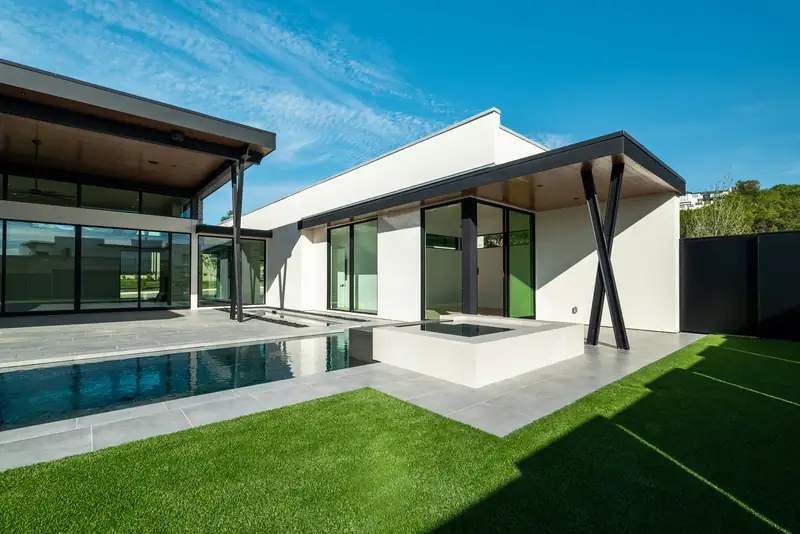
Artificial Turf · Greater Orlando & Sarasota
Artificial Turf Lawns, Pet Areas and Putting Greens Built to Florida's New Turf Rule
Artificial turf in Florida covers more than a front lawn: we install pet areas, backyard putting greens and turf set between pavers, all built to DEP Rule 62-308.100, the state turf standard that took effect May 19, 2026. As of October 2026, installed turf runs $10 to $25 per sq ft in Florida market data, with a typical Orlando project averaging about $4,758. We build to that standard across Greater Orlando and Sarasota–Manatee.
By the Opera Concrete & Pavers estimating team · Updated October 1, 2026
Get a free estimate
Tell us about the project and we'll call to set up a free site visit.
What an artificial turf project covers
This service covers four kinds of work, and most jobs mix at least two of them. A full front or back lawn replaces sod with a synthetic lawn panel, graded and based the same way across the yard. A pet area is usually a fenced run or a side strip built with a more open-backed turf and a steeper drainage slope, since it carries far more liquid than a lawn ever does. A backyard putting green is a different product, a short, dense nylon or polyethylene face with little or no infill, set on a flatter, more precisely screeded base than a lawn panel needs. Turf between pavers, a narrow accent strip inside a driveway, along a walkway edge or framing a fire pit, follows the same subgrade rule as the rest of the yard but ties into the paver field's existing edge restraint instead of standing on its own perimeter. Lawn, pet area, putting green or paver accent, all four now answer to the same state material and base standard.
The 2026 Florida turf standard: what DEP Rule 62-308.100 requires
Florida didn't regulate synthetic turf at the state level until recently. HB 683, passed in 2025, created F.S. 125.572 and directed the Department of Environmental Protection to write minimum standards for turf on single-family lots of one acre or less (HB 683, 2025; F.S. 125.572). DEP adopted Rule 62-308.100 to do that, and it took effect May 19, 2026 (FLRules 62-308.100). The rule doesn't create a new state permit; it sets the floor a compliant lawn has to clear, whichever city or county issues the local permit.
| Requirement | What it means |
|---|---|
| Materials | No heavy metals or intentionally added PFAS in turf, backing or infill; everything disposable at a landfill |
| Infill | Clean silica sand, rock, shell or coated silica sand only; rubber infill limited to inside playground-equipment footprints |
| Subgrade / base | Washed crushed rock or crushed concrete; no limerock or road base with fines |
| Permeability | Turf and backing must be permeable over a pervious subgrade; a local government may set a 10 in/hour maximum |
| Irrigation | In-ground irrigation can't water turf; a local government may require existing heads capped below grade |
| Water setback | At least 10 ft from a natural or man-made waterbody, unless a seawall or bulkhead already separates the yard from it |
| Tree drip lines | No turf inside a tree's drip line unless a certified arborist signs off that installing it won't harm the roots |
| Anchoring | Edges and seams anchored against wind and flooding, on top of the manufacturer's own installation spec |
Rule 62-308.100, adopted text.
Two more requirements sit outside that table: turf can't go inside a swale, ditch, stormwater pond or a pond's littoral zone, and it can't block a septic tank's access lid, since pump-out crews still need to reach it with the lawn installed.
Who the law actually binds: local governments, not HOAs
The preemption in F.S. 125.572 reaches local governments only. Once DEP's rule took effect, a city or county can no longer ban compliant turf or write a stricter local standard (F.S. 125.572). Community development districts keep the right to enforce their own deed restrictions, a carve-out added in 2026, and the statute never mentions homeowners' associations at all. That distinction holds because an HOA is a private contract, not a unit of local government, and a different statute governs what it can and can't restrict.
F.S. 720.3045 is the statute homeowners usually mean when they ask whether an HOA can ban turf, and it protects less than most people assume. It bars an association from restricting items that aren't visible from the parcel's frontage, an adjacent parcel, an adjacent common area or a community golf course, naming artificial turf specifically among those items (F.S. 720.3045). A backyard lawn hidden by a fence usually qualifies; a front lawn facing the street usually doesn't, since it's the one place turf is most visible. Florida law also stopped HOAs, as of 2026, from requiring a government permit to already be issued before the board will review an application, so the two approvals can move together instead of one waiting on the other (F.S. 720.3035). Our full read on Florida HOAs and the turf law and getting HOA approval for pavers or turf go further.
How a turf lawn is installed, step by step
The order rarely changes between a lawn, a pet area and a paver accent strip; what changes is the detail inside each step.
- Remove the old lawn or bed. Sod, mulch and any irrigation heads inside the turf footprint come out down to bare soil.
- Grade and compact the base. Washed crushed rock or crushed concrete goes down in thin lifts, graded for positive drainage and kept open enough to meet the rule's permeability standard.
- Cap or redirect irrigation. Heads inside the turf zone are capped below grade or moved to serve beds and sod that still need them, since the rule bars watering turf with an in-ground system.
- Roll out and seam the turf. Panels are trimmed to the footprint and joined at seams rather than overlapped, with extra care on any run that crosses a slope.
- Add infill and brush the pile. Clean sand, rock or shell infill, never rubber outside a playground footprint, is worked into the pile with a power broom.
- Anchor the perimeter. Edges and seams are nailed or spiked at tighter spacing than the open field, the anchoring the rule requires against wind and flooding.
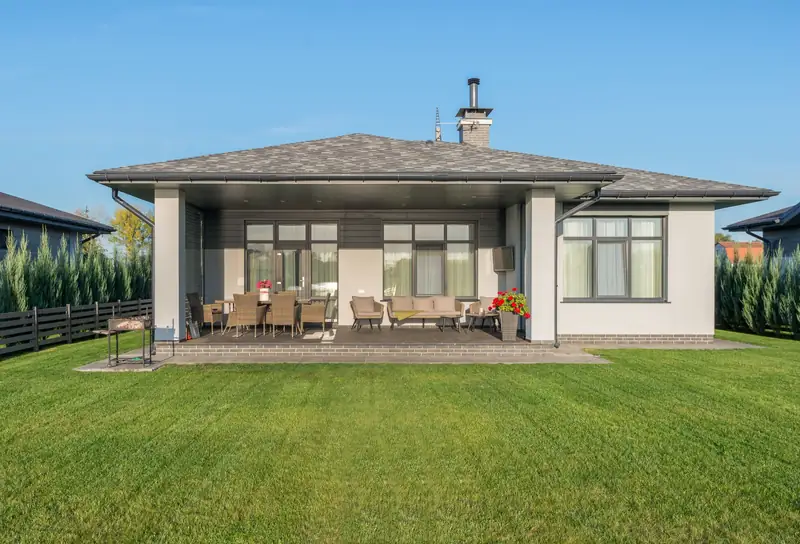
The full walkthrough of how turf goes in covers the base work in more detail, including what changes on a sandy ridge lot versus a flatwoods yard.
Lawns, pet areas, putting greens and turf between pavers: how the build changes
All four uses start from the same rule, but the backing, infill and base thickness shift with how the surface gets used.
| Use | Backing and base | Infill | Note |
|---|---|---|---|
| Lawn panel | Standard washed-rock base | Clean sand or rock | Widest range of pile heights and colors |
| Pet area | More open, perforated backing for faster drainage | Light, natural infill, rinsed on a routine | Hose rinsing keeps odor down since the lawn can't be watered by an in-ground zone |
| Putting green | Flatter, more precisely screeded base | Little to none on the putting surface itself | Fringe around the cups is built closer to lawn spec |
| Paver accent strip | Same washed-rock base, tied into the paver's edge restraint | Matches the surrounding turf | Edge restraint, not nails alone, holds the seam where turf meets pavers |
Planning a backyard putting green and turf for dogs: odor, drainage and infill go deeper on those two uses specifically.
What artificial turf costs in Florida
As of October 2026, installed turf runs $10–$25 per sq ft installed in Florida and national market data, typically $12–$18. Angi's Orlando-specific figures put the average project at $4,758, with a typical range of $2,811 to $6,950 for excavation, base and turf material together (Angi, Orlando). Tampa's figures run higher, averaging $7,246 (Angi, Tampa), a reminder that these ranges move with yard size, slope and how much of the old lawn has to come out, not with which Florida city the work is in. A backyard putting green costs more per square foot than a lawn panel, commonly $15 to $40 depending on size, since a small green carries more labor per square foot than an open lawn does (HomeGuide, putting greens; Angi, putting greens). These are market ranges compiled from published Florida and national cost-guide data, not a quote for your yard; a written price follows a site visit. The artificial turf cost guide breaks the numbers down further by size and use.
Water restrictions make turf worth a second look in 2026
Both water management districts covering our service areas are under tighter-than-normal rules as of October 2026, part of why turf keeps coming up as an option. In the Orlando unit's counties, the St. Johns River Water Management District's year-round schedule already limits lawn irrigation to set days, caps each zone at roughly an inch of water, and bars watering between 10 a.m. and 4 p.m.; parts of Lake County and several neighboring counties currently sit under a Phase III Extreme Water Shortage order that cuts watering to one day a week (SJRWMD watering restrictions). On the Sarasota side, the Southwest Florida Water Management District's Modified Phase III Extreme Water Shortage order, in effect April 3, 2026 through March 31, 2027 across Sarasota, Manatee, Polk and several neighboring counties, limits watering to one day a week by the last digit of the street address, inside two narrow overnight or late-evening windows (SWFWMD district water restrictions). Manatee County confirms it's following that order through March 2027 (Manatee County, Modified Phase III), and the City of Sarasota reports the same extension (City of Sarasota, Modified Phase III). Turf built to Rule 62-308.100 never draws on an in-ground irrigation zone in the first place, which sidesteps that restriction schedule rather than working around it. How much water and money turf saves and turf vs. sod in Florida cover the trade-off in more depth.
Turf and Florida heat
Turf gets hotter underfoot in direct Florida sun than the grass it replaces, and darker fiber and infill both absorb more heat than light-colored stone or concrete nearby. We don't have a verified, Florida-specific measurement to publish for how much hotter a given product runs, since the figures in circulation vary by manufacturer and test method and we won't print a number we can't stand behind. What does help in practice: siting turf where afternoon shade reaches it, picking a lighter infill color where the product line offers one, and a quick hose rinse before bare feet or pets use it, which is allowed since a hose isn't the in-ground system the state rule restricts. Our full look at turf heat in Florida compares turf against pavers and concrete nearby.
Caring for artificial turf
A new lawn needs less upkeep than sod, but not none. Leaves, oak pollen and storm debris sit on top of the pile instead of breaking down into soil, so a regular pass with a blower or a stiff broom keeps the surface from matting. Infill migrates toward low spots and high-traffic paths over a few seasons and needs the occasional top-up with the same natural material the rule requires at installation, never a rubber substitute swept in to save a trip. A pet area benefits from a routine hose rinse rather than an occasional deep clean, since odor comes from liquid sitting on the infill, not from the turf fibers themselves. Our turf cleaning and maintenance guide covers the full routine, season by season.
How do you find the best artificial turf installer near you?
Searching for artificial turf installers near you turns up landscaping companies, pool contractors and general handymen alongside dedicated turf crews, and the state's new rule gives an easy first filter: ask whether the quote names the base material specifically.
- 'Compacted base' isn't enough on its own; Rule 62-308.100 requires washed crushed rock or crushed concrete with the fines removed, and a crew that doesn't know the difference is likely to cut that corner.
- Confirm the infill is on the state's approved list, natural sand, rock, shell or coated silica sand, rather than a generic 'infill' line item with no material named.
- Ask directly whether the project sits within 10 ft of a pond, canal or other waterbody, or inside a tree's drip line, since both trigger specific requirements the quote should already address.
- Get the irrigation plan in writing: which heads get capped, and where the lines get rerouted.
- If the work happens near a fenced pool, ask how the crew protects the water and the equipment pad during base work.
Our full turf installer checklist goes further.
Where we install artificial turf
We install artificial turf lawns, pet areas, putting greens and paver accent strips across Greater Orlando and Sarasota–Manatee. Related towns: artificial turf in Orlando, artificial turf in Kissimmee, artificial turf in Sarasota and artificial turf in Lakewood Ranch.
Artificial Turf by city
Each local page covers that town's permit office, soil, HOA approvals and weather.
Orange County
- Orlando
- Winter Garden
- Windermere
- Winter Park
- Lake Nona
- Dr. Phillips
- Apopka
- Horizon West
- Ocoee
- Maitland
- Hunter's Creek
- Avalon Park
- Belle Isle
Osceola County
Seminole County
Lake County
Polk County
Sarasota County
Manatee County
Frequently asked questions
How long does artificial turf last in the Florida sun?
Published lifespan claims vary widely by product line and manufacturer, and we don't have a verified, Florida-specific figure to put a number on. What drives how long a lawn holds up is UV exposure, foot and pet traffic, and whether infill gets topped off before it thins out. Ask any product you're considering for its manufacturer warranty terms, which is a more reliable lifespan figure than a sales page.
Does artificial turf drain during heavy rain?
It should, if it's built to Florida's current standard. Rule 62-308.100 requires turf to be permeable and affixed to a permeable backing over a pervious subgrade, graded for positive drainage (DEP Rule 62-308.100). A lawn that holds standing water after a storm almost always traces back to a base built with fines-heavy fill instead of washed rock, not to the turf material itself.
What goes under artificial turf in Florida?
A subgrade of washed crushed rock or crushed concrete, never limerock or road base with fines, compacted in thin lifts and graded so water keeps moving through it. That's a state requirement, not just a build preference: fines bind together once compacted and wet, sealing the soil the way a sidewalk base is meant to seal it, which is the opposite of what turf needs underneath it.
Is artificial turf safe for kids?
The materials are regulated for that question specifically: Rule 62-308.100 bars heavy metals and intentionally added PFAS in the turf, backing and infill, and limits infill to natural sand, rock, shell or coated silica sand, with rubber crumb allowed only inside playground-equipment footprints. The one caveat worth knowing is heat; turf gets hotter underfoot in direct sun than grass does, so shade or a quick rinse matters more for comfort than for safety.
Does artificial turf need infill?
Most lawn and pet-area turf does. Infill weighs the backing down, holds the blades upright instead of matting flat, and helps the surface drain the way it's meant to. A putting green is the exception, built with little or no infill so the ball rolls true. Whatever product goes in has to meet Florida's material rule: clean silica sand, rock, shell or coated silica sand, with rubber limited to playground-equipment areas.
How long does an artificial turf installation take?
Most of the time on a standard yard goes into removal, grading and the compacted base, not into laying the turf itself. A typical quarter- to half-acre Florida lawn usually finishes in a few days once the site is ready, longer if the soil needs more prep or the layout has a lot of cutting around beds, trees or a pool deck. A narrow side yard with limited equipment access can take longer than its square footage suggests.
Can artificial turf be installed over concrete or pavers?
Yes, with a drainage layer or pad between the hard surface and the turf rather than laying it straight on top. That suits a balcony, an old concrete patio that isn't worth tearing out, or dressing up a section of pavers. The base rule for a full ground-level lawn, washed crushed rock over soil, doesn't apply the same way on top of an existing slab; drainage and attachment to that surface do the work instead.
Sources
- Florida Senate — CS/CS/CS/HB 683 (2025), Construction Regulations
- F.S. 125.572 (2026) Regulation of synthetic turf
- FLRules 62-308.100 Synthetic Turf
- Rule 62-308.100 adopted text (.doc)
- F.S. 720.3045 (2026) Installation, display, and storage of items
- F.S. 720.3035 (2026) Architectural control covenants
- HB 683 (2025) Final Bill Analysis
- SJRWMD Watering Restrictions
- SWFWMD District Water Restrictions
- Manatee County - Modified Phase III water shortage restrictions
- City of Sarasota - SWFWMD Modified Phase III extended
- HomeGuide — Artificial Grass Cost
- Angi — Synthetic Grass Installation Cost, Orlando FL
- Angi — Synthetic Grass Installation Cost, Tampa FL
- Angi — Artificial Grass Installation Cost
- HomeGuide — Backyard Putting Green Cost
- Angi — Backyard Putting Green Cost
Ready for a price on your project?
Request a free estimate
Tell us about the project and we'll call to set up a free site visit.