
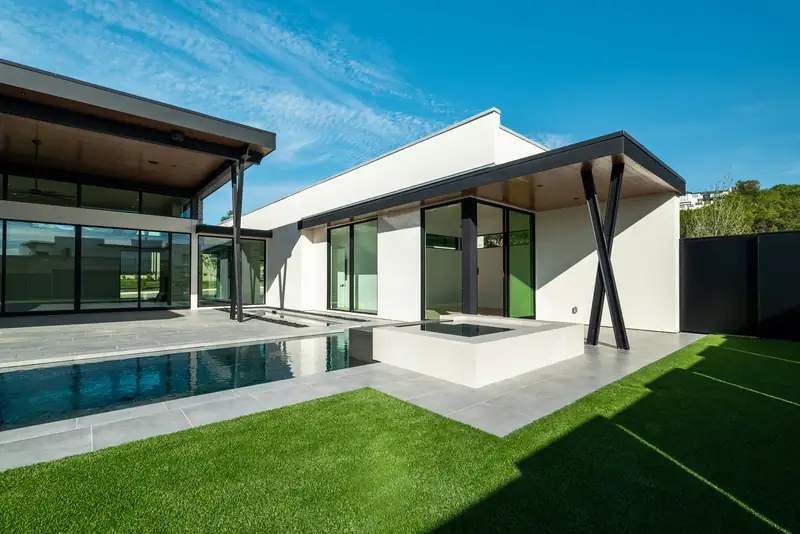
Artificial Turf · Celebration, FL
Artificial Turf for Celebration Yards
Artificial turf in Celebration runs $10–$25 per sq ft installed as of October 2026. On lots near Lake Rianhard or Lake Evalyn, Florida's turf standard keeps synthetic grass at least 10 feet from the water, and the same state law limits how far Celebration's own architectural guidelines can go in restricting turf elsewhere on the lot.
By the Opera Concrete & Pavers estimating team · Updated October 1, 2026
Get a free estimate
Tell us about the project and we'll call to set up a free site visit.
The 10-foot buffer matters most on the downtown lake blocks
Rule 62-308.100 sets Florida's turf standard: a washed base, natural infill, no in-ground irrigation line buried beneath the turf, and at least 10 feet of clearance from a water body unless a seawall separates the yard from it (Florida Administrative Code, Rule 62-308.100). A lot backing onto Lake Rianhard or Lake Evalyn has to measure that buffer before the layout is set, while a lot elsewhere in Celebration, away from the lakes, doesn't carry that particular constraint.
State law puts a ceiling on how far Celebration's own rules can reach
A 2025 law caps how aggressively any local government can restrict residential turf beyond the DEP standard (Florida Statutes §125.572), and a separate statute keeps most HOA turf rules, the kind the CROA or CNOA might otherwise set for Celebration, from reaching a panel that isn't visible from the street or a neighboring lot (F.S. §720.3045). The Architectural Review Committee's monthly process still applies to anything that is visible, the same as it would for a stamped driveway or a new patio.
Why a side-yard turf strip needs its own drainage path
A narrow run of turf between the house and the fence collects more water than a wide-open lawn panel does, because roof runoff, AC condensate and the neighbor's grade all drain toward the same few feet. The base in a side yard at a Celebration home has to be built with a slight fall away from the foundation, not flat, so water keeps moving instead of sitting under the turf backing. Washed crushed rock is compacted in the same thin lifts used anywhere else on the property, but the finished grade gets checked with a level across the whole run before turf goes down, since there's no second chance to fix a low spot once it's covered.
Why a narrow side yard takes longer than its square footage suggests
Material and equipment access through a Celebration side yard is usually limited to a gate or a path a wheelbarrow can clear, which rules out larger compaction equipment and slows every stage down to what can be moved by hand. Base lifts go in with smaller, hand-guided plate compactors instead of ride-on equipment, and turf rolls that would normally be carried by two people get walked in sideways through a narrow gate. None of that changes what the finished base or turf has to meet, but a side yard with the same square footage as an open lawn panel routinely takes longer to finish.
Turf near Lake Rianhard, worked out in square feet
Say a home near Lake Rianhard replaces 400 square feet of worn lawn with artificial turf, laid out to clear the water by at least 10 feet. That footage at $10–$25 per sq ft installed totals roughly $4,000 to $10,000, depending on pile height and infill. Submitting the visible portion of that layout to the ARC ahead of its monthly meeting keeps the design step from trailing behind the installation schedule.
What the turf itself is made of, under Florida's new rule
Residential turf sold and installed in Florida has to clear DEP Rule 62-308.100's material standard: the turf, its backing and its infill can't contain heavy metals or intentionally added PFAS, and all of it has to be disposable at a landfill. Infill is limited to clean silica sand, rock, shell or other natural material, or silica sand with a non-toxic coating; loose rubber crumb is allowed only inside the footprint of playground equipment, not across a Celebration lawn. Pile height and backing weight vary by product line, but the infill rule doesn't, it's the same whether the turf goes in a front yard or a side yard.
The problem with leaving an old sprinkler head under new turf
DEP Rule 62-308.100 bars using in-ground irrigation to water a synthetic turf area, which means every head that used to cover that zone has to be dealt with, not just switched off at the controller. A head left live and buried under turf in Celebration eventually pressurizes against the turf backing, finds a low spot or a seam, and pushes water up through it on a schedule nobody controls. What looks like a drainage problem months later is often an irrigation problem that was never actually fixed, just hidden under a new surface that made it harder to find.
Why infill needs occasional top-ups, not just brushing
Infill settles and migrates over years of foot traffic, rain and brushing, and a turf panel that looked fully filled at installation can thin out at high-traffic paths or low spots in a Celebration yard well before the turf fibers themselves show wear. A top-up uses the same natural material the rule requires at installation, clean silica sand, rock, shell or coated silica sand, not whatever happens to be on hand, since the material standard doesn't relax for a maintenance pass. Brushing the pile upright after a top-up redistributes the new infill evenly instead of leaving it in a pile at the low point.
Frequently asked questions
How close to Lake Rianhard can artificial turf go?
No closer than 10 feet under the state's turf standard, unless a seawall sits between the yard and the water. The rule also requires a washed base, natural infill and no buried irrigation line under the turf.
Can Celebration's ARC or CROA ban artificial turf entirely?
Not for turf that isn't visible from the street or an adjacent lot; a separate statute limits that. Turf that is visible still goes through the same monthly architectural review as any other exterior change.
Does turf near the lake need the same water-table check as a slab?
No. The 10-foot setback and the DEP installation standard are what govern turf near Lake Rianhard or Lake Evalyn; the water-table questions that matter for a concrete or paver base don't apply once turf and its washed base are down.
Sources
- Celebration, Architectural Review Committee
- Osceola County — Parking Ordinance, Ch. 22 Art. II (Sec. 22-50.6)
- Osceola County — Right-of-Way Permit Information
- Osceola County — Permit Information
- Osceola County — Homeowners
- NRCS OSD Smyrna
- NRCS OSD Myakka
- NRCS OSD Basinger
- Florida Administrative Code — Rule 62-308.100, Synthetic Turf (effective May 19, 2026)
- Florida Statutes §125.572 — synthetic turf on single-family lots
- Florida Statutes §720.3045 — items not visible from the frontage or an adjacent parcel
- Census Reporter, Celebration, FL (ACS 2020-2024 5-yr)
- Celebration Community Development District, About the CDD
- Wikipedia, Celebration, Florida
- Max Life Realty, Celebration, FL Community Guide
Ready for a price on your project?
Request a free estimate
Tell us about the project and we'll call to set up a free site visit.