
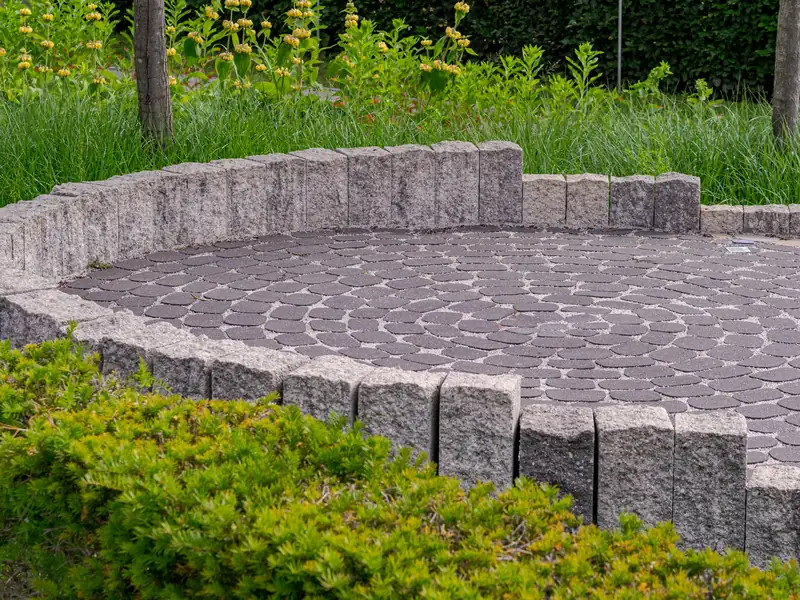
Pavers · Greater Orlando & Sarasota
Paver Patios, Walkways and Fire-Pit Areas for Florida Backyards
A paver patio, walkway or fire-pit area sets concrete pavers or travertine on a compacted aggregate base at least 4 inches deep, thinner than a driveway because furniture and foot traffic load the ground far less than a car. As of October 2026, installed paver patios run $10–$17 per sq ft in Florida market data, and travertine runs higher. We build patios, walkways, lanai extensions and fire-pit pads to that spec across Greater Orlando and Sarasota–Manatee.
By the Opera Concrete & Pavers estimating team · Updated October 1, 2026
Get a free estimate
Tell us about the project and we'll call to set up a free site visit.
Patios, walkways, fire-pit areas and lanai extensions, one base system
This page covers every paver surface that isn't a driveway or a pool deck: back patios, front and side walkways, fire-pit areas, and extensions that tie a new paver field into an existing lanai or screen enclosure. Travertine is a material option here too, not a separate service, chosen most often for the way it stays cooler underfoot in direct sun than a dark concrete paver, though we won't put an unverified number on how much cooler. All of it shares the same base principles as a driveway, built lighter because furniture and foot traffic load the ground far less than a parked car. For the stamped-concrete alternative, see stamped concrete vs. pavers for patios.
The base spec for a patio or walkway
ICPI Tech Spec 2 sets a minimum of about 4 inches of compacted aggregate base under a patio or walkway on well-drained soil, 2 to 4 inches more where the ground is wet or drains poorly, the same wet-soil allowance the spec gives a driveway (ICPI Tech Spec 2). That's roughly two-thirds the depth a driveway needs, not because the work is less careful but because the load is lighter. The base is still compacted in lifts and checked against 98 percent of standard Proctor density before bedding sand goes down, and a narrow 3- or 4-foot walkway gets the same base program as an open patio, since a path with no base shifts and dishes faster than a wide one.
| Layer | Standard | Note |
|---|---|---|
| Compacted aggregate base | 4 in minimum, well-drained soil | 2–4 in more on wet or poorly drained ground |
| Paver thickness | 60 mm (2⅜ in) | Standard for all pedestrian surfaces; no need to upsize for a patio |
| Bedding sand | 1 in, screeded, uncompacted before laying | Compacted only after the pavers and joint sand are in |
| Joint width | ⅛ in or less | Dry or polymeric joint sand |
| Edge restraint | Full perimeter, spiked into the base | Required anywhere the paving material changes, including at a fire pit |
| Finished slope | About 1 in per 8–10 ft, away from the house | Keeps water off the foundation and the lanai threshold |
ICPI Tech Spec 2 and Tech Spec 3 (ICPI Tech Spec 2 Construction of Interlocking Concrete Pavements (2020), ICPI Tech Spec 3).
Material options: concrete pavers or travertine
Concrete pavers and travertine solve the same problem with very different materials and very different prices.
| Material | Range | A 300 sq ft patio |
|---|---|---|
| Concrete pavers | $10–$17 | About $3,000–$5,100 |
| Travertine | $13–$45 | About $3,900–$13,500 |
HomeGuide, paver patio and travertine cost guides (HomeGuide, paver patios, HomeGuide, travertine).
Concrete pavers run more pattern and color options and cost less to replace if a unit cracks. Travertine is a porous natural stone that needs sealing to resist stains, and it's the material most homeowners choose around a pool for exactly the reason it suits a patio: it doesn't hold heat underfoot the way a dark surface does. These are market ranges, not a quote for your yard; we price a patio after seeing the site. The paver patio cost guide breaks down sizes from a small seating area to a full backyard patio.
Walkways, fire-pit areas and lanai extensions
A connecting walkway from the driveway to a side gate or the backyard usually runs 3 to 4 feet wide and shares the same base and bedding sand as the open patio it connects to; the design options are in front walkway ideas. A paver-set fire pit needs a separate, denser base detail under the fire pit ring itself, plus clearance from the house, any screen enclosure and overhanging branches, covered in safe fire pit setups on pavers. Extending a patio under or beyond an existing pool cage means matching the paver field's elevation to the enclosure's track and setting a flexible joint where the two meet so they can move independently without cracking the enclosure's footer; the full walkthrough is in extending a patio under a screen enclosure.
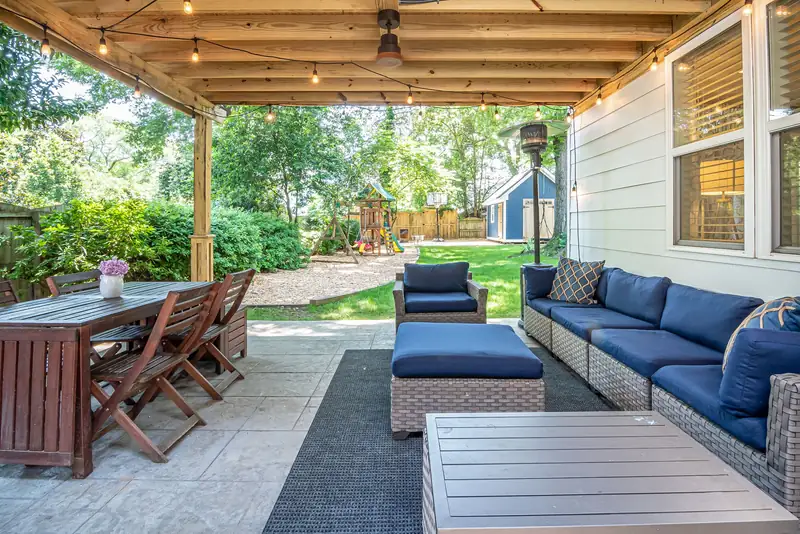
Installation, step by step
A straightforward patio or walkway follows the same order as a driveway, scaled to a lighter base.
- Layout and excavation. Stake the footprint against the house and excavate past the planned grade to leave room for base, sand and pavers together.
- Compact the base in lifts. Aggregate goes down 4 to 6 inches at a time, each lift compacted before the next, graded to slope water away from the house.
- Screed the bedding sand. A uniform 1-inch layer goes down last, guided by pipe rails, and stays uncompacted until the pavers are set.
- Lay the field and cut the borders. Full pavers are set course by course from a fixed edge; pieces at a curve, a fire pit or an enclosure track are cut to fit.
- Set edge restraint. Installed along the full perimeter and anywhere the material changes, including around a fire pit.
- Sweep and compact the joints. Dry joint sand is worked in and the whole surface gets a final compactor pass to lock the field together.
An average patio runs 1 to 2 days once the site is prepared; a straightforward walkway can finish in a single day. How pavers are installed in Florida goes deeper on the base and compaction steps.
What rain, sun and shade do to a paver patio
A patio graded flat, or tipped back toward the house, holds water against the slider or the lanai door instead of carrying it into the yard, which is exactly what the roughly 1-in-10-ft slope in the spec table above is built to prevent. Orlando and Sarasota–Bradenton both see around 50 inches of rain a year, most of it in a rainy season running late May into mid-October, often as a sharp afternoon storm (NOAA 1991–2020 normals). Where standing water in the yard is a bigger issue than drainage off the patio, a permeable paver system can help; permeable pavers and yard drainage covers when that trade-off is worth it.
Pigments in concrete pavers fade gradually under UV exposure, lighter colors less noticeably than dark ones; a sealer slows the fade but doesn't stop it. A patio tucked under tree canopy or on the north side of the house stays damp longer after each rain, which is the condition that lets mold and algae take hold in the joints; good drainage through the base helps it dry faster, but a shaded patio still needs more frequent cleaning than one in full sun.
Permits for a patio or paver walkway
Whether a patio needs a permit varies more than driveway rules do, since a patio rarely touches the public right-of-way.
| Jurisdiction | What's required | Notes |
|---|---|---|
| Orange County (unincorporated) | Zoning permit for pavers | Same $38 + $38 fee structure as a paver driveway |
| City of Orlando | Engineering permit | Covers pavers, asphalt or concrete patios and pool-deck slabs alike |
| Manatee County (unincorporated) | No permit for a non-structural concrete or paver patio | A concrete slab with footers, or a pool, still needs one |
| City of Sarasota | No flatwork-specific rule published | Call the Building Division to confirm before a larger patio |
Orange County; City of Orlando; Manatee County; City of Sarasota.
Several cities also cap how much of a lot can be covered by driveways, patios and roofs combined; the City of Sarasota's zoning table runs 60 to 75 percent of the lot depending on the zone, with coastal-island parcels capped at 70 percent (City of Sarasota zoning code). A screen enclosure built over the new patio has its own separate permit, tied to its footers rather than the paver field. On a contract over $2,500, Florida's lien law still requires a recorded Notice of Commencement (F.S. 713.13). More in Orange County and Orlando permits and HOA approval for pavers and a pool deck.
Caring for a paver patio
New concrete pavers can show a whitish efflorescence bloom within about 60 days; it's cosmetic and fades with normal weather, not something a sealer is required to fix (ICPI Tech Spec 2). Joint sand that's thinned from rain and foot traffic gives ants and weed seed an opening, so topping it off and compacting it back in is routine upkeep rather than a repair. Sealing has no fixed interval in the industry's own guidance, only a rough few years for an acrylic coat before it's worth recoating (ICPI Tech Spec 5); travertine, being more porous, benefits from staying on that schedule more than concrete pavers do. Our paver sealing service handles cleaning, re-sanding, sealing and resetting pavers that have sunk or shifted.
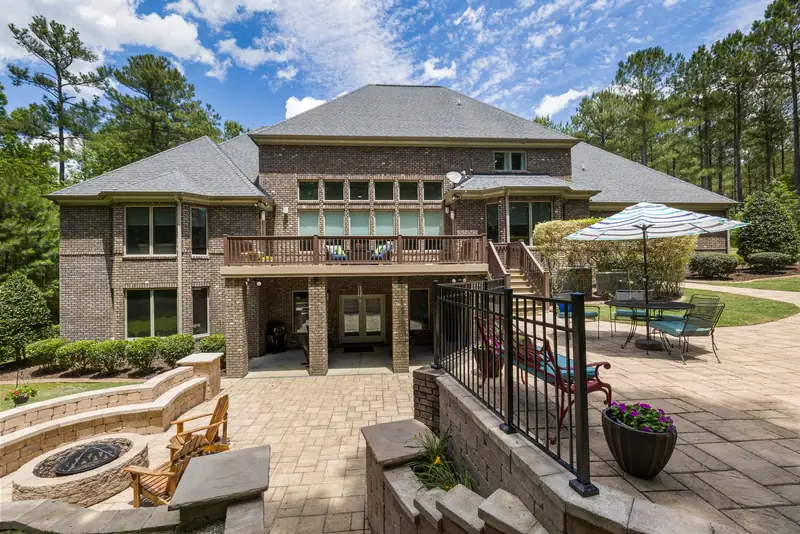
How do you choose the best paver patio contractor near you?
Paver patio contractors near me is a long list in both service areas; a few questions narrow it to the ones worth a quote.
- Ask for the base depth in writing, not just a square-footage price. A patio quoted with no stated base depth is a patio quoted on hope.
- If a fire pit or a screen-enclosure tie-in is part of the scope, ask specifically how that section's base and edge restraint differ from the open field.
- Confirm who pulls any required permit, and ask directly whether your jurisdiction needs one; Manatee County's non-structural exemption doesn't apply everywhere.
- Get the paver brand, color and thickness specified, not just 'pavers,' so a second bid can be compared on the same material.
- Ask how the crew handles a downpour mid-install, since an open base or screeded sand left exposed to a storm often has to be redone.
Our paver contractor checklist and what a paver warranty should cover go further.
Where we build paver patios and walkways
We lay paver patios, walkways and fire-pit areas across Greater Orlando and Sarasota–Manatee. Related towns: paver patios & walkways in Orlando, paver patios & walkways in Winter Garden, paver patios & walkways in Sarasota and paver patios & walkways in Bradenton.
Paver Patios & Walkways by city
Each local page covers that town's permit office, soil, HOA approvals and weather.
Orange County
- Orlando
- Winter Garden
- Windermere
- Winter Park
- Lake Nona
- Dr. Phillips
- Apopka
- Horizon West
- Ocoee
- Maitland
- Hunter's Creek
- Avalon Park
- Belle Isle
Osceola County
Seminole County
Lake County
Polk County
Sarasota County
Manatee County
Frequently asked questions
How long does it take to install a paver patio?
Most patios take 1 to 2 days once the site is prepared, and a straightforward connecting walkway can finish in a single day. Size, how much border cutting the layout needs, and whether the job ties into an existing slab or screen enclosure all change that range; a 400 sq ft patio with a curved edge runs longer than a square one the same size.
Can you match new pavers to my existing driveway or pool deck pavers?
Sometimes. If the original paver line is still in production, a close match is usually possible; many lines are discontinued or re-blended over a few years, which is the more common outcome. We bring a sample to the site visit so you can see the match before committing, and blending a slightly different shade into a new section, rather than hiding it, is often the better-looking result.
How deep is the base under a paver patio in Florida?
About 4 inches of compacted aggregate on well-drained soil, 2 to 4 inches more where the ground is wet or drains poorly, per the industry construction standard. That's thinner than the 6-inch minimum under a driveway because foot traffic and furniture load the ground far less than a car. The full build-up, lift by lift, is in our paver installation process guide.
Will a paver patio drain during heavy rain?
Yes, if it's graded to shed water away from the house and the joints stay filled; we slope the finished surface roughly 1 inch per 8 to 10 feet toward the yard rather than toward the foundation. Standing water in the surrounding lawn, not the patio itself, is usually a base-and-grading issue; a permeable paver system is worth considering where yard drainage, not the patio surface, is the real problem.
Do pavers fade in the Florida sun?
Pigmented concrete pavers fade gradually under UV exposure, lighter colors less than dark ones, which is a cosmetic change rather than a structural one. A sealer slows the fade and deepens the color for a while after it's applied, but no sealer stops UV fading permanently. Travertine and other natural stone don't carry a pigment to fade the same way.
Can you install a paver walkway around the side of the house?
Yes, side-yard walkways connecting a driveway, gate or trash-can area to the backyard are common work in both service areas and fall under this service. They run the same base and bedding-sand program as a patio, scaled to a narrower 3- to 4-foot width, and can tie into an existing patio or stand on their own.
Sources
- ICPI Tech Spec 2 Construction of Interlocking Concrete Pavements (2020)
- ICPI Tech Spec 3 Edge Restraints (2020)
- ICPI Tech Spec 5 Cleaning, Sealing and Joint Sand Stabilization (2020)
- HomeGuide — Paver Patio Installation Cost
- HomeGuide — Travertine Pavers Cost
- NOAA NCEI 1991-2020 annual precip normals (MCO, SRQ)
- Orange County — Residential Pavers
- City of Orlando — Residential Permitting Requirements
- Manatee — What Does Not Require a Permit (6-16-26)
- City of Sarasota Building Permit Requirement Guidelines
- City of Sarasota Zoning Code §VI-203 (Table VI-203)
- F.S. 713.13 (2026) Notice of commencement
Ready for a price on your project?
Request a free estimate
Tell us about the project and we'll call to set up a free site visit.