
Concrete · Greater Orlando & Sarasota
Concrete walkways built for Florida yards and rights-of-way
A concrete walkway or sidewalk in Greater Orlando or Sarasota–Manatee runs $7–$17 per square foot installed, as of October 2026, typically 4 inches thick on private ground. Several cities in our area require a thicker, 6-inch section specifically where the sidewalk crosses a driveway, which we build to on every job that touches the right-of-way.
By the Opera Concrete & Pavers estimating team · Updated October 1, 2026
Get a free estimate
Tell us about the project and we'll call to set up a free site visit.
What a Walkway or Sidewalk Job Covers
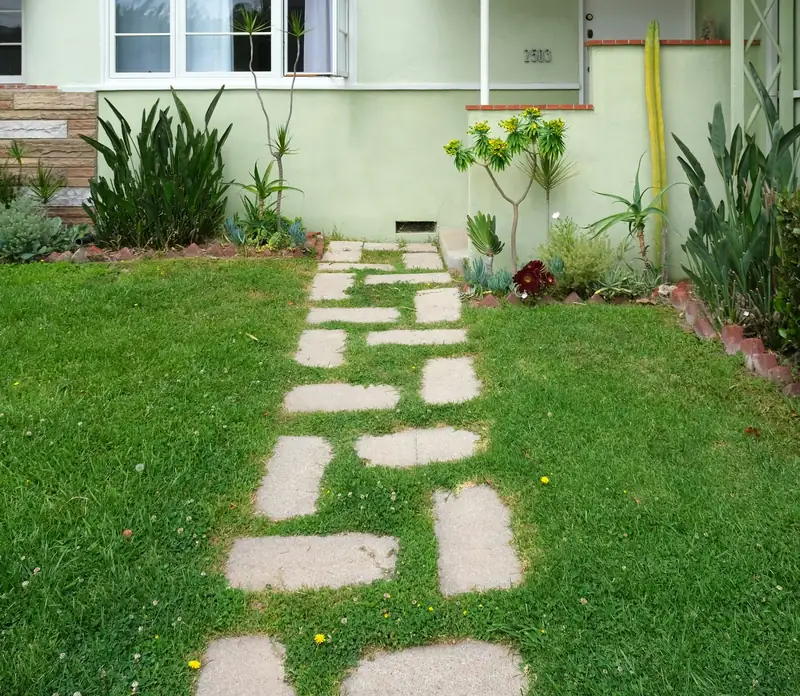
This service covers the narrower concrete work around a house: a front walk from the driveway to the door, a side-yard path to a gate or a trash can pad, and sidewalk work, both the section on private property and the stretch that sits in the public right-of-way. It also covers section repairs, where one slab of an existing walk has cracked, heaved or sunk and the rest is still sound. A full driveway rebuild is a related but separate job with its own thickness and joint spec; see concrete driveways. If the plan is a path of individual stepping pavers through a lawn rather than a continuous poured slab, that's covered under paver patios & walkways.
Private Walk or Right-of-Way Sidewalk? The Difference Changes the Spec
A walkway on your own lot and a sidewalk section in the public right-of-way are not the same build, even when they're poured the same week and look identical once they're finished. The private section is yours to design within setback and impervious-surface rules; the right-of-way section follows the city or county's standard, and in several of the jurisdictions we build in, that standard is thicker than an ordinary walk.
Orange County's lot-grading policy calls for 6 inches of non-steel-reinforced concrete anywhere a driveway crosses the right-of-way, “including the sidewalk section,” and Seminole County's driveway application uses nearly identical language for the sidewalk crossing a new driveway (Orange County Residential Lot Grading Policy; Seminole County Residential Driveway Application). Orlando's engineering manual says the sidewalk section through a driveway “must be at least 3000 psi concrete at least 6 inches in thickness,” even where the sidewalk on either side of that crossing is thinner (City of Orlando Engineering Standards Manual). Manatee County's paver-driveway inspection sheet specifies a concrete sidewalk crossing at 4 inches thick and 5 feet wide, broom-finished, with saw cuts every 10 feet, framed from one side lot line to the other (Manatee County paver driveway inspection guidance). Bradenton sets a general residential sidewalk minimum of 4 inches thick and 5 feet wide citywide (Bradenton Land Use Regulations §4.1). None of that is optional once it applies: a walk built to a uniform 4 inches everywhere, with no thicker section where it meets the driveway, is the kind of detail that fails inspection on a permitted job.
The Spec We Build To
Because a private front walk and a right-of-way sidewalk crossing answer to different standards, we spec them separately rather than pouring one thickness for the whole run.
| Element | Private walk or path | Right-of-way sidewalk or driveway crossing |
|---|---|---|
| Thickness | 4 in. | 4–6 in.; 6 in. where several counties require it at a driveway crossing |
| Width | 3–4 ft for a single-file path; 4–5 ft where two people need to pass | 5 ft is the standard in Bradenton and in Manatee's sidewalk-crossing spec |
| Strength | 2,500–3,000 psi | 3,000 psi where county right-of-way rules apply |
| Joints | Spaced about equal to the walk's width so panels stay close to square (NRMCA CIP 6) | Saw cuts about every 10 ft on Manatee's sidewalk-crossing spec |
| Base | Compacted subgrade, clean fill per FBC where soil allows (FBC Residential Ch. 5) | Same, with county inspection before the pour where a permit applies |
| Finish | Broom standard; stamped or colored to match a patio on request | Broom finish, per the jurisdictions that specify it |
Our build standard; confirm the exact right-of-way thickness and width with the local permit desk before a bid is final.
How a Walkway or Sidewalk Gets Built, Start to Finish
The sequence is shorter than a driveway's but follows the same logic: check the ground, confirm what's required, build the base, then pour.
- Site visit and layout. We walk the path, note any root crossings, grade changes or a gate the walk has to clear, and flag whether any part of the run sits in the right-of-way.
- Permit check. A private front walk is often exempt from a building permit in our area and only needs a zoning sign-off; a right-of-way sidewalk section almost always needs a separate permit from the city or county.
- Demolition, for a repair or replacement. Damaged sections get cut out and removed rather than poured over.
- Forming and base. Forms follow the walk's final width and any curve, and the subgrade is compacted before concrete goes down.
- Pour and finish. The slab is poured, broomed or stamped to match an adjoining patio if requested, and joints are cut at roughly the walk's own width.
- Curing and walkthrough. The surface cures before regular foot traffic resumes, and we point out where joints and any color match sit relative to the house.
What Florida Ground Does to a Narrow Slab
A walkway behaves differently from a driveway under the same ground conditions, mostly because it's narrow enough that one problem spot can affect the whole width at once.
A single root can lift an entire panel. On a wide driveway, a root under one edge can tent part of a panel while the rest stays flat. A 3- or 4-foot walk doesn't have that margin: the same root runs under the whole width, so the lift shows up edge to edge rather than as a partial tilt. Orlando, Winter Park and Sarasota each protect trees above a set trunk diameter by ordinance, and cutting into a protected root system to fix a lifted walk can need a permit of its own, not just a shovel.
Standing water on a path people use barefoot is a bigger nuisance than the same puddle on a driveway. Flatwoods soils common across both service areas hold a water table within roughly 18 inches of the surface for part of the year (NRCS, Myakka series), and a walk graded flat, instead of with a slight crown or cross-slope, is where that shows up first as standing water after an afternoon storm.
A narrow pour dries out just as fast as a wide one. The same hot-weather threshold that applies to a driveway applies to a front walk: once the evaporation rate crosses roughly 0.2 pounds per square foot per hour, the surface can dry faster than the slab underneath gains strength, and a walk poured in the open sun with no windbreak hits that line as easily as a larger pour does.
What a Concrete Walkway Costs
As of October 2026, a concrete walkway or sidewalk runs $7–$17 per square foot installed, with a typical job nearer $8–$12; national data also prices a standard 4-foot-wide section at $28 to $68 per linear foot (HomeGuide, concrete sidewalk). A short front walk, 4 feet wide by 20 feet long, works out to about $560 to $1,360 at that per-square-foot range before any demolition of an old section. Width, thickness at a right-of-way crossing, and whether an old walk has to come out first are what move a quote from one end of the range to the other. The full cost guide runs through more sizes and scopes.
Permits for Walks, Sidewalks and Right-of-Way Sections
Whether a permit applies depends on which side of the property line the work falls on, and the answer changes by city. Clermont, for example, doesn't require a building permit for a driveway or walk on private property, only a zoning approval, while the apron and sidewalk crossing in the city right-of-way need their own application and a city inspection (City of Clermont permit checklists). The City of Sarasota has no published exemption for private flatwork and tells homeowners to call the Building Division when in doubt (City of Sarasota Building Permit Requirement Guidelines). Sarasota County requires a Right-of-Way Use Permit for any work in the county right-of-way, and its code is explicit that no walkway may be placed inside a drainage easement (Sarasota County Right-of-Way Use Permit; Sarasota County Code §124-255). On jobs over $2,500, Florida's lien law also requires a recorded Notice of Commencement before work starts (F.S. 713.13); a small section repair under that threshold is exempt from most of the same lien-law paperwork, though not from any permit the city still requires (F.S. 713.02). The permits and HOA hub has the full jurisdiction table, and Orlando and Orange County and Sarasota, Venice and North Port cover their counties in more depth.
Caring for a Walkway
A walkway sees more foot traffic and less vehicle weight than a driveway, so upkeep leans toward keeping it level and clean rather than watching for the kind of load-related cracking a driveway deals with. Keep the joints swept clear of dirt and mulch, especially where a path runs under a tree canopy, since organic debris packed into a joint traps moisture against the edges of each panel. Walk the path after a storm or two each rainy season and look for water sitting in one spot rather than sheeting off; that's usually a sign the original grading needs a touch-up, not that the concrete has failed. A single cracked or sunken section can often be cut out and replaced on its own rather than repouring the whole run, though a color or texture match on an older walk isn't guaranteed; weathering and sun exposure change concrete's color over the years in ways a fresh batch can't always match exactly.
Choosing a Walkway or Sidewalk Contractor
A walkway is a smaller job than a driveway, but the same gaps in a bid show up at this scale too, just with smaller dollar amounts attached.
- Ask whether any part of the path falls in the right-of-way, and if so, who pulls that permit. A bid that only covers the private portion can leave a homeowner to sort out the sidewalk crossing separately.
- Get the thickness and width in writing, especially at a driveway crossing, since that's the one spot several local codes set a higher standard than the rest of the walk.
- If matching an existing patio's color or stamp pattern matters, ask to see a sample poured and cured rather than judging from a wet sample at the truck.
- For a section repair, ask whether the existing slab will be cut on a clean joint line or just patched at the crack, since a patch at a crack tends to fail again at the same spot.
Walkways and Sidewalks by City
The sidewalk and right-of-way rules in this service differ enough by jurisdiction that we keep a page for each town: walkways in Orlando, Winter Garden, Sarasota and Bradenton. Send us the address if your town isn't on that list and we'll confirm the local rules before we quote.
Sidewalks & Walkways by city
Each local page covers that town's permit office, soil, HOA approvals and weather.
Orange County
Osceola County
Seminole County
Lake County
Sarasota County
Manatee County
Frequently asked questions
How wide should a front walkway be?
We usually lay out a front walk 3 to 4 feet wide, enough for one person to move comfortably with a delivery or a trash can. Where two people need to pass, or the walk serves as a main entry path, 4 to 5 feet is a better fit. A right-of-way sidewalk crossing a driveway is a separate question: several cities in our area set that section at 5 feet regardless of how wide the private walk leading to it is.
Can you build a walkway from the driveway to the backyard or side gate?
Yes, and it's one of the more common requests we get, usually for trash and recycling cans, a side-yard gate, or access to a detached garage or shed. A side path like this sits entirely on private property in most cases, which generally keeps it out of right-of-way permitting, though it may still count toward a city's impervious-surface or lot-coverage limit.
How far apart should joints be in a concrete walkway?
Roughly equal to the walk's own width, so a 4-foot-wide path gets a joint about every 4 feet, keeping each panel close to square rather than long and narrow. That's a tighter spacing than a driveway uses, because a narrow slab left in long panels is more likely to crack randomly between the cuts than a properly jointed one.
Can you replace just one cracked section of my walkway?
Usually, yes. We cut the damaged panel out at its joint lines and pour a new one in its place rather than repouring the whole run. The one caveat is color: concrete lightens and weathers over the years, so a new section poured next to a decade-old walk won't match it exactly on day one, even with the same mix design.
Can a concrete walkway be colored or stamped to match my patio?
Yes, within reason. A walkway can be integrally colored or stamped to carry a pattern through from an adjoining patio or driveway, which is a common request on a backyard project built in phases. It works best when it's planned before the first pour, since matching a stamp pattern or color on a walk poured separately, months or years later, is harder than getting it right the first time; see our stamped concrete page for the pattern and color options.
Sources
- HomeGuide — Concrete Sidewalk Cost
- NRMCA CIP 6 Joints in Concrete Slabs on Grade
- 2020 FBC Residential Ch. 5 Floors (UpCodes)
- Orange County — Residential Lot Grading Policy 2023
- Seminole County — Residential Driveway Construction Application
- City of Orlando — Engineering Standards Manual, 5th ed.
- Manatee — Inspections Required for Paver Driveways
- Bradenton LUR §4.1 Land alterations (access, sidewalks)
- NRCS OSD Myakka
- City of Clermont — Permit Checklists
- City of Sarasota Building Permit Requirement Guidelines
- Sarasota County Code §124-48 Right-of-Way Use Permit
- Sarasota County Code §124-255 Additional Provisions (culverts)
- F.S. 713.13 (2026) Notice of commencement
- F.S. 713.02 (2026) Types of lienors and exemptions
Ready for a price on your project?
Request a free estimate
Tell us about the project and we'll call to set up a free site visit.