
Concrete · Greater Orlando & Sarasota
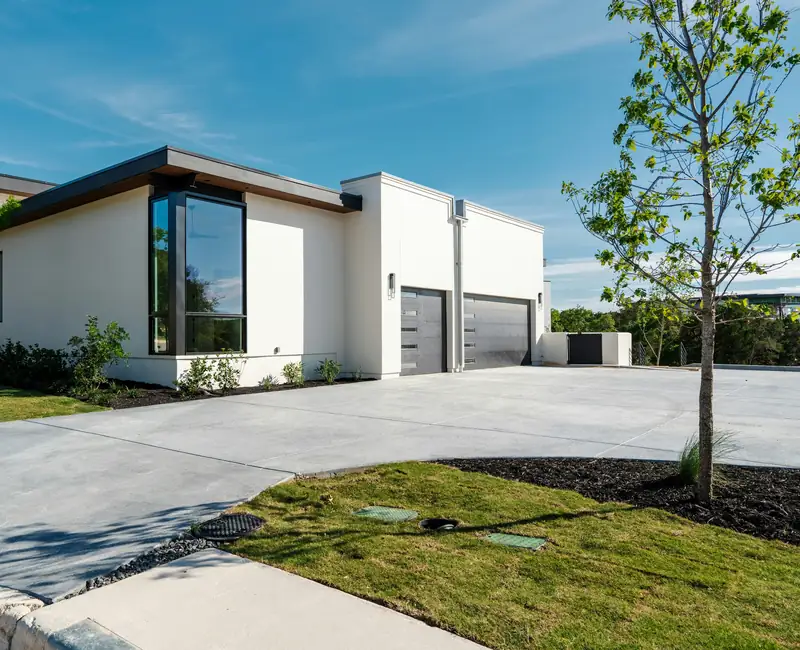
Concrete driveways poured for Florida soil, heat and rain
A new concrete driveway in Greater Orlando or Sarasota–Manatee runs $6–$15 per square foot installed, as of October 2026, poured 4 inches thick for daily traffic or 5 to 6 inches for RVs, boats and heavy trailers. We size the base, joint spacing and cure schedule to the county's permit rules and to sandy soil that holds water for months at a time.
By the Opera Concrete & Pavers estimating team · Updated October 1, 2026
Get a free estimate
Tell us about the project and we'll call to set up a free site visit.
What a Concrete Driveway Job Covers
Most of what we quote under this service is a new driveway on a lot that never had one, a full tear-out-and-replace on a cracked or sunken slab, or a widening that adds a parking pad or a second strip next to an existing drive. The job runs from the edge of the garage or the house out to the street, which in practice means it crosses two different kinds of ground: the private part of the lot, where you set the layout, and the apron in the public right-of-way, where the city or county sets the rules. A short extension to park a boat or a trailer is the same trade but a different scope than a full rebuild, and pricing runs differently for each. If the goal is interlocking pavers instead of a poured slab, that's a separate build with its own base spec; see paver driveways.
Concrete or Pavers: When a Slab Still Makes Sense
Concrete stays the lower-cost option for a straight driveway rebuild, running roughly $6–$15 per square foot installed against $10–$30 for pavers, and it pours as one continuous surface with no joint sand to top off later. It makes the most sense on a budget-driven replacement, a rental or investment property, a long straight run with no curves to work around, or a subdivision where the HOA has no finish requirement beyond color. Pavers earn their higher price where a sunken section needs to disappear without a visible patch, where a master-planned community specifies a paver or decorative finish, or where the driveway wraps a curve that a slab would have to joint heavily to handle. The full trade-offs, including how each one takes a Florida storm, are in our pavers vs. concrete driveway comparison.
The Concrete Spec We Build To
Florida's residential code sets a bare floor for slab thickness that isn't meant for a surface carrying a car every day, so our driveway spec starts above it rather than at it.
| Element | Daily cars and light trucks | RVs, boats and heavy trailers |
|---|---|---|
| Thickness | 4 in. | 5–6 in. |
| Strength | 3,000–4,000 psi | 3,000–4,000 psi |
| Reinforcement | Fiber mesh standard | Wire mesh or rebar, by request |
| Control joints | Every 8–12 ft, cut a quarter of the slab's depth (NRMCA CIP 6) | Same spacing rule, laid out around the heavier panels |
| Vapor retarder | 6-mil poly under the slab, 6-in. laps, where code calls for it (FBC Residential Ch. 5) | Same |
| Finish | Broom standard; exposed aggregate or stamped optional | Broom, for traction under a loaded trailer |
Our build standard, above the code floor of 3½ in. for an ordinary slab on ground.
Why a Standard Slab Isn't the Right Call for a Boat Trailer
A 4-inch driveway is sized for the distributed weight of a car or a pickup, not for the narrow, concentrated load a loaded boat trailer or an RV's jacks put on one spot. Going to 5 or 6 inches spreads that point load over more concrete, which does more for a heavy, narrow load than adding strength to the mix alone. Florida's code table ties required strength to weathering exposure for porches, carports and garage floors (FBC Residential Table R402.2); interior slabs need 2,500 psi at minimum, and we build driveways well above that floor regardless.
How the Job Runs, Start to Finish
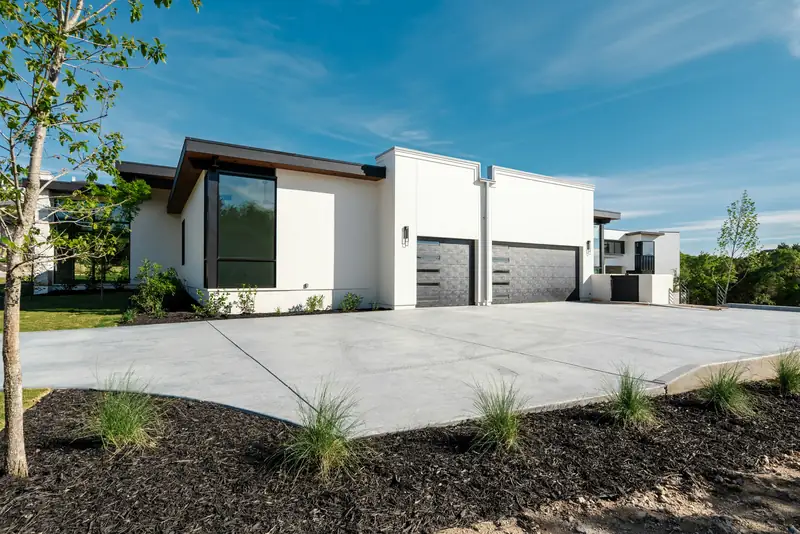
A driveway replacement and a brand-new pour follow the same order; a replacement just adds a demolition day up front.
- Site visit and layout. We check the subgrade, the slope toward the street and the house, any tree roots in the path, and what the city or HOA will require before a shovel moves.
- Permits and the Notice of Commencement. Where the apron falls in the right-of-way, that's a separate permit from any work on the rest of the lot. On jobs over $2,500, Florida's lien law also calls for a recorded Notice of Commencement before work starts (F.S. 713.13).
- Demolition, if replacing an existing slab. The old concrete comes out and gets hauled off, which is usually priced and listed as its own line.
- Grading and base. Any soft, wet or organic material comes out, and compacted fill goes in, in lifts, graded to carry water away from the garage rather than toward it.
- Forming, pour and finish. Forms set the layout, the truck pours, and the crew screeds, floats and finishes the surface before cutting control joints while the concrete is still workable.
- Curing and walkthrough. The surface stays moist, by curing compound or wet cure, for at least 3 days before we hand the job back and go over when it's ready for foot and vehicle traffic.
What Florida Ground and Weather Do to a Driveway
Three regional conditions shape how we build, more than the concrete mix itself does.
The subgrade holds water on a schedule. A lot of both service areas sits on flatwoods soil, Myakka, Smyrna, Immokalee and similar series, where the water table can sit within 18 inches of the surface for part of the year (NRCS, Myakka series). Soil in that condition in August behaves differently than the same lot in April, so we test and compact rather than assume one pass of the plate compactor settled it.
Heat and wind dry the surface faster than the slab gains strength. Hot-weather guidance flags concrete at 95°F or an evaporation rate above 0.2 pounds per square foot per hour as the point where plastic shrinkage cracking becomes likely (ACI; Concrete International, 2007). A still, hot Central Florida afternoon crosses that line easily, which is why we schedule pours early and keep sprinkling water on a stiffening surface off the table entirely (NRMCA CIP 12).
The rainy season has a start date, roughly. Orlando averages 51.45 inches of rain a year and Sarasota–Bradenton about 49, most of it between late May and mid-October, with NWS Melbourne putting Central Florida's median wet-season onset at May 27 (NOAA 1991–2020 normals; NWS Melbourne). A base left uncovered ahead of a 3 p.m. storm, or a slab rained on before it sets, is a scheduling problem we plan around rather than something to fix afterward.
A fourth factor matters more for repairs than new pours: a driveway that develops a slow, uneven dip almost always traces back to a soft spot in the base or a drainage path that changed, not to the geological event Florida law defines as a catastrophic ground cover collapse, which requires a sudden, visible depression and structural damage (F.S. 627.706). Orange County sits on the state's broader list of counties with concentrated sinkhole claims; Sarasota and Manatee do not (Florida Senate Interim Report 2011-104). Either way, settlement is the far more common explanation, and it's fixable.
What a New Driveway Costs
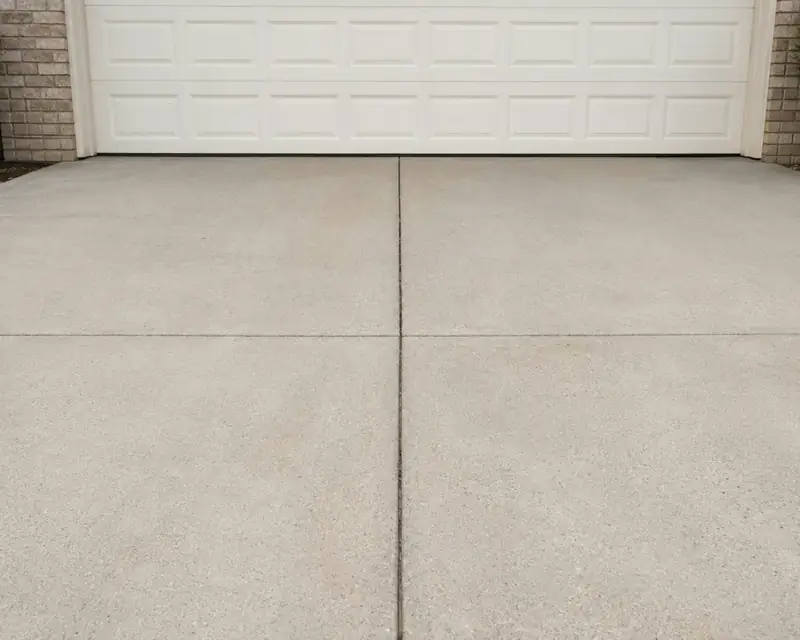
As of October 2026, Florida market data puts a new concrete driveway at $6–$15 per square foot installed, with a typical job landing nearer $8–$12. Angi's Orlando figures put the average project around $6,490, inside that band (Angi, Orlando, May 2026). A plain 400-square-foot two-car driveway at the published range works out to roughly $2,400 to $6,000 before demolition; tearing out an old one typically adds $3 to $8 per square foot on top. Thickness, reinforcement, finish and demolition each move the number, which is exactly what the concrete driveway cost guide breaks down by size and scope, with worked examples for a one-, two- and three-car job.
Permits and HOA Approval for a Driveway
The section between the sidewalk and the street is almost never just yours to build however you like. Every jurisdiction we checked across Greater Orlando and Sarasota–Manatee requires a permit for work on the apron, even in cities that waive a building permit for small private-lot jobs under Florida's 2026 exemption law. Orlando's standard calls for a 6-inch, 3,000-psi apron with a break joint at the property line (City of Orlando Engineering Standards Manual); Orange County's lot-grading policy requires the same 6-inch, non-steel-reinforced section through the right-of-way, including the sidewalk crossing (Orange County Residential Lot Grading Policy); and Manatee County specifies 6 inches from the edge of pavement to the right-of-way line on every residential driveway permit (Manatee County Driveway & Culvert Application). Florida law does bar a city or county from requiring a state or local license specifically for driveway installation (F.S. 489.117); that's a licensing rule, not a permit exemption, and the permit still applies. Homeowners can check any contractor's license status directly through DBPR’s license search.
HOAs add a second layer in master-planned communities, and since 2026 a Florida HOA can't require a building permit to already be issued before it will review your application (F.S. 720.3035). The permits and HOA hub has the jurisdiction-by-jurisdiction table, and the county guides for Orlando and Orange County and Sarasota, Venice and North Port go through the local paperwork in detail.
Caring for a New Driveway
Once the slab is handed over, upkeep is mostly about keeping the joints and the drainage doing what they were built to do. Sweep soil and mulch out of the control joints before the rainy season builds, since a packed joint can't shed water the way an open one does. Check sprinkler heads against the new edge; a head that cleared an old garden bed can land squarely on fresh concrete, and repeated overspray both works against a compacted base and leaves mineral staining on the surface over time. Sealing is optional on plain concrete and runs $1 to $3 per square foot in national cost data when it's added; it's worth doing before the first wet season if the finish is stamped or exposed aggregate rather than plain broom. A hairline crack along a joint is the slab doing what it was designed to do; a crack that wanders diagonally across a panel, or a corner that's noticeably lower than the rest, is worth a call. More in whether a Florida driveway needs sealing and which driveway cracks are normal.
How Do You Pick the Best Concrete Driveway Contractor Near You?
Searching for the best concrete driveway contractor near you turns up a long list of businesses that all say roughly the same thing, so the shortlist comes down to what each one puts in writing rather than what's on the homepage. A handful of questions separate a comparable bid from a cheaper one that's missing a step:
- Ask for thickness, strength, joint spacing and reinforcement in writing, not just a square-foot price. A number without a spec can't be compared to another bid.
- Ask who applies for the apron or right-of-way permit and whether the fee is included. If nobody mentions it, that's a gap, not a savings.
- Ask about the base: what gets removed, what gets compacted, and how thick it ends up. This is where a low bid most often cuts a corner that doesn't show until the first wet season (FBC Residential Ch. 5).
- Check the business on DBPR’s license search and ask which category, if any, the quoted scope falls under.
- Ask how the crew handles a hot or rainy pour day. A contractor who hasn't thought about it hasn't poured many Florida driveways.
Ten criteria for choosing a concrete contractor in Orlando goes through this in more depth, and who owns the driveway apron is worth reading before the first estimate if the lot backs onto a public street.
Concrete Driveways by City
Permit rules, soil and HOA review change from one town to the next even when the concrete spec doesn't, so we keep a page for each: concrete driveways in Orlando, Kissimmee, Sarasota and Lakewood Ranch. If your town isn't one of those four, tell us the address and we'll confirm which crew and which local rules apply.
Concrete Driveways by city
Each local page covers that town's permit office, soil, HOA approvals and weather.
Orange County
- Orlando
- Winter Garden
- Windermere
- Winter Park
- Lake Nona
- Dr. Phillips
- Apopka
- Horizon West
- Ocoee
- Maitland
- Hunter's Creek
- Avalon Park
- Belle Isle
Osceola County
Seminole County
Lake County
Polk County
Sarasota County
Manatee County
Frequently asked questions
How long before I can drive on a new concrete driveway?
Concrete is rated by the strength it reaches at 28 days, which is also roughly when a slab reaches its full design strength, though it carries foot and car traffic well before that. Curing itself has to continue at least 3 days once finishing is done, keeping the surface moist rather than letting it dry out in the Florida sun. We give each homeowner a specific date for driving on it based on that day's mix, pour time and weather instead of one fixed number for every job.
How thick should a concrete driveway be in Florida?
4 inches is standard for cars and light trucks; 5 to 6 inches is the move for RVs, boat trailers or anything else that concentrates weight on a narrow footprint. Several of the counties we build in also require a thicker, 6-inch section specifically where the driveway crosses the right-of-way, regardless of what the private portion is poured to, so the apron and the rest of the slab aren't always the same thickness.
How long does a concrete driveway last in Florida?
There's no single number that applies everywhere, because what shortens a driveway's service life is almost always something under it, not the concrete itself. A base that was compacted in lifts and tested, joints that were cut to the right depth and spacing, and grading that keeps water moving away from the slab are what keep a driveway from needing attention for a long time. A soft subgrade that was never corrected, or a root from a tree that wasn't there at pour time, is what shows up first.
Do you use rebar, wire mesh or fiber in driveways?
Fiber mesh is our standard reinforcement for a typical 4-inch driveway. Wire mesh or rebar is available on request, usually for heavier-use slabs, but it's worth knowing what reinforcement actually does: NRMCA's guidance is direct that wire mesh does not prevent cracking, it just holds a crack together once it forms. Control joints, not the reinforcement, are what decide where the slab cracks.
How long does it take to replace a concrete driveway?
Demolition and haul-off usually take a day, forming and base work another, and the pour and finish a third, with the schedule stretching for a larger driveway or one with a lot of landscaping to protect. The slab then needs to cure before it's back in daily use. The full walk-through of the process, step by step, is in our post on how a concrete driveway is installed.
Do you remove and haul away the old driveway?
Yes, on a replacement job. Demolition and disposal are priced and listed as their own line on the estimate rather than folded into the per-square-foot rate, since the cost depends on the old slab's thickness and whether it has reinforcement in it. National cost data puts removal at roughly $3 to $8 per square foot, and Angi's Orlando figures run close to the top of that range.
Sources
- HomeGuide — Concrete Driveway Cost
- Angi — Concrete Driveway Cost, Orlando FL
- NRMCA CIP 6 Joints in Concrete Slabs on Grade
- 2020 FBC Residential Ch. 5 Floors (UpCodes)
- 2020 FBC Residential Ch. 4 Foundations (UpCodes)
- ACI FAQ - Maximum temperature limits for hot-weather concreting
- ACI Concrete International Q&A - Estimating Evaporation Rates (Snell, 2007)
- NRMCA CIP 12 Hot Weather Concreting
- NRCS OSD Myakka
- NOAA NCEI 1991-2020 annual precip normals (MCO, SRQ)
- NWS Melbourne Wet/Dry Season Onset
- Florida Statutes 627.706
- Florida Senate Interim Report 2011-104 (sinkhole insurance)
- City of Orlando — Engineering Standards Manual, 5th ed.
- Orange County — Residential Lot Grading Policy 2023
- Manatee Driveway and Culvert Application (2022)
- F.S. 489.117 (2026) Registration; specialty contractors
- DBPR License Search
- F.S. 713.13 (2026) Notice of commencement
- F.S. 720.3035 (2026) Architectural control covenants
Ready for a price on your project?
Request a free estimate
Tell us about the project and we'll call to set up a free site visit.