
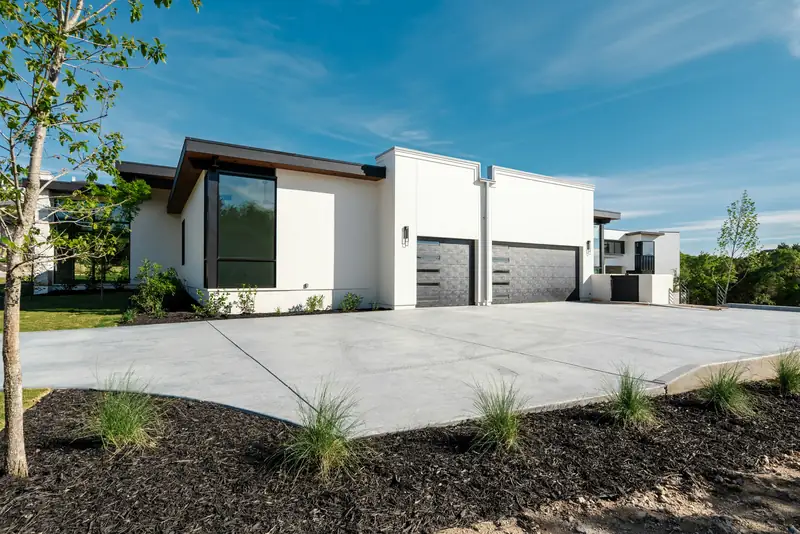
Concrete Driveways · Dr. Phillips, FL
Pouring a Concrete Driveway in Dr. Phillips
A concrete driveway in Dr. Phillips runs $6–$15 per sq ft installed as of October 2026, the same Florida market range used across the Orlando unit. Because the community sits in unincorporated Orange County, the driveway is reviewed under the county's own lot-grading standard rather than a city building code, and on an established street that often means working around a mature oak canopy as much as around the house itself.
By the Opera Concrete & Pavers estimating team · Updated October 1, 2026
Get a free estimate
Tell us about the project and we'll call to set up a free site visit.
Replacing a cracked original driveway under an oak canopy, worked out in square feet
Picture a Clubhouse Estates home built in the late 1980s, its original 16 by 24 foot driveway, 384 square feet, heaved along one edge by a live oak planted the same year the house went up. At $6–$15 per sq ft installed, replacing that slab lands between roughly $2,300 and $5,760, before the cost of a root cut or an arborist's opinion on the tree itself. A frontage under 100 feet keeps the job to a single driveway under the county's own grading policy, so the new layout has to work inside that same footprint rather than adding a second curb cut.
The county spells out the apron, not just the permit requirement
Orange County's Residential Lot Grading Policy sets the apron itself at a minimum 6 inches of 3,000 psi concrete where the driveway crosses the right-of-way, keeps the driveway at least 3 feet off the property line, and caps most lots under 100 feet of frontage at a single driveway (Orange County, Residential Lot Grading Policy 2023). Where a lot drains to a roadside ditch instead of a curb, the same policy calls for a culvert built with at least a 15-inch reinforced concrete pipe, mitered at both ends, which is worth confirming before a new driveway layout is finalized on an older Dr. Phillips street that still drains that way.
What Wire Mesh Actually Does in a Driveway Slab
Wire mesh in a driveway slab does not stop concrete from cracking, and no reinforcement at this thickness does. What it does is hold a crack together once it forms, keeping the two sides from separating or lifting unevenly under a tire. That distinction matters because a Dr. Phillips homeowner who assumes mesh means a crack-free driveway is set up to be disappointed by a hairline crack that shows up anyway, even though the slab is doing exactly what it was designed to do. The joints still handle where cracks happen; the mesh is backup for whatever forms between them.
Decades of oak canopy change the order of operations
Trees 8 inches or more in diameter are regulated countywide, and removing one from an occupied single-family lot under 2 acres needs its own tree removal permit, unless the removal is already covered by an approved building permit for the driveway, pad or septic field (Orange County, Tree Removal Permit). On streets built out in the 1980s and 1990s, where live oaks planted with the original subdivision have had decades to spread, a driveway replacement often starts with a look at which roots cross the slab before the pour itself is scheduled.
Ridge Sand Doesn't Behave Like Flatwoods Soil
The sand ridge soils west of Orlando, Candler, Astatula and Tavares, drain almost too well: the water table can sit more than 80 inches down. That sounds like easier ground to build on, but loose, excessively drained sand does not hold a compactor's pass the way a firmer soil does, and it can shift under the plate instead of locking together. On a ridge lot in Dr. Phillips, we wet the material enough to bind it, then compact in shallow lifts rather than one deep pass. Skip that step and the driveway can still settle later, just for the opposite reason a flatwoods lot would.
Irrigation Heads Aimed at the Driveway Cause Slow Damage
A sprinkler head that has drifted even slightly over the years can end up soaking the edge of a driveway every time the zone runs, and that repeated wetting works against a compacted base the same way standing rainwater would, just more predictably. It also leaves mineral staining on the concrete surface that gets worse with every cycle. On a Dr. Phillips lot, it is worth checking irrigation head aim against the new driveway's footprint before the first watering cycle after the pour, since a head that was fine aimed at an old garden bed is not necessarily fine aimed at fresh concrete and a compacted edge that has not fully settled yet.
What Actually Happens Before the Concrete Truck Arrives
Forming and grading come before anything gets poured. We set the forms to the final layout, grade and compact the subgrade, and if Dr. Phillips requires a permit for the work, the inspector typically needs to see the forms and base before concrete covers them up. Only after that review, where one applies, do we schedule the truck. Skipping straight to a pour date without this sequence is how a driveway ends up with a base nobody checked, which is the most common point where later problems start. The forming and grading day usually takes longer than the pour itself.
Watching for Root Heave Before It Becomes a Crack
A slab edge that starts to tent or lift slightly near a mature oak is an early sign of root growth underneath, worth noticing before it turns into a full crack. Orlando and Winter Park both regulate trees at 6 inches in diameter by ordinance, so the right first move in a Dr. Phillips yard with a protected tree nearby is checking the local rule, not reaching for a shovel or a saw. Catching heave early sometimes lets a contractor address the slab section without disturbing the root system at all, where waiting until the crack is severe narrows the options considerably.
Frequently asked questions
Does Orange County require a specific driveway thickness where it meets the street in Dr. Phillips?
Yes. The county's lot grading policy sets the apron at a minimum 6 inches of 3,000 psi concrete across the right-of-way, separate from whatever thickness is used for the rest of the driveway on private property.
Can a tree be removed in Dr. Phillips to make room for a new driveway?
Often, yes, without a separate tree removal permit, if the removal is already covered by an approved building permit for that driveway, pad or septic field. A tree removed outside that scope, on an occupied lot under 2 acres, needs its own permit.
Is more than one driveway allowed on a Dr. Phillips lot?
Generally not if the lot has under 100 feet of frontage. The county's grading policy caps those lots at a single driveway, which shapes how a widened or second-access layout can be designed.
Sources
- Orange County Division of Building Safety
- Orange County — Do I Need a Permit
- Orange County — Residential Pavers
- Orange County — ROW Utilization Permit directory
- Orange County — Municode Ch. 21 Art. VI ROW Utilization
- Orange County — Residential Lot Grading Policy 2023
- Orange County — A Guide for Residential Plan Approval
- Orange County, Tree Removal Permit
- SJRWMD Watering Restrictions
- Florida Administrative Code — Rule 62-308.100, Synthetic Turf (effective May 19, 2026)
- Florida Statutes §125.572 — synthetic turf on single-family lots
- F.S. 720.3045 (2026) Installation, display, and storage of items
- Florida Senate Interim Report 2011-104 (sinkhole insurance)
- NRCS OSD Candler
- NRCS OSD Tavares
- NRCS OSD Myakka
- NRCS OSD Smyrna
- Wikipedia, Dr. Phillips, Florida
- Census Reporter, Doctor Phillips, FL (ACS 2024 5-yr)
- Florida Neighborhood Realty, Restaurant Row in Dr. Phillips
- MarketConnect Realty, Phillips Landing homes
- FDEP, Outstanding Florida Waters fact sheet
- Point2Homes, Doctor Phillips demographics
Ready for a price on your project?
Request a free estimate
Tell us about the project and we'll call to set up a free site visit.