
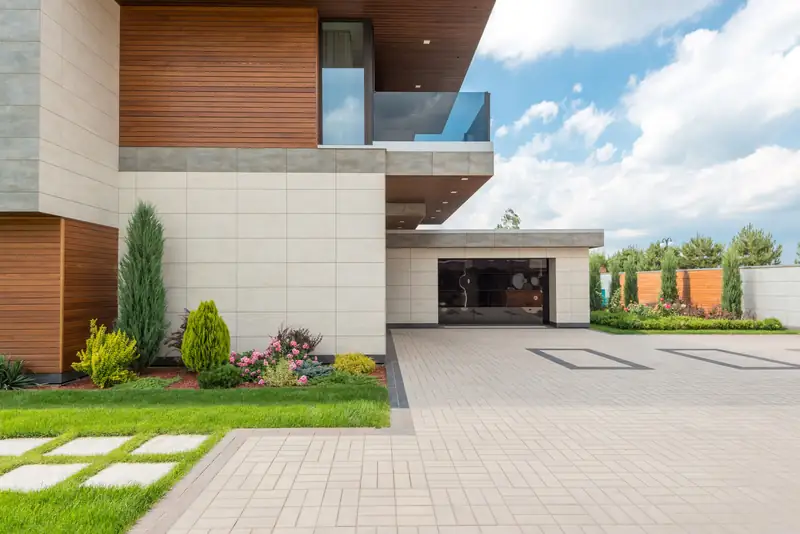
Paver Driveways · Dr. Phillips, FL
Paver Driveways in Dr. Phillips
A paver driveway in Dr. Phillips runs $10–$30 per sq ft installed as of October 2026. Unincorporated Orange County reviews a paver driveway through its own residential paver permit, a lighter zoning process than the building review a poured slab goes through, with a site plan and a set fee rather than an engineering submittal.
By the Opera Concrete & Pavers estimating team · Updated October 1, 2026
Get a free estimate
Tell us about the project and we'll call to set up a free site visit.
A $38 permit plus a $38 review fee, not a building application
The county's residential paver permit asks for a dimensioned site plan showing the paver layout, property lines and easements, charges a $38 permit fee plus a $38 Development Engineering review fee, and turns the review around in about 4 business days (Orange County, Residential Pavers). The same zoning code sets residential private open space at a 40 percent minimum for the lot (Orange County — Residential Pavers), which a paver driveway widening has to leave room for alongside the house, pool cage and any existing patio.
Gated streets in Bay Hill still answer to the same county desk
Bay Hill's guard-gated frontage on Lake Tibet-Butler doesn't change which office reviews a paver driveway; the gate controls who drives in, not who signs off on the permit, and the county's Division of Building Safety reviews work there the same way it reviews a non-gated street elsewhere in Dr. Phillips (Orange County Division of Building Safety). Where a driveway section reaches the right-of-way at the street, a separate Right-of-Way Utilization permit from Development Engineering Permitting applies on top of the paver review itself (Orange County, ROW Utilization Permit directory).
What a 98 percent Proctor reading actually means for a Dr. Phillips driveway
ICPI calls for the compacted subgrade and the aggregate base under a driveway to reach at least 98 percent of standard Proctor density, tested against ASTM D698, with vehicular areas held to the stricter modified Proctor instead. That number comes from a plate compactor working the base in lifts of 4 to 6 inches, not one pass over the whole excavation. Skipping a lift, or compacting a lift that's too thick, is how a base looks finished on the surface and still settles under Dr. Phillips traffic within a season. The spec also sets a surface tolerance of plus or minus three-eighths of an inch over 10 feet, tighter than it sounds once pavers sit on top of it.
The order a paver driveway actually goes in
The sequence doesn't vary much from job to job: excavate to the planned depth, compact the subgrade, place and compact the aggregate base in lifts, screed the bedding sand, lay the pavers course by course, cut units at the borders, install edge restraint, then sweep in and compact the joint sand. Each step depends on the one before it holding up, which is why a Dr. Phillips crew that rushes the base to reach the visually satisfying part, laying pavers, usually pays for it later in an uneven field. Nothing about the order is optional, even though only the last two steps are visible once the driveway is done and swept clean.
Widening a paver driveway inside the open-space limit, worked out in square feet
Say a Sand Lake Hills home adds a 6-foot-wide parking apron beside an existing 480 square foot paver driveway, 150 square feet more, bringing the total to 630 square feet. At $10–$30 per sq ft installed, that addition alone runs roughly $1,800 to $4,500, and because the county's open-space rule holds the lot to a 40 percent minimum of unpaved area, that addition gets checked against the pool deck and existing patio before the layout is final, not assumed to fit.
Joint sand or polymeric sand: what the spec leaves open
ICPI's own spec treats joint sand plainly: dry sand swept into the eighth-inch joints and compacted in place, with sealers or joint sand stabilizers listed as optional rather than required. Polymeric sand is the common stabilizer choice, meant to bind in the joint and resist the ordinary washout that plain sand can see over time, but the spec doesn't mandate it for a standard residential driveway. That leaves it as a real decision for a Dr. Phillips homeowner rather than a box every crew checks the same way: plain sand costs less and can be swept back in after a pressure wash, while a stabilized joint holds up longer between resweeps but costs more up front. Either way the joint itself keeps the same eighth-inch tolerance.
Skipping edge restraint, or installing it wrong
Edge restraint is required along the full perimeter of a paver driveway, and the spec is specific that the anchoring spikes go into the compacted aggregate base, not the surrounding soil, because soil doesn't hold a spike the way a dense base does. A restraint installed into soft dirt, or skipped at a section that looked solid enough on its own, lets the field spread sideways under traffic over time, which shows up as widening joints and pavers creeping outward near the edge of a Dr. Phillips driveway. The spec also rules out substituting plastic landscape edging meant for flower beds, since it isn't built to resist the lateral force a driveway puts on it.
Resetting a sunken paver, instead of patching it
Because a paver driveway is built from individual units rather than one poured surface, a localized low spot, from a soft patch in the base or sand that migrated after heavy rain, can usually be fixed by lifting the affected pavers, correcting the bedding sand underneath, and resetting the same units rather than pouring a visible patch the way a concrete repair would need. That's a meaningful difference for a Dr. Phillips homeowner weighing long-term upkeep: the fix addresses the base problem directly instead of covering it, and the repaired section matches the rest of the driveway once the joint sand is swept back in, rather than standing out as an obviously patched spot.
Frequently asked questions
What does Orange County charge for a residential paver permit in Dr. Phillips?
A $38 permit fee plus a $38 Development Engineering review fee, with review typically taking about 4 business days once the site plan is submitted.
Does a gated Bay Hill street skip the county's paver permit?
No. The gate controls access to the street; the county's Division of Building Safety still reviews the permit for a paver driveway there the same way it would on a non-gated Dr. Phillips street.
What open-space rule applies to a wider paver driveway in Dr. Phillips?
Unincorporated Orange County's zoning code sets residential private open space at a 40 percent minimum for the lot, which a driveway widening has to leave room for alongside the house, pool enclosure and any patio.
Sources
- Orange County Division of Building Safety
- Orange County — Do I Need a Permit
- Orange County — Residential Pavers
- Orange County — ROW Utilization Permit directory
- Orange County — Municode Ch. 21 Art. VI ROW Utilization
- Orange County — Residential Lot Grading Policy 2023
- Orange County — A Guide for Residential Plan Approval
- Orange County, Tree Removal Permit
- SJRWMD Watering Restrictions
- Florida Administrative Code — Rule 62-308.100, Synthetic Turf (effective May 19, 2026)
- Florida Statutes §125.572 — synthetic turf on single-family lots
- F.S. 720.3045 (2026) Installation, display, and storage of items
- Florida Senate Interim Report 2011-104 (sinkhole insurance)
- NRCS OSD Candler
- NRCS OSD Tavares
- NRCS OSD Myakka
- NRCS OSD Smyrna
- Wikipedia, Dr. Phillips, Florida
- Census Reporter, Doctor Phillips, FL (ACS 2024 5-yr)
- Florida Neighborhood Realty, Restaurant Row in Dr. Phillips
- MarketConnect Realty, Phillips Landing homes
- FDEP, Outstanding Florida Waters fact sheet
- Point2Homes, Doctor Phillips demographics
Ready for a price on your project?
Request a free estimate
Tell us about the project and we'll call to set up a free site visit.