
Pavers · Greater Orlando & Sarasota–Manatee
Travertine, Shell Stone and Concrete Pavers for a Pool Deck
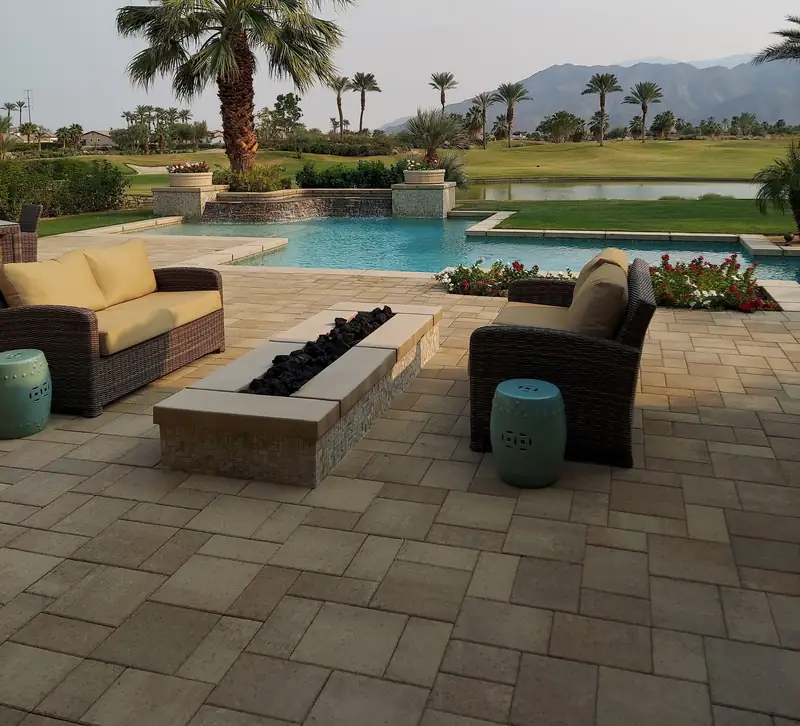
Pool deck pavers in Greater Orlando or Sarasota–Manatee run about $12–$30 per square foot installed as of October 2026, in travertine, shell stone or concrete, set either on a new compacted base or as an overlay on a sound old concrete deck. Travertine and shell stone stay cooler underfoot than concrete pavers in direct sun.
By the Opera Concrete & Pavers estimating team · Updated October 1, 2026
Get a free estimate
Tell us about the project and we'll call to set up a free site visit.
What Pool Deck Pavers Cover
Pool deck pavers are individual units, travertine, shell stone or concrete, set in a sand bed over a compacted aggregate base around the water, instead of one continuous poured slab. Installed cost runs $12–$30 per square foot as of October 2026, depending on material, with travertine and shell stone at the top of that range and concrete pavers at the bottom (HomeGuide; Central Florida resurfacing data). The same materials work both on a new build and set over an old concrete deck that's still structurally sound.
Choosing a Material: Travertine, Shell Stone or Concrete
Travertine stays noticeably cooler underfoot in direct sun than a dark concrete paver, which is a large part of why it's the material most often chosen right around a Florida pool; we won't attach a specific temperature figure to that difference, since no verified measurement for Florida conditions exists. Shell stone, quarried coquina with visible shell fragments running through it, offers a similarly light, naturally textured surface in a different look. Both are porous enough that sealing matters more than it does on concrete. Concrete pavers cost the least, come in the widest range of colors, and are the cheapest to pull and replace individually if one cracks.
| Material | Feel underfoot in sun | Sealing | Installed cost |
|---|---|---|---|
| Travertine | Noticeably cooler than dark concrete | Needed; porous stone | $13–$30 per sq ft for pool deck installs |
| Shell stone (coquina) | Light, naturally textured surface | Needed; porous stone | $16–$35 per sq ft, natural stone (HomeGuide) |
| Concrete pavers | Warmer than natural stone in full sun | Optional; lower porosity | $8–$15 per sq ft (Central Florida data) |
A 1,000 sq ft travertine pool deck runs roughly $22,000–$28,000 installed in published Florida contractor pricing.
Base and Spec for a Paver Pool Deck
A paver pool deck carries a light pedestrian load, the same as a patio, so it follows the lighter ICPI spec rather than the heavier one written for driveways. Units for a pedestrian or lightly used area run 2⅜ inches thick; the base underneath goes at least 4 inches on well-drained soil, with 2 to 4 inches more on wet or poorly drained ground, compacted to 98% of standard Proctor density (ICPI Tech Spec 2). Bedding sand screeds to an uncompacted 1 inch, and a continuous edge restraint runs the full perimeter, including the inside edge where the field meets the coping (ICPI Tech Spec 3).
| Element | Spec | Why |
|---|---|---|
| Paver thickness | 2⅜ in (60 mm), pedestrian grade | No vehicle loads around a pool |
| Base depth | 4 in minimum on well-drained soil, +2–4 in wet soil | Flatwoods soils near a pool often run wet |
| Compaction | 98% standard Proctor, 4–6 in lifts | Prevents settling under furniture and traffic |
| Bedding sand | 1 in uncompacted, screeded level | Sets the paver bearing surface |
| Edge restraint | Continuous perimeter, including against the coping | Stops the field from creeping toward the water |
| Coping joint | Flexible sealant over backer rod, not sand | Coping and field move independently |
ICPI Tech Spec 2 and ICPI Tech Spec 3, 2020.
Coping: What Finishes the Pool's Edge
Field pavers are sand-set on a flexible base; coping along the water's edge is almost always mortar-set onto the pool's bond beam, a different structural system entirely. We set the coping course first, working the field pattern back from that fixed line, and detail the joint between the two with a flexible sealant rather than sand, since sand-set pavers and mortar-set coping move at different rates. Precast bullnose coping, with a rounded, overhanging front edge, is the standard profile because a square-edged unit left proud of the bond beam is uncomfortable against bare skin.
Pavers Over an Existing Concrete Deck
Setting pavers over a sound old concrete deck skips excavation but not prep: the slab gets sounded for hollow or soft spots, patched where needed, and cleaned before a thin bedding system, sand-set on a membrane or mortar-set, carries the new pavers. That added height has to be checked against every door threshold, the pool equipment housing and the coping before work starts, since the paver plus bedding layer adds real thickness the original slab didn't have. General overlay feasibility is covered in can you put pavers over existing concrete; pool decks have the added wrinkle of the coping line.
How Pool Deck Pavers Are Installed, Step by Step
A ground-up install and an overlay over an existing slab share most of this sequence, minus excavation on an overlay.
- Protect the pool and sound the old slab, if there is one. The water gets covered, and on an overlay job, the existing deck is checked for hollow or failed sections before anything is set.
- Excavate or clean and prep the surface. A new install is excavated to the base depth and graded; an overlay gets pressure-washed and patched instead.
- Set and cure the coping. Mortar-set coping along the bond beam goes in early and cures on its own schedule before field work starts against it.
- Compact the base in lifts. Aggregate base is placed and compacted to 98% Proctor, with the two-direction slope toward deck drains built in.
- Screed the bedding sand. A 1-inch layer of bedding sand is screeded level across the compacted base, or over the bedding system on an overlay.
- Lay the field pattern from the coping outward. Full pavers go in first against the fixed coping line, with cut pieces pushed to the outer perimeter.
- Set edge restraint and compact. Restraint goes in at every open edge, including against the coping, before the whole field is compacted.
- Sweep joint sand, seal, and test every drain. Joint sand is swept and compacted, the deck is sealed where specified, and water is run across the surface to confirm it reaches the drains.
Florida Conditions a Paver Pool Deck Has to Handle
Wet Flatwoods Soil Right Where the Deck Sits
Flatwoods soils common on the Suncoast, series like EauGallie and Immokalee, hold a seasonal high water table within about 18 inches of the surface for part of the year, and splash-out and equipment-pad runoff add to that moisture right where a pool deck's base sits (NRCS EauGallie series; NRCS Immokalee series). Greater Orlando has its own flatwoods soils in Myakka and Smyrna with the same behavior (NRCS Myakka series). We default to the thicker, wet-soil base near the coping on both sides of the territory rather than waiting to find a soft spot.
Saltwater Pools and Salt Residue on Stone
A saltwater pool runs well below seawater concentration, but splash-out still leaves that salt on the coping and the nearest paver courses as the water evaporates, cycle after cycle, and it reads as a dull white residue that recurs on a schedule tied to pool use rather than fading out like ordinary efflorescence does. Sealed travertine and shell stone resist that staining far better than the same stone left bare.
Scheduling Around the Rainy Season
Joint sand compaction and sealing both need a dry window, which matters on a job scheduled during the rainy season that typically runs from late May into October across both coasts (NWS Melbourne). We push base compaction to the morning and save joint sand and sealing for the driest stretch in the forecast, since a downpour on fresh, uncompacted joint sand washes it toward the pool before it locks in.
Settling at the Coping Versus a Structural Problem
A low spot or an opening joint right along the coping is almost always ordinary base settling, not movement in the pool shell itself. Orange County sits on the state's broader list of counties with higher documented sinkhole claims; Sarasota and Manatee do not (Florida Senate Interim Report 2011-104). Coastal salt exposure near the water, by FDOT's bridge-engineering standard for structures within 2,500 feet of salt water, is a separate, more common reason to check for corrosion at any exposed metal edge restraint, not a structural pool issue (FDOT Structures Design Guidelines).
What Pool Deck Pavers Cost
Installed pool deck pavers run $12–$30 per square foot in Florida as of October 2026, with concrete pavers at the bottom of that range and travertine and shell stone toward the top. The pool deck cost guide breaks that down by size and material, including how an overlay over an existing slab compares to a ground-up install.
Permits and HOA Rules
In unincorporated Manatee County, a pool deck on grade can sit as close as 5 feet to a side or rear lot line, a setback written specifically for pools and the decks around them (Manatee County LDC §511.16). In Orlando, pavers around a pool go through the same engineering permit as concrete or asphalt (City of Orlando Residential Permitting Requirements). The permits and HOA hub, Bradenton and Lakewood Ranch guide and Sarasota and Venice guide cover the rest.
Lakewood Ranch's Country Club/Edgewater community manual requires a Modification Request Form before the material of a residential driveway or walkway changes, approved before work starts (Lakewood Ranch CEVA Homeowners Manual); pool-area hardscape typically goes through that same architectural review. In Lake Nona's Laureate Park, any improvement to the property, including the pool, needs sign-off from the Architectural Review Board (Laureate Park Master Association FAQ). A 2026 change to Florida law bars an HOA from requiring a building permit before it will review the request (F.S. 720.3035). Lakewood Ranch ARC approval for pavers and pool decks goes deeper.
Caring for Pool Deck Pavers
Rinse the coping and the paver courses closest to the water more often than the rest of the deck; salt, chlorine residue and sunscreen oils concentrate there and build into staining faster than ordinary rain and dust ever would elsewhere on the field. Joint sand in that same zone wears out faster too, from splash-out and hose-downs on top of normal weathering, so it's worth topping off on a shorter cycle than the rest of the deck. Travertine and shell stone don't have a published resealing interval; watch for water that no longer beads, or a color gone flat in the splash zone specifically, rather than counting years (ICPI Tech Spec 5). Travertine pool deck care and cleaning pavers without damaging the joints cover the routine.
How Do You Pick the Best Pool Deck Paver Contractor?
Ask to see how they detail the coping joint before you sign anything; a flexible sealant over a backer rod, not sand run straight up to mortar-set coping, is the detail that keeps that first course of pavers from rocking loose within a year or two. Ask who's applying for whatever permit the job needs and whether that fee is in the quote. For work over $2,500, a recorded Notice of Commencement protects you under Florida's lien law (F.S. 713.13). Check the DBPR license search for anyone claiming a state certification, and ask for proof of the liability insurance coverage Florida requires (F.S. 489.115). More criteria for Orlando and for Sarasota and Lakewood Ranch.
Pool Deck Paver Service Areas
We install travertine, shell stone and concrete pool deck pavers across Greater Orlando and the Sarasota–Manatee area, including:
Related Reading
Pool Deck Pavers by city
Each local page covers that town's permit office, soil, HOA approvals and weather.
Orange County
Osceola County
Seminole County
Lake County
Polk County
Sarasota County
Manatee County
Frequently asked questions
Will pavers over my existing pool deck end up higher than the coping?
Often, since the paver plus its bedding layer adds height the original slab didn't have. We check that buildup against the coping, the equipment housing and every nearby door threshold before starting, and set a thinner bedding system or shave the old slab where it's needed so the finished surface meets the coping cleanly. General overlay feasibility covers driveways and patios too.
Is travertine a good choice for a saltwater pool?
Yes, with routine sealing and rinsing. A saltwater pool runs far below seawater concentration, but splash-out still leaves salt on the stone, and travertine's porosity means that residue and moisture need a sealed surface to keep from working in over time. More on salt air and coastal hardscape.
Is travertine slippery when wet?
A honed or polished finish can get slick around a pool. A tumbled or brushed travertine finish, the finish most often specified for pool decks, carries enough surface texture to hold traction when wet, which is why it's chosen far more than a polished finish in this use.
Can you install new paver or travertine coping?
Yes. Precast bullnose units, in paver or travertine, set along the pool's bond beam with a rounded edge that overhangs the water slightly, giving bare feet a comfortable, non-slip lip to grip. Bullnose coping prices separately from the field pavers, typically by the linear foot rather than the square foot.
What size travertine pavers are best for a pool deck?
There's no single right size. A French pattern, a mix of four module sizes laid in a repeating layout, hides cut pieces well around a curved coping, while a single large format such as 16x16 or 12x24 inches gives a cleaner, more modern look with fewer joints. The coping's curve and the deck's overall shape usually settle which one fits.
Can pavers be installed inside a screen enclosure without removing it?
Usually, yes. A screen cage's aluminum frame sits on isolated footers around the deck's perimeter, not on the deck surface itself, so a crew can work the base and lay pavers inside the enclosure without taking the screen down, as long as base material and equipment can get through an existing door or panel.
Does a travertine pool deck have to be sealed?
Not structurally required, but close to it in practice. Travertine is porous enough that sunscreen, chlorine splash and standing water will stain or etch an unsealed surface faster than most homeowners expect. Routine travertine pool deck care covers how often and what that upkeep looks like.
Sources
- HomeGuide — Travertine Pavers Cost
- HomeGuide — Pool Deck Cost
- Pool Mechanic — Pool Deck Resurfacing in Central Florida (contractor)
- Craft Pavers — Paver Prices in Florida (contractor)
- ICPI Tech Spec 2 Construction of Interlocking Concrete Pavements (2020)
- ICPI Tech Spec 3 Edge Restraints (2020)
- ICPI Tech Spec 5 Cleaning, Sealing and Joint Sand Stabilization (2020)
- NRCS OSD EauGallie
- NRCS OSD Immokalee
- NRCS OSD Myakka
- Florida Senate Interim Report 2011-104 (sinkhole insurance)
- FDOT Structures Design Guidelines Vol. 1, §1.3.2 environmental classification
- City of Orlando — Residential Permitting Requirements
- Manatee County LDC §511.16 Swimming Pools, Spas, Screen Enclosures
- Lakewood Ranch Town Hall, CEVA Homeowners' Manual 2022
- Laureate Park Master Association FAQ
- F.S. 720.3035 (2026) Architectural control covenants
- F.S. 489.115 (2026) Certification and registration; insurance
- F.S. 713.13 (2026) Notice of commencement
- DBPR License Search
- NWS Melbourne Wet/Dry Season Onset
Ready for a price on your project?
Request a free estimate
Tell us about the project and we'll call to set up a free site visit.