
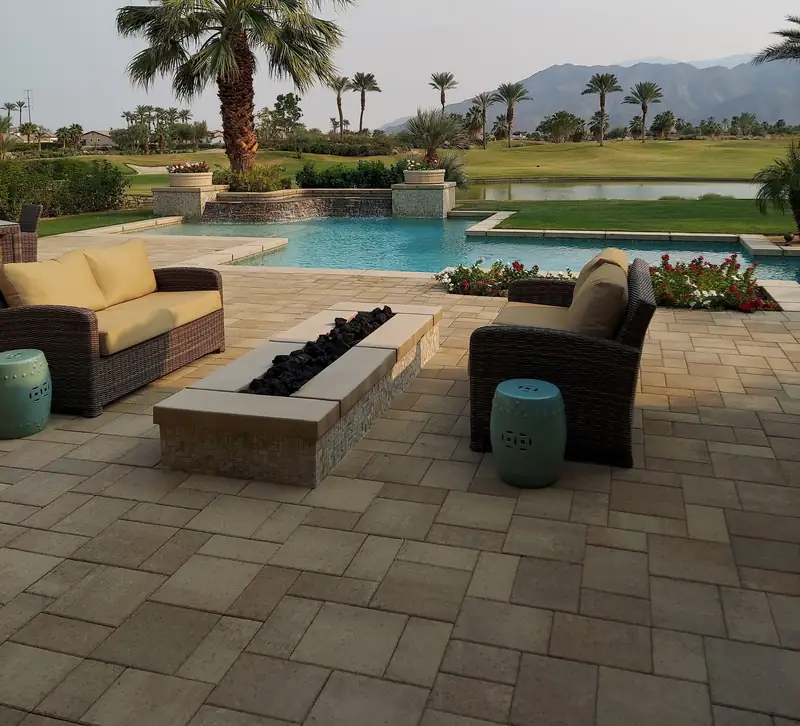
Pool Deck Pavers · Venice, FL
Travertine and Paver Pool Decks in Venice
Pool deck pavers or travertine in Venice run $12–$30 per sq ft installed as of October 2026. Stretching a deck toward the Gulf-facing side of Venice Island can put part of it past Florida's own construction control line, which brings in a state review before the city's permitting office even looks at the job.
By the Opera Concrete & Pavers estimating team · Updated October 1, 2026
Get a free estimate
Tell us about the project and we'll call to set up a free site visit.
Reaching toward the beach brings in a state review first
Where a deck extends past Florida's Coastal Construction Control Line, the Department of Environmental Protection's Bureau of Beaches and Coastal Systems has to sign off first, since the program exists to limit beach erosion and dune damage rather than to judge the deck design itself FDEP's CCCL program, with its own separate application process FDEP's CCCL application page. A travertine or paver overlay stretching toward the Gulf-facing edge of a Venice Island lot is exactly the kind of addition where that state line, not any setback the city might otherwise apply, decides how far the deck gets to reach.
Salt air off the Gulf and the Intracoastal shortens the sealing clock
Bridge engineers at FDOT use a specific cutoff for what counts as a corrosive marine environment, water running above 2,000 parts per million chloride within 2,500 feet of the structure, and that same standard is a reasonable stand-in for how salt-laden the air gets off the Gulf beach and the Intracoastal stretch wrapping Venice Island FDOT Structures Design Guidelines Vol. 1, §1.3.2 environmental classification. The paver base and bedding sand go in the same way regardless, but that salt load speeds up how soon joint sand washes out and an unsealed surface starts staining around the pool coping, which is why resealing a Gulf-side deck tends to land on a shorter cycle than the identical job a few miles inland.
Grading a Paver Deck to the Drains, Not Just Away From the House
Like any pool deck, a paver field around the water needs to shed rain toward deck drains or a perimeter channel instead of back into the pool, on top of the ordinary slope away from the house any patio needs. We build that grade into the compacted base itself, shaping it before the bedding sand goes down, since correcting a pitch problem after pavers are laid means pulling up a section rather than adjusting a sand layer. On a Venice deck, getting that two-direction slope right in the base is what keeps a hard afternoon rain from pushing pollen and yard debris straight into the pool.
Setting Mortar-Set Coping on Its Own Schedule
Coping goes in on a different timeline than the sand-set field pavers around it, since mortar needs its own cure time before the coping units can take weight or be struck with a tool during finishing. We typically set coping early in the sequence, let it cure, then build the field paver work up to that fixed, cured edge rather than trying to finish both systems on the same day. On a Venice job, rushing the field pavers against coping that hasn't fully cured risks knocking a unit out of line before the mortar has set up enough to hold it in place.
A travertine overlay on an older Venice Island pool deck, worked out in square feet
Say a home on Venice Island is ready to overlay an aging 750 square foot concrete pool deck in travertine, and part of the existing slab sits close enough to the Gulf that the control line cuts right across the yard. Pricing the overlay at $12–$30 per sq ft installed comes out between $9,000 and $22,500, tightening toward $10,500 to $16,500 inside the typical $14–$22 range once the stone and pattern are picked. Figuring out exactly where that line falls on the parcel happens before a number gets quoted, and the salt exposure on a lot this close to open water steers which sealer and edge-restraint hardware get specified rather than defaulting to an inland spec.
Paver Thickness for a Pool Deck Matches a Patio, Not a Driveway
ICPI's 60 mm, 2.375-inch standard for pedestrian areas covers a pool deck the same way it covers a patio, since lounge chairs and bare feet don't come close to the load a driveway carries. A Venice homeowner who's seen 80 mm units quoted for a neighbor's driveway doesn't need that heavier paver around a pool, where the extra thickness adds cost without adding anything the job actually requires. What matters more for a paver deck's long-term feel is a properly compacted base and a tight joint at every edge, including the one against the coping, not a thicker unit sitting on an otherwise ordinary base.
Saltwater Pools Leave Salt Behind on the Coping and Nearby Pavers
A saltwater pool runs at a far lower concentration than seawater, but splash-out and backwash still carry that salt onto the coping and the few feet of paver field closest to the water, and it stays behind as a dull white residue once the water evaporates. It looks similar to ordinary efflorescence on new concrete pavers but comes from the pool itself rather than from the paver material curing, and it keeps recurring on a schedule tied to pool use rather than fading out over a season. On a Venice deck, the coping and splash zone need a routine rinse the rest of the field doesn't.
Upkeep on an Overlay Deck Versus a Ground-Up Install
A paver system set over an existing concrete deck needs the same joint and surface care as a ground-up install, but it's worth an occasional check at the overlay's outer edge and at any door threshold, where the bedding system meets the old slab's edge, for signs of the two layers separating. That edge is the weak point in an overlay that a ground-up paver field, with edge restraint anchored into a full compacted base, doesn't really have. On a Venice overlay job, catching an edge that's started to lift early means resetting a border course, not redoing the whole transition.
Frequently asked questions
Does a pool deck overlay on Venice Island need a state permit?
Only the portion that falls past Florida's Coastal Construction Control Line. Where that applies, DEP's own sign-off comes first, before the city's permitting office gets involved, so pinning down the line's exact position on a given parcel is step one.
Why does salt air matter more for a Venice pool deck than an inland one?
FDOT's bridge-design cutoff for a corrosive marine environment, water above 2,000 parts per million chloride within 2,500 feet, happens to describe nearly the whole of Venice Island and its Gulf-facing lots, which is why sealer and hardware choices differ on a deck built that close to the water.
Is travertine cooler than a concrete paver pool deck in Venice's heat?
Manufacturer and third-party claims point that direction, but no verified degree figure exists for either material, so we don't quote a specific temperature difference when pricing the job.
Sources
- Venice LDR §9.1 Defined Terms (Right-of-Way Use Permit)
- Venice LDR §3.1 General Development Standards
- Venice LDR §3.8 Fences, Walls, Berms, and Retaining Walls
- Venice Engineering — Permits, Forms and Applications (search excerpt)
- Venice Building Division FAQ (search excerpt)
- Venice Building Permit Guidelines (3rd-party copy, FBC 2014 era)
- Census Bureau PEP, City and Town Population Totals, Vintage 2025 (July 1, 2025)
- Census Reporter, Venice FL (ACS 2020-2024 5-yr, B25035)
- Wikipedia, John Nolen Plan of Venice Historic District
- SWFWMD District Water Restrictions
- FDOT Structures Design Guidelines Vol. 1, §1.3.2 environmental classification
- FEMA - Features of Flood Insurance Rate Maps in Coastal Areas
- FDEP Coastal Construction Control Line Program
- FDEP — Apply for a CCCL permit
- Florida Senate Interim Report 2011-104 (sinkhole insurance)
- Sarasota County Code §124-255 Additional Provisions (culverts)
- Sarasota County Code §124-76 District Development Standards
- Sarasota County Code §22-63 (retaining walls > 4 ft engineered)
- Sarasota County Online Permitting
- Florida Administrative Code — Rule 62-308.100, Synthetic Turf (effective May 19, 2026)
- Florida Statutes §125.572 — synthetic turf on single-family lots
- Venetian Golf & River Club POA, ACC Application
- Sarasota County / USF Water Atlas, Intracoastal Waterway (Venice)
- Sarasota County / USF Water Atlas, Roberts Bay (Venice)
Ready for a price on your project?
Request a free estimate
Tell us about the project and we'll call to set up a free site visit.