
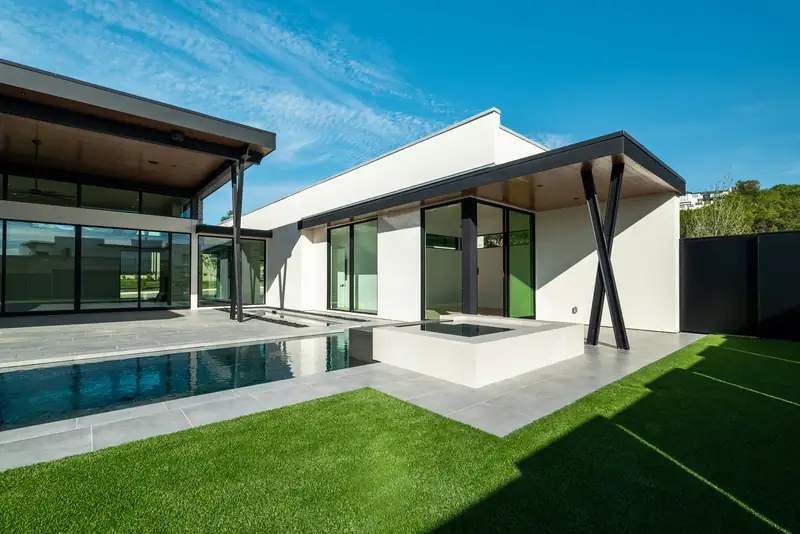
Pool Deck Pavers · Osprey, FL
Travertine and Paver Pool Decks in Osprey
Pool deck pavers or travertine in Osprey run $12–$30 per sq ft installed as of October 2026. Being a short walk from Little Sarasota Bay matters more to how a sealed surface ages here than how far the lot sits from the Gulf itself.
By the Opera Concrete & Pavers estimating team · Updated October 1, 2026
Get a free estimate
Tell us about the project and we'll call to set up a free site visit.
A bay-front material classification, not just a beachfront one
The yardstick FDOT's bridge engineers use for a corrosive marine setting is a chemistry reading, not a view of the Gulf: water testing above 2,000 parts per million chloride within 2,500 feet of the structure FDOT Structures Design Guidelines Vol. 1, §1.3.2 environmental classification, a number that reaches well past the barrier islands into bay-front Osprey streets along Little Sarasota Bay. That classification leaves the paver base and bedding sand spec exactly as they'd be inland, but it's a fair signal that joint sand and a sealer coat won't last as long here as the identical job set a mile back from the water.
The Coping Joint Needs a Sealant, Not Just Sand
Where the field pavers meet mortar-set coping at the pool's edge, a standard sand joint isn't the right detail, since the two systems move independently and a rigid mortar line right there cracks the same way a concrete deck would without an isolation joint. We detail that transition with a flexible sealant over a backer rod instead, the same approach a poured concrete deck uses at its own coping line. On a Osprey paver deck, butting sand-set pavers straight against mortar-set coping without that flexible joint is one of the more common reasons the first paver course against the pool starts rocking within a year or two.
A travertine overlay on a bay-adjacent Osprey deck, worked out in square feet
A 480 square foot concrete pool deck two streets from Little Sarasota Bay is getting a travertine overlay on a lot that's also still carrying its original 1970s plat. Pricing the overlay at $12–$30 per sq ft installed comes to $5,760 and $14,400, tightening to about $6,720 to $10,560 inside the typical $14–$22 range once the stone grade is chosen. Because the lot predates 1975, the new overlay's footprint gets checked against the nonconforming coverage ceiling before the number gets quoted, a step a newer lot across town wouldn't need.
Where a bigger overlay lands on an older lot's coverage total
Expanding a pool deck in pavers or travertine on a parcel platted on or before November 11, 1975 adds that new square footage straight to the county's 50 percent impervious ceiling, the same rule that names pool decks and paved surfaces directly Sarasota County Code §124-283. A newer RSF lot skips that particular math entirely, since its 35 percent cap only reaches the house footprint Sarasota County Code §124-76.
Screen Cage Footers Shifting a Paver Field Near the Pool
A screen enclosure footer that wasn't isolated from the surrounding paver base during construction can settle or heave on its own schedule, and the nearest paver courses follow it, showing up as a localized dip or bump that tracks each post location around the pool rather than a random low spot. That pattern is often mistaken for ordinary base settling until someone notices it lines up with every footer rather than spreading evenly across the field. On a Osprey deck with an older screen cage, resetting the affected pavers usually fixes the symptom, but the footer itself may need its own separate repair if it keeps moving.
Ridge Sand Doesn't Mean a Thinner Base Near the Pool Either
On the excessively drained ridge sands west of Orlando, in series like Candler and Astatula, water moves through the ground so fast that a paver base can seem like overkill next to a pool that's constantly adding its own water through splash-out. It isn't. Loose, fast-draining sand shifts under foot traffic and pool furniture more than a firmer soil does, regardless of how well it drains, so a Osprey deck on ridge sand still gets the full compacted base depth rather than a thin leveling layer over native material. The water table sitting deep doesn't change how the sand behaves under repeated weight.
Setting Mortar-Set Coping on Its Own Schedule
Coping goes in on a different timeline than the sand-set field pavers around it, since mortar needs its own cure time before the coping units can take weight or be struck with a tool during finishing. We typically set coping early in the sequence, let it cure, then build the field paver work up to that fixed, cured edge rather than trying to finish both systems on the same day. On a Osprey job, rushing the field pavers against coping that hasn't fully cured risks knocking a unit out of line before the mortar has set up enough to hold it in place.
Checking the Coping's Flexible Joint for Wear
The sealant in the flexible joint between coping and field pavers absorbs the independent movement of the pool and the deck around it, and like any sealant it wears out well before the pavers or the coping itself show any age. A Osprey homeowner who checks that joint once or twice a year for cracking, gaps or sections that have pulled free from either surface catches a failing joint while a simple recaulk still solves it. Letting that joint fail quietly lets water and debris work into exactly the gap it was built to protect, a slower problem to notice than it is to fix early.
Frequently asked questions
Does bay-front Osprey count as a marine environment for pavers?
Under FDOT's own engineering standard, yes, within about 2,500 feet of water carrying more than 2,000 parts per million chloride, a boundary that reaches well past the barrier islands into bay-front neighborhoods.
Does a pool deck paver overlay need a county permit in Osprey?
Yes, the same building-permit review that applies to the original deck applies to a paver or travertine overlay over it, regardless of whether the stone sits on new concrete or an older slab.
Does an overlay on an older Osprey lot affect its coverage limit?
On a parcel platted on or before November 11, 1975, yes, since the overlay's square footage adds to the county's 50 percent impervious-coverage total that names pool decks directly.
Sources
- Sarasota County Code §124-48 Right-of-Way Use Permit
- Sarasota County Code §98-3 Driveway culvert / ROW use permit fees
- Sarasota County Code §124-255 Additional Provisions (culverts)
- Sarasota County Code §124-76 District Development Standards
- Sarasota County Code §124-283 Nonconforming Lots of Record
- Sarasota County Code §22-63 (retaining walls > 4 ft engineered)
- Sarasota County Online Permitting
- Sarasota County Building (search excerpt; 403 to direct fetch)
- FEMA - Features of Flood Insurance Rate Maps in Coastal Areas
- FDEP Coastal Construction Control Line Program
- SWFWMD District Water Restrictions
- FDOT Structures Design Guidelines Vol. 1, §1.3.2 environmental classification
- Florida Senate Interim Report 2011-104 (sinkhole insurance)
- NRCS OSD EauGallie
- NRCS OSD Immokalee
- NRCS OSD Pomello
- Florida Administrative Code — Rule 62-308.100, Synthetic Turf (effective May 19, 2026)
- Florida Statutes §125.572 — synthetic turf on single-family lots
- F.S. 720.3045 (2026) Installation, display, and storage of items
- Palmer Ranch Master Association
- Census Reporter, Osprey CDP, FL (ACS 2020-2024 5-yr, B01003/B25035)
- Wikipedia, Osprey, Florida
- Wikipedia, Historic Spanish Point
- Selby Gardens, Visit Historic Spanish Point
- Wikipedia, Oscar Scherer State Park
Ready for a price on your project?
Request a free estimate
Tell us about the project and we'll call to set up a free site visit.