
Pool Deck Pavers · Nokomis, FL
Travertine and Paver Pool Decks Near Nokomis
Travertine or paver pool decks near Nokomis price out at $12–$30 per sq ft installed this October. How far a backyard sits from Casey Key's shoreline or Dona Bay matters more to how soon a sealed surface shows salt staining than which stone gets chosen.
By the Opera Concrete & Pavers estimating team · Updated October 1, 2026
Get a free estimate
Tell us about the project and we'll call to set up a free site visit.
How close is close enough for salt to matter
Bridge engineers at FDOT draw their own marine-environment line at 2,500 feet from any chloride-heavy waterway, a chemistry test rather than a distance anyone eyeballs from the yard FDOT Structures Design Guidelines Vol. 1, §1.3.2 environmental classification, and that line sweeps in essentially every lot on Casey Key plus a good share of those backing to Dona Bay or Roberts Bay on the mainland side of Nokomis. That exposure doesn't change the paver base spec underneath, but it shortens how long joint sand and a sealer coat hold up against an inland overlay built the same way.
Two separate lines can both run through a Casey Key backyard
Sarasota County's own Gulf Beach Setback Line prohibits construction or excavation seaward of it, or waterward of the Barrier Island Pass Hazard Line, anywhere on Casey Key, independent of whatever Florida's own coastal program requires Sarasota County Code §54-723. A homeowner stretching a travertine overlay toward the Gulf can find the county line and the state's own control line falling in two different spots on the same lot, which is why pinning down both before quoting a square-foot number matters more here than it would a mile inland FDEP's CCCL application page. A plain concrete deck expansion on the same parcel runs into both lines identically.
Ridge Sand Doesn't Mean a Thinner Base Near the Pool Either
On the excessively drained ridge sands west of Orlando, in series like Candler and Astatula, water moves through the ground so fast that a paver base can seem like overkill next to a pool that's constantly adding its own water through splash-out. It isn't. Loose, fast-draining sand shifts under foot traffic and pool furniture more than a firmer soil does, regardless of how well it drains, so a Nokomis deck on ridge sand still gets the full compacted base depth rather than a thin leveling layer over native material. The water table sitting deep doesn't change how the sand behaves under repeated weight.
Overlay Prep: Cleaning and Testing the Old Slab Before Pavers Go Down
An overlay job starts with testing, not installing, since every square foot of the old concrete deck has to be sound enough to carry a new paver system before bedding material goes on top of it. We sound the slab for hollow spots, pressure-wash it to remove any sealer or coating that would block adhesion, and patch anything that fails before the bedding system goes down. On a Nokomis overlay, this prep stage often takes as long as the paver-laying stage itself, since a problem found here is far cheaper to fix than one discovered after the new surface is already down.
Resurfacing a Casey Key deck in travertine where two setback lines cross the yard
A Casey Key cottage has a tired 540 square foot broom-finish deck ringing its cage, and the owner wants travertine instead, except a corner of that deck sits past the county's own Gulf Beach Setback Line. Pricing the resurface at $12–$30 per sq ft installed puts the job at $6,480 to $16,200, narrowing to about $7,560 to $11,880 inside the typical $14–$22 band once stone and pattern are chosen. The corner past the setback line either gets redesigned around that boundary or goes through a county variance first, and either way, the sealer spec on the rest of the deck still answers to how close the whole lot sits to open saltwater.
Travertine, Shell Stone or Concrete Pavers: What Changes Around a Pool
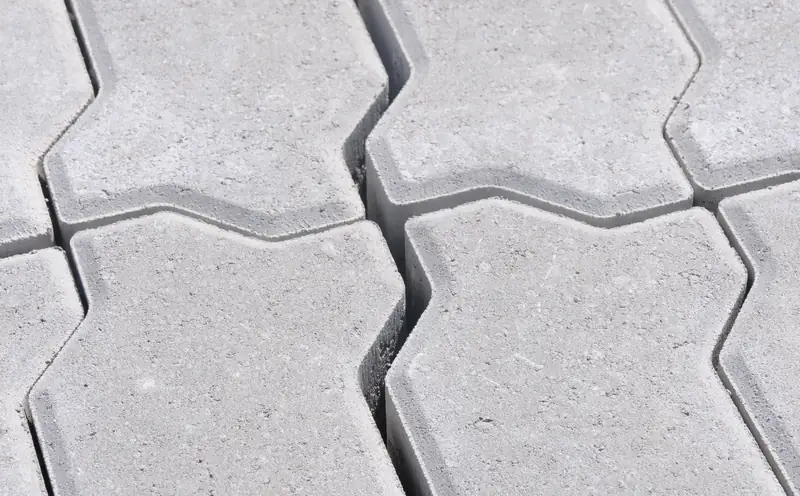
Travertine stays noticeably cooler underfoot in direct sun than a dark concrete paver, part of why it's a common choice right around a Nokomis pool, though we won't put a number on that difference since no verified measurement exists for Florida conditions. Shell stone, quarried coquina with visible shell fragments, offers a similarly light, naturally textured surface with its own look. Both are more porous than concrete and need sealing attention sooner. Concrete pavers cost less, come in more colors, and are cheaper to replace individually if one cracks, trading some of that heat and texture advantage for lower material cost.
A Paver Field That Slopes the Wrong Way Dumps Debris in the Pool
A paver deck graded flat or tilted toward the water instead of toward its drains sends pollen, cut grass and yard debris straight into the pool with every rain, which throws off the chemical balance faster than ordinary splash-out and evaporation would. On a Nokomis property, that kind of misgrade usually traces back to a base that was leveled by eye rather than shaped with the pool deck's two-direction slope built in from the start. The pattern often shows up first as an unusually chemical-hungry pool rather than as visibly standing water, since a flat paver field doesn't always look wrong until someone runs a hose across it.
A Seasonal Rinse Timed Before the Rainy Season Starts
A broader rinse and sweep of the whole paver deck a few times a year, timed ahead of the rainy season that typically runs from late May into October in this part of Florida, clears pollen and leaf litter before it works into joints near the deck drains and slows how fast water moves off the surface. On a Nokomis deck, this routine rinse matters as much for keeping the drains themselves clear as it does for the paver joints, since debris collecting right at a drain inlet defeats the two-direction slope the base was built with in the first place.
Frequently asked questions
Why does a Casey Key pool deck need a tighter sealing schedule?
Nearly the entire key falls inside FDOT's own marine-chloride boundary, water above 2,000 parts per million within 2,500 feet, and that level of salt exposure wears through joint sand and a sealer coat faster than an inland Nokomis yard sees.
Can the Gulf Beach Setback Line cut through the middle of a Casey Key deck?
On a narrow lot, yes. The county's own line and Florida's separate coastal control line don't always fall in the same spot, so a deck redesign or overlay near the Gulf side gets both checked against the actual survey before pricing.
Is a travertine deck worth the added cost this close to the water on Casey Key?
Plenty of owners near the Gulf pick it for the lighter surface and look, though no verified temperature figure separates it from a concrete paver deck, so the choice tends to come down to upkeep and appearance rather than a specific degree claim.
Sources
- Sarasota County Code §124-48 Right-of-Way Use Permit
- Sarasota County Code §98-3 Driveway culvert / ROW use permit fees
- Sarasota County Code §124-255 Additional Provisions (culverts)
- Sarasota County Code §124-76 District Development Standards
- Sarasota County Code §124-283 Nonconforming Lots of Record
- Sarasota County Code §22-63 (retaining walls > 4 ft engineered)
- Sarasota County Code §54-723 Gulf Beach Setback Line
- Sarasota County Online Permitting
- Sarasota County Building (search excerpt; 403 to direct fetch)
- FDEP Coastal Construction Control Line Program
- FDEP — Apply for a CCCL permit
- FEMA - Features of Flood Insurance Rate Maps in Coastal Areas
- SWFWMD District Water Restrictions
- FDOT Structures Design Guidelines Vol. 1, §1.3.2 environmental classification
- Florida Senate Interim Report 2011-104 (sinkhole insurance)
- NRCS OSD EauGallie
- NRCS OSD Immokalee
- NRCS OSD Felda
- Florida Administrative Code — Rule 62-308.100, Synthetic Turf (effective May 19, 2026)
- Florida Statutes §125.572 — synthetic turf on single-family lots
- F.S. 720.3045 (2026) Installation, display, and storage of items
- Census Reporter, Nokomis CDP, FL (ACS 2020-2024 5-yr, B01003/B25035)
- Wikipedia, Nokomis, Florida
- Wikipedia, Casey Key, Florida
- Wikipedia, Nokomis Beach Pavilion
- Visit Sarasota County, Nokomis Beach
Ready for a price on your project?
Request a free estimate
Tell us about the project and we'll call to set up a free site visit.