
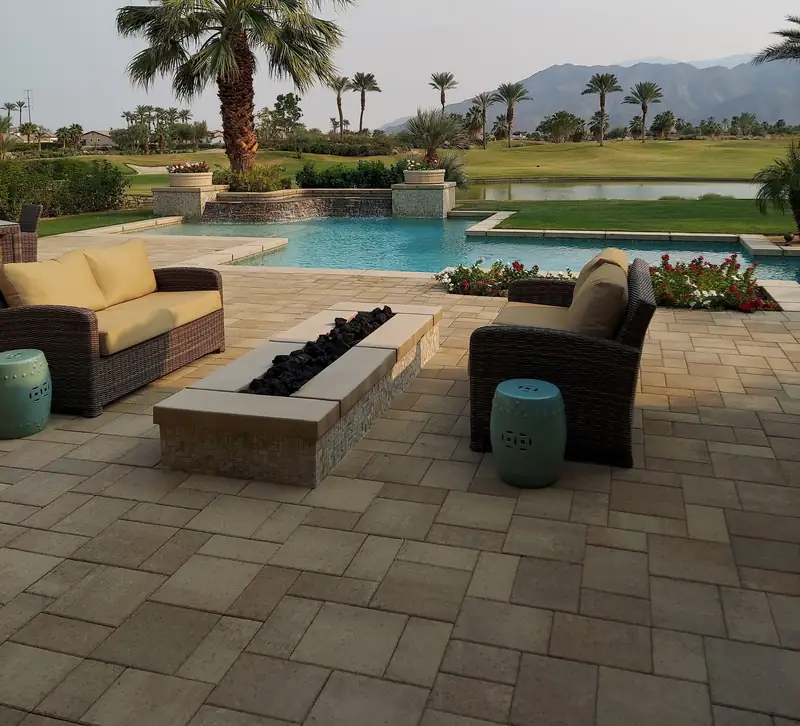
Pool Deck Pavers · North Port, FL
Travertine and Paver Pool Decks in North Port
Pool deck pavers or travertine in North Port run $12–$30 per sq ft installed as of October 2026. On a canal-front lot tied into the city's drainage grid, where the deck's runoff ends up matters as much as which stone sits on top.
By the Opera Concrete & Pavers estimating team · Updated October 1, 2026
Get a free estimate
Tell us about the project and we'll call to set up a free site visit.
Say a 480 sq ft paver overlay goes over an older pool deck on a North Port canal-front lot
Say a 480 sq ft paver overlay goes over an older pool deck on a North Port canal-front lot. At $12–$30 per sq ft, figure $5,760 to $14,400 across the full range, narrowing to about $6,720 to $10,560 inside the typical $14–$22 band depending on stone grade and pattern. Grading the new surface to shed water toward the canal side rather than the house takes priority over the paver pattern itself, and the base underneath still gets sized for Myakka or Immokalee soil the same way it would three blocks inland.
Why North Port's drainage system shapes deck grading
The city's own stormwater system, 64 water control structures and about 30 miles of roadside swale rehabbed every year, routes runoff toward Myakkahatchee Creek and the Cocoplum waterway, the same path the city draws its drinking water from City of North Port, Stormwater Management. A pool deck overlay on a canal lot gets graded to keep runoff moving toward that system rather than pooling against the house, a detail that matters more here than in a city without this scale of engineered drainage.
Paver Thickness for a Pool Deck Matches a Patio, Not a Driveway
ICPI's 60 mm, 2.375-inch standard for pedestrian areas covers a pool deck the same way it covers a patio, since lounge chairs and bare feet don't come close to the load a driveway carries. A North Port homeowner who's seen 80 mm units quoted for a neighbor's driveway doesn't need that heavier paver around a pool, where the extra thickness adds cost without adding anything the job actually requires. What matters more for a paver deck's long-term feel is a properly compacted base and a tight joint at every edge, including the one against the coping, not a thicker unit sitting on an otherwise ordinary base.
The soil underneath still sets the base
Myakka and Immokalee, both common across North Port, hold a seasonal high water table within about 18 inches of grade for part of most years NRCS Myakka soil series NRCS Immokalee soil series, which affects how much compacted aggregate a travertine or paver overlay needs underneath regardless of how well the citywide canal system drains the rest of the lot.
Ridge Sand Doesn't Mean a Thinner Base Near the Pool Either
On the excessively drained ridge sands west of Orlando, in series like Candler and Astatula, water moves through the ground so fast that a paver base can seem like overkill next to a pool that's constantly adding its own water through splash-out. It isn't. Loose, fast-draining sand shifts under foot traffic and pool furniture more than a firmer soil does, regardless of how well it drains, so a North Port deck on ridge sand still gets the full compacted base depth rather than a thin leveling layer over native material. The water table sitting deep doesn't change how the sand behaves under repeated weight.
Height Mismatch at the Door When Pavers Go Over an Old Deck
Pavers set over an existing concrete deck add height, and if that buildup wasn't checked against the door thresholds before the job started, the finished surface can end up sitting higher than a slider or French door's sill. That mismatch does more than look wrong, it can let rainwater that used to drain away from the house instead pool against the threshold and work its way inside during a hard storm. A North Port overlay job that skipped this check at the design stage usually needs the threshold itself modified after the fact, a far more disruptive fix than planning for it before the first paver went down.
The Final Walk: Checking Drains, the Coping Joint and Every Loose Paver
With joints swept and compacted, we walk the finished deck checking every deck drain for flow, running a hose along the coping to confirm the flexible sealant joint is sealed end to end, and resetting any paver that rocks or sits proud in its sand bed before calling the job finished. On a North Port deck, this final check with water running catches a slope problem a dry walk-through would miss entirely, since a flat or slightly misgraded section doesn't always look wrong until water is moving across it. Cleanup includes clearing excess joint sand off the coping and out of the pool if any blew in.
Re-Sanding Joints Near a Pool Needs a Shorter Interval
Joint sand anywhere in a paver field wears thin from rain and foot traffic over time, but the rows closest to a pool lose sand faster still, since splash-out and pool-service hose-downs wash sand out of those joints on top of normal weathering. Topping off and compacting joint sand in that zone on a shorter cycle than the rest of a North Port deck, rather than waiting for the whole field to need it at once, keeps the pavers nearest the water from rocking before the rest of the deck shows any sign of wear at all.
Frequently asked questions
Does a canal lot in North Port need special drainage planning for a pool deck overlay?
Generally yes. Grading the new surface to move runoff toward the canal and the broader city drainage system, rather than pooling it near the house, is a bigger factor than on a non-canal lot.
Does North Port's water supply connection affect pool deck work?
Not directly for the construction itself, but it's a reason the city takes swale and canal maintenance seriously citywide, since the same system that drains yards also feeds the utility's drinking-water source.
What soil is typically under a North Port pool deck?
Myakka or Immokalee are both common across the city, and either one holds a seasonal high water table that affects how deep the compacted base under an overlay needs to run.
Sources
- North Port Application for ROW Use Permit (rev. Aug 2022)
- North Port ULDC App. A.1.1.1 Public Works permit
- North Port ULDC §4.4.1 One-and-two-family development
- North Port ULDC §3.2.3 Standard districts dimensional standards
- North Port ULDC §3.6.13 Permeable or pervious pavers
- North Port ULDC §6.5.15.3 Retaining walls, sidewalks, driveways in floodways
- North Port Permitting (search excerpt)
- North Port Public Works (search excerpt)
- SWFWMD District Water Restrictions
- FEMA Flood Map Service Center
- NRCS OSD Myakka
- NRCS OSD Immokalee
- NRCS OSD EauGallie
- Florida Administrative Code — Rule 62-308.100, Synthetic Turf (effective May 19, 2026)
- Florida Statutes §125.572 — synthetic turf on single-family lots
- F.S. 720.3045 (2026) Installation, display, and storage of items
- Census Bureau PEP, City and Town Population Totals, Vintage 2025 (North Port city, FL)
- Census Reporter, North Port, FL (ACS 2020-2024 5-yr, B25035)
- Wikipedia, North Port, Florida
- City of North Port, Stormwater Management
- Wikipedia, Myakkahatchee Creek Environmental Park
- Wikipedia, Warm Mineral Springs, Florida
Ready for a price on your project?
Request a free estimate
Tell us about the project and we'll call to set up a free site visit.