
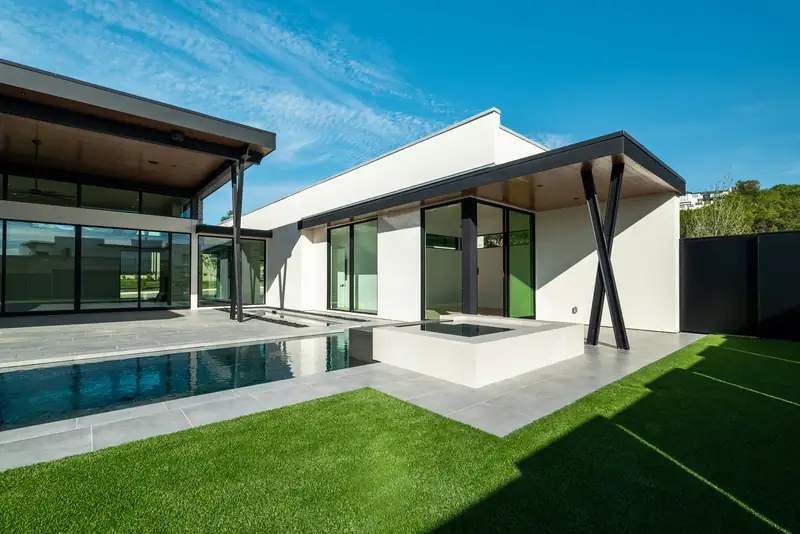
Pool Deck Pavers · Parrish, FL
Travertine and Paver Pool Decks in Parrish
Pool deck pavers or travertine in Parrish run $12–$30 per sq ft installed as of October 2026. Because so many pools here came with the house as a builder package, a paver or travertine overlay on the existing broom-finished deck is a common upgrade rather than a first installation.
By the Opera Concrete & Pavers estimating team · Updated October 1, 2026
Get a free estimate
Tell us about the project and we'll call to set up a free site visit.
Overlaying rather than starting from bare ground
With the median Parrish-area home dated to around 2011 Census Reporter, Parrish CCD, a large share of the pools in the community's newer subdivisions came with a standard broom-finished concrete deck already in place. A paver or travertine overlay on top of that existing slab is a non-structural resurfacing job on the county's own terms the way a fresh patio pour is, which keeps the permit question the same as it would be for any other non-structural hardscape Manatee no-permit list.
Ridge Sand Doesn't Mean a Thinner Base Near the Pool Either
On the excessively drained ridge sands west of Orlando, in series like Candler and Astatula, water moves through the ground so fast that a paver base can seem like overkill next to a pool that's constantly adding its own water through splash-out. It isn't. Loose, fast-draining sand shifts under foot traffic and pool furniture more than a firmer soil does, regardless of how well it drains, so a Parrish deck on ridge sand still gets the full compacted base depth rather than a thin leveling layer over native material. The water table sitting deep doesn't change how the sand behaves under repeated weight.
The base underneath still matters
EauGallie soil, mapped across parts of the Parrish area, keeps a water table within about 18 inches of grade for one to four months most years NRCS EauGallie soil series, which is worth checking before an overlay goes down, since an uneven or soft base underneath an existing deck can undercut a new paver surface even when the project itself is cosmetic rather than structural.
Sealing Travertine Isn't Optional the Way It Is on Concrete Pavers
Concrete pavers can go years unsealed with no real problem beyond a faded surface, but travertine's porosity makes sealing closer to a requirement than an option on a deck this close to a pool, where sunscreen, chlorine splash and standing water all have more chances to soak into unsealed stone. A Parrish homeowner choosing travertine for its look and its cooler surface in full sun should plan for that sealing schedule as part of the material choice, not as optional maintenance added later. Shell stone carries a similar porosity and benefits from the same approach, even though it's a different material entirely.
Say a 500 sq ft travertine overlay goes over an existing builder-installed pool deck on a Parrish lot
Say a 500 sq ft travertine overlay goes over an existing builder-installed pool deck on a Parrish lot. At $12–$30 per sq ft, figure $6,000 to $15,000 across the full range, narrowing to about $7,000 to $11,000 inside the typical $14–$22 band depending on stone grade and pattern. Before the overlay goes down, the crew checks the existing slab's grade and drainage toward the pool, since a builder's original deck was designed for a broom finish, not necessarily for the slightly different thickness and joint pattern a stone overlay adds.
Laying Field Pavers From the Coping Outward
Once the base is compacted and bedding sand is screeded, we typically start the field pattern at the fixed coping line and work outward toward the perimeter restraint, since the coping's curve is the one edge in the layout that can't be adjusted after the fact. Border and cut pieces get set last at the outer edge, where small adjustments in cut width are easier to absorb than they would be right against the pool. On a Parrish deck of average size, this stage usually runs a full day or two, depending on how much cutting the coping curve and any deck drains require.
No Flexible Joint at the Coping Means a Cracking or Rocking Edge
A paver field butted directly against mortar-set coping with sand instead of a flexible sealant joint eventually shows it, usually as the first course of pavers against the pool starting to rock or the sand joint there opening up faster than anywhere else in the field. The coping and the field move independently whether or not anyone detailed for it, so skipping the flexible joint doesn't prevent that movement, it just leaves nothing absorbing it. A Parrish homeowner noticing looseness specifically in the row of pavers closest to the water, and nowhere else in the field, is looking at a missing or failed coping joint.
Sealing Travertine and Shell Stone on a Pool-Specific Schedule
Travertine and shell stone's porosity means sealing matters more around a pool than it does on a patio further from water, since sunscreen, chlorine splash and standing puddles all have more chances to soak in before a sealer wears through. Rather than resealing on a fixed calendar, which neither material has a published interval for, the better signal on a Parrish deck is watching whether water still beads on the surface near the water's edge specifically, since that zone wears through a sealer faster than the rest of the field. A faded or flattened color in that same zone is the other early sign.
Frequently asked questions
Can pavers go over an existing concrete pool deck in Parrish?
Yes, as an overlay, which is common here given how many pools came with the house as a builder package. The existing slab's grade and drainage toward the pool get checked first.
Does a pool deck overlay need a Manatee County permit?
A non-structural resurfacing job generally doesn't, under the same no-permit guidance that covers a non-structural patio, though a borderline case is worth confirming with Development Services first.
Does the soil under a Parrish pool deck affect an overlay?
It can. EauGallie soil, common in the area, holds a seasonal high water table that can soften the base under an older deck, which is worth checking before adding a stone surface on top.
Sources
- Manatee County LDC §1004.2 Access and Drainage Permit
- Manatee — Request a Driveway or Culvert Permit
- Manatee Driveway and Culvert Application (2022)
- Manatee — Inspections Required for Paver Driveways
- Manatee — What Does Not Require a Permit (6-16-26)
- Manatee County LDC §511.16 Swimming Pools, Spas, Screen Enclosures
- Manatee County - Modified Phase III water shortage restrictions
- SWFWMD District Water Restrictions
- FEMA Flood Map Service Center
- NRCS OSD Myakka
- NRCS OSD EauGallie
- NRCS OSD Felda
- Florida Administrative Code — Rule 62-308.100, Synthetic Turf (effective May 19, 2026)
- Florida Statutes §125.572 — synthetic turf on single-family lots
- F.S. 720.3045 (2026) Installation, display, and storage of items
- Census Reporter, Parrish CCD, Manatee County FL (ACS 2020-2024 5-yr, B01003/B25035)
- Wikipedia, Fort Hamer Bridge
- USGS Water Data, Gamble Creek at County Road 675 near Parrish FL (Station 02300017)
- USF Water Atlas, Gamble Creek
- Your Observer, Big projects to keep an eye on in Parrish
Ready for a price on your project?
Request a free estimate
Tell us about the project and we'll call to set up a free site visit.