
Artificial Turf · Parrish, FL
Artificial Turf for Parrish Yards
Turf installers in Parrish are quoting $10–$25 per sq ft installed this October, a range that applies equally to a bare new-build lot and a yard that's carried sod for years. The appeal on the newer side of town is simple: turf never has to wait out the county's once-a-week sprinkler limit the way fresh sod does.
By the Opera Concrete & Pavers estimating team · Updated October 1, 2026
Get a free estimate
Tell us about the project and we'll call to set up a free site visit.
Four things to settle before the order goes in, regardless of the lot's age
Since May 19, 2026, Florida Administrative Code Rule 62-308.100 has governed every residential turf install in the state, and it comes down to the infill (a natural product, never crumb rubber), what sits underneath it (washed rock, not raw fill), what can't run beneath it (an irrigation line) and how far it has to sit from open water (10 feet, unless a seawall forms that boundary) DEP Rule 62-308.100. A dog run tucked against a side fence with nothing but more yard beyond it skips that last condition outright; a lawn that backs onto one of Parrish's ponds or canals doesn't. Local ordinances can't push past this statewide floor on a single-family lot under F.S. 125.572 F.S. 125.572.
How seams and edges are anchored against wind and flooding
Florida's turf rule requires edges and seams to be anchored against wind and flooding, on top of whatever adhesive or seam tape the manufacturer specifies for the product itself. That usually means nail or spike spacing tightens up at the perimeter and along every seam, not just at the corners, so a gust under a loose edge can't start a peel that runs the length of a panel. Around a Parrish yard, perimeter nailing also has to work around a septic tank's cleanout and lid, which the rule requires stay accessible for pump-outs rather than being nailed over or buried under turf.
Say a 750 sq ft stretch of side yard and backyard behind a new Parrish build gets turf instead of sod
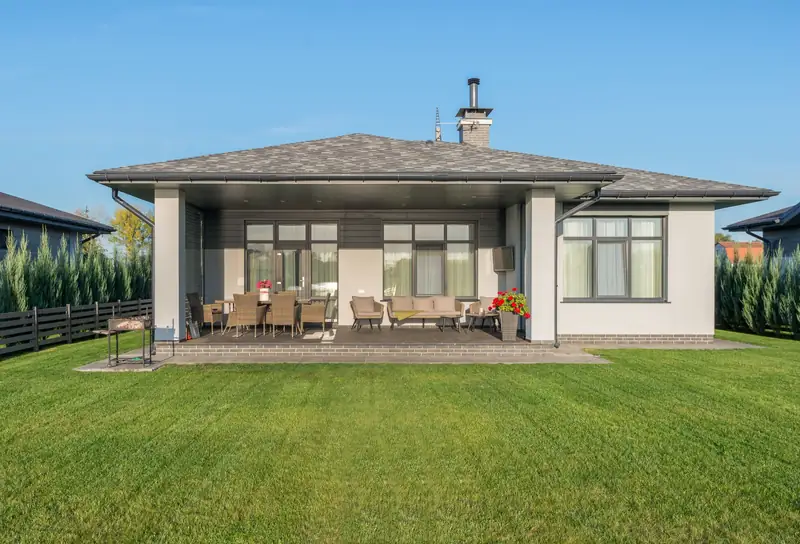
Say a 750 sq ft stretch of side yard and backyard behind a new Parrish build gets turf instead of sod, with no canal or pond touching the property. Pricing runs $7,500 to $18,750 at $10–$25 per sq ft across the full range, or $9,000 to $13,500 inside the typical $12–$18 band once pile height and backing are chosen. Nothing about the lot triggers the 10-foot water-buffer condition here, but the washed-rock base and natural infill rule still apply exactly as they would three streets over on a lot that does touch water.
Why timing matters more for sod than for turf
Through March 31, 2027, Manatee County has every address, new or old, on a single assigned sprinkler day under SWFWMD's Modified Phase III order, running from just after midnight to 4 a.m. or from 8 p.m. to midnight Manatee Modified Phase III order SWFWMD district restrictions. A pallet of fresh sod trying to root under that single weekly window is a genuinely different proposition than turf, which needs no watering day at all once it's down, a gap our turf-versus-sod comparison walks through in more detail. A patch screened from the street by a fence or hedge also picks up cover from most HOA restrictions under 2026's F.S. 720.3045 F.S. 720.3045.
Why compacting the base too hard can be its own mistake
The instinct on a sandy Parrish lot is to compact the base as hard as it'll go, since a firm surface feels like a better foundation for turf. Florida's turf rule caps that instinct: the subgrade can't be compacted tight enough to stop water percolating through it, and a local government may set a specific maximum permeability standard the installed system has to meet. A base compacted past that point behaves almost like the fines problem, water that should move through the soil instead collects at the surface, under the turf, where nobody sees it until the yard starts smelling or feeling spongy underfoot.
Why a backyard putting green needs a flatter, finer base than a lawn panel
A lawn panel can tolerate a little waviness; a putting surface can't. The aggregate base under a backyard green in Parrish gets screeded and compacted in thinner lifts than a standard lawn area, so the finished plane reads true across slopes and breaks instead of showing every ripple in the subgrade. DEP Rule 62-308.100 still governs the material: washed crushed rock or crushed concrete, not limerock with fines, and the state rule caps how tight the subgrade can be compacted so water still percolates through it. A green that's compacted hard enough to putt true but still drains is a balance the base work has to get right the first time.
The extra steps a backyard putting green adds to the schedule
A putting green needs more passes at the base stage than a lawn panel does, since the subgrade gets screeded and checked for a true plane rather than just a consistent compacted depth. Contours, breaks or tiers built into the green are shaped at this stage, before any turf goes down, because they can't be adjusted once the surface is seamed. Cup locations and the fringe transition are marked and cut after the main green panel is placed on a Parrish green, not before, so the hole positions land where the finished surface actually breaks. The fringe area around the cups is seamed and infilled last.
Checking seams and edges after storm season, not just once a year
A seam or edge that was anchored correctly at installation can still work loose over a season of heat cycling, wind and the occasional named storm moving through Parrish, so a walk around the full perimeter and every seam after a significant storm catches a lifted spot before it grows. Re-securing a loose edge early is a small fix; leaving it through another storm turns it into a bigger one, since each gust that gets under an open edge peels it back a little further. This check costs nothing but time and doesn't require pulling up any turf to do it.
Frequently asked questions
Why would a new Parrish homeowner choose turf over sod right after closing?
Mostly timing. Fresh sod has to establish under the county's single weekly sprinkler window through March 2027, while turf is finished the day it's installed and never needs a watering slot at all.
Does a Parrish yard with no canal or pond still have to meet the state's turf setback?
No. The 10-foot buffer in Rule 62-308.100 only kicks in near open water; a landlocked yard has nothing to measure against.
Can crumb rubber be used as turf infill in Parrish?
No. The state rule in effect since May 2026 calls for a natural infill material statewide, ruling out crumb rubber or similar synthetic products on any residential lot regardless of location.
Sources
- Manatee County LDC §1004.2 Access and Drainage Permit
- Manatee — Request a Driveway or Culvert Permit
- Manatee Driveway and Culvert Application (2022)
- Manatee — Inspections Required for Paver Driveways
- Manatee — What Does Not Require a Permit (6-16-26)
- Manatee County LDC §511.16 Swimming Pools, Spas, Screen Enclosures
- Manatee County - Modified Phase III water shortage restrictions
- SWFWMD District Water Restrictions
- FEMA Flood Map Service Center
- NRCS OSD Myakka
- NRCS OSD EauGallie
- NRCS OSD Felda
- Florida Administrative Code — Rule 62-308.100, Synthetic Turf (effective May 19, 2026)
- Florida Statutes §125.572 — synthetic turf on single-family lots
- F.S. 720.3045 (2026) Installation, display, and storage of items
- Census Reporter, Parrish CCD, Manatee County FL (ACS 2020-2024 5-yr, B01003/B25035)
- Wikipedia, Fort Hamer Bridge
- USGS Water Data, Gamble Creek at County Road 675 near Parrish FL (Station 02300017)
- USF Water Atlas, Gamble Creek
- Your Observer, Big projects to keep an eye on in Parrish
Ready for a price on your project?
Request a free estimate
Tell us about the project and we'll call to set up a free site visit.