
How to Clean Pavers Without Ruining the Joints or Sealer
Cleaning pavers safely in Greater Orlando or Sarasota–Manatee comes down to a pressure washer kept around 500 to 1,500 psi, a wide 25-degree fan tip held about 12 inches off the surface, and a mild or paver-safe cleaner instead of an acidic or ammonia-based one. As of October 2026, that combination lifts dirt and algae without stripping a sealer coat or washing sand out of the joints.
By the Opera Concrete & Pavers estimating team · Updated October 1, 2026
How Do You Clean Pavers Without Damaging the Joints or Sealer?
Clean pavers from the top down with the lowest pressure that still lifts the dirt, working in a sweeping motion across the field rather than holding the wand on one spot, and keep the spray off the joints themselves so compacted sand doesn't blow out along with the grime. The two things that actually ruin a paver surface during a routine clean are a nozzle held too close or too narrow, which can etch or pit the unit, and a cleaner that's too harsh for a sealed finish. Both are avoidable with the right technique. Professional cleaning, re-sanding and sealing resets a surface that's already lost sand or faded; this page is the routine upkeep homeowners can do between those visits.
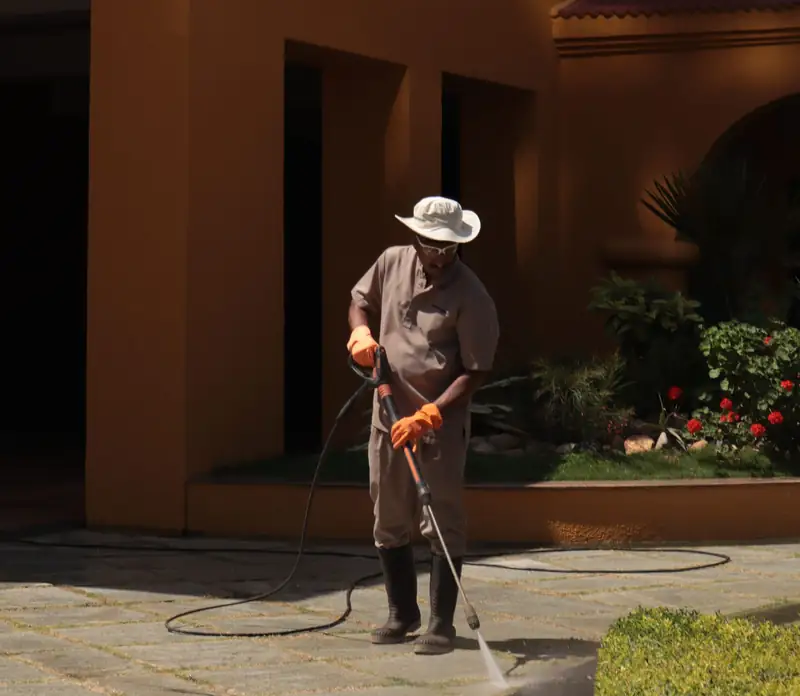
What PSI and Nozzle Should You Use on a Pressure Washer?
Most contractor guidance for interlocking pavers stays well under what a typical consumer pressure washer can put out: roughly 500 to 1,500 psi, through a wide 25-degree fan tip rather than a narrow 0-degree "pencil" nozzle, held about 12 inches off the surface and kept moving (Panda Pavers, pressure washing best practices). A 0-degree tip concentrates all of that force into a dot the size of a coin, which is enough to chip a paver's surface or carve a groove straight through the joint sand in seconds. A sealed surface tolerates a wash a little better than bare concrete pavers do, since the coating takes the brunt of the spray, but the nozzle and distance rules don't change either way. Travertine and shell stone are softer and more porous than concrete pavers, so staying at the low end of that range and testing an inconspicuous corner first matters more there than on a standard driveway paver; travertine pool deck care covers that surface specifically.
What Cleaners Are Safe on Pavers, and Which Ones Ruin a Sealer?
A mild dish soap or a cleaner labeled safe for sealed pavers, worked in with a soft-bristle brush and rinsed well, handles ordinary dirt, pollen and light grime without touching the finish. Acidic cleaners such as muriatic acid, and ammonia-based household cleaners, are the two categories that do real damage, dulling or stripping a sealer coat faster than Florida sun and rain manage on their own. Bleach carries a different risk: it can lighten or blotch some natural stone and concrete-paver colors unevenly, and runoff from a bleach wash kills nearby grass and landscape beds, so it's worth skipping on an everyday clean even where it wouldn't directly harm the paver itself. The one exception is a dedicated efflorescence remover, which is intentionally acidic and belongs only on bare, unsealed pavers before the first sealing visit, never on a surface that's already coated; the white haze on new pavers and concrete explains why that bloom shows up and when it's safe to seal over it.
How Do You Clean a Specific Stain Without Scrubbing It in Deeper?
Scrubbing a stain with whatever's on hand, before identifying what caused it, is how a light mark turns into a permanent one; each common Florida stain has a cause-specific fix that a generic all-purpose cleaner won't match.
| Stain | Likely cause | Where to start |
|---|---|---|
| Orange or brown blotches near a sprinkler head | Iron in well or reclaimed water | Rust and irrigation stains from sprinklers |
| Dark smears where a car parks | Plasticizer migration from a hot tire into a film sealer, or oil soaking into bare concrete | Oil drips and tire marks on driveways |
| Black or green film, worse in shade | Mold and algae feeding on humidity and organic debris | Black mold and green algae on Florida pavers |
| Whitish, chalky haze on a newer surface | Efflorescence, a mineral deposit from inside the paver | the white haze on new pavers |
| Sand missing from joints, ants or weeds present | Lost joint sand creating an open gap | ants and weeds between pavers |
Each of these gets its own write-up because the fix, and what makes it worse, differs by cause.
A Safe DIY Paver Cleaning Routine
This order keeps a routine clean from turning into a repair.
- Clear loose debris first. A broom or leaf blower across the whole field before any water touches it keeps grit from getting dragged across the surface and scratching it.
- Pre-wet and apply a mild cleaner. Wet the pavers, apply a paver-safe or dish-soap solution, and let it sit a few minutes rather than scrubbing it in dry.
- Work stains with a soft brush, not a wire one. A stiff nylon or natural-bristle brush lifts most everyday grime; a wire brush can scratch concrete pavers and abrade a sealer coat.
- Rinse at an angle, never straight down into a joint. Keep the fan nozzle moving and aimed across the field rather than pointed into any single gap between units.
- Let it dry fully before deciding whether it needs more. A paver that still looks dull once it's bone dry, not just damp, is the one that's due for a professional cleaning and reseal rather than another DIY pass.
How Often Should You Clean Pavers in Florida, and When Is It Time to Call a Pro?
A light sweep and rinse every few weeks keeps windblown sand, pollen and organic debris from grinding into the surface underfoot, which does more cumulative wear than any single storm. A deeper wash makes sense once or twice a year, timed for a dry stretch rather than squeezed in ahead of a forecast storm, since joint sand and sealer both need time to dry before the next rain. A few signs mean the job has outgrown a garden hose and a soft brush: sand visibly missing from several joints at once, a paver that rocks underfoot, a stain that didn't respond to a cause-specific cleaner, or water that no longer beads on a surface that used to be sealed. Our paver cleaning, re-sanding and sealing service covers all of that in one visit, and the paver sealing cost guide breaks down what a full service runs by surface size. Polymeric sand vs. regular joint sand is worth reading before a re-sanding visit, since the choice changes how long the joints hold up against the next pressure wash.
Frequently asked questions
Can I pressure wash my pavers myself, or does it need a professional?
A routine pressure wash, at a modest 500 to 1,500 psi through a wide fan nozzle, is a reasonable DIY job for most homeowners. Where it's worth calling a professional instead is a surface that's already lost significant joint sand, has a sunken or rocking paver, or needs stains identified and treated with the right product rather than guessed at, since those issues can get worse under the wrong technique.
What PSI is too high for cleaning pavers?
Pressure well above 1,500 to 2,000 psi, especially through a narrow or 0-degree nozzle, starts to risk etching concrete pavers and stripping or streaking a sealer coat. Most consumer electric pressure washers top out in a range that's safe if the nozzle and distance are right; gas units with higher output need more caution and a wider fan tip.
Should I clean pavers before or after it rains?
Before, if there's a choice. Cleaning ahead of a dry stretch gives the surface time to dry fully before the next storm, which matters most if a sealing visit follows the cleaning, since sealer applied over a damp surface can cloud or fail to bond properly. Cleaning right after rain usually just adds standing water to a job that needed drying time anyway.
Can I use a pressure washer on travertine pavers?
Yes, but at the lower end of the pressure range and with extra caution, since travertine and shell stone are softer and more porous than concrete pavers and scar more easily under too much force or too close a nozzle. A test pass on a hidden corner before washing the whole deck is worth the extra few minutes it takes.
Do I need to reseal every time I clean pavers?
No. A routine clean, sweep and rinse doesn't remove a sound sealer coat, so resealing after every wash isn't necessary. Reseal when the surface itself tells you it's due: water that no longer beads, a color that's gone flat, or a sealer that looks worn in high-traffic areas, not on a fixed cleaning schedule.