
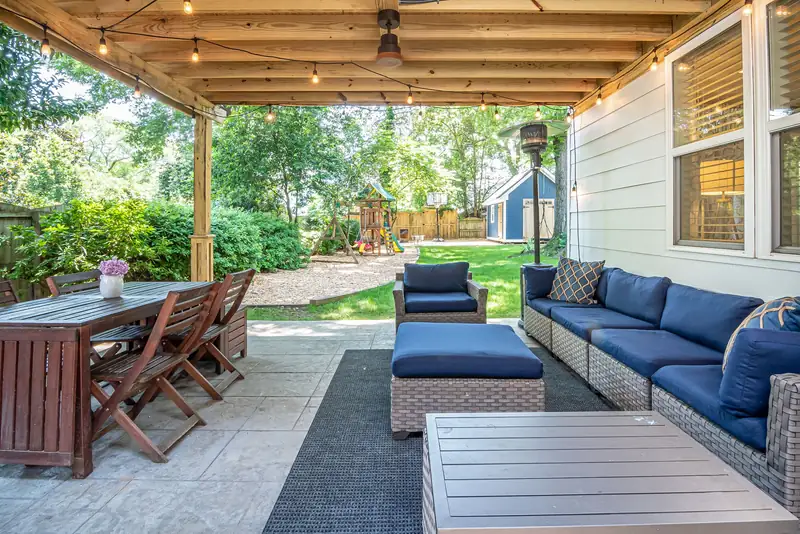
Concrete Patios · Dr. Phillips, FL
Building a Concrete Patio in Dr. Phillips
A concrete patio in Dr. Phillips runs $6–$13 per sq ft installed as of October 2026. The residential streets a few blocks off Restaurant Row's restaurant strip sit on land that was mostly citrus grove before the 1980s and 1990s, so a patio addition here usually means extending a screened lanai's original slab rather than pouring on undisturbed ground.
By the Opera Concrete & Pavers estimating team · Updated October 1, 2026
Get a free estimate
Tell us about the project and we'll call to set up a free site visit.
A patio addition still goes through the county's own permit, not a commercial review
West Sand Lake Road's Restaurant Row sits inside the same unincorporated stretch of Orange County as the homes behind it, so a residential patio addition there answers to the county's Division of Building Safety like any other Dr. Phillips address, regardless of how close it sits to the restaurant corridor (Orange County Division of Building Safety). The county's general rule is explicit that pouring new concrete anywhere on a residential lot triggers a permit, addition or not (Orange County, Do I Need a Permit).
Why a Tie-In Seam Gets an Isolation Joint, Not a Bond
Where a new patio section ties into an existing slab, we use an isolation joint between the two rather than bonding fresh concrete directly to old, since the new pour will shrink as it cures while the existing slab already finished shrinking years ago. On a Dr. Phillips tie-in, that joint, typically a strip of compressible material between the two edges, lets each section expand, contract and settle on its own schedule instead of fighting the other one at a single hard seam. Skipping the isolation joint and pouring tight against the old edge is how a tie-in develops a crack right at the seam within the first year or two.
Extending a 1990s lanai slab, worked out in square feet
Take a Sand Lake Hills lanai pad original to the house, 12 by 10 feet, 120 square feet, getting extended by 180 square feet toward the back fence for an outdoor dining area. At $6–$13 per sq ft installed, that 180 square foot addition runs roughly $1,080 to $2,340, with the existing slab's joint layout checked first so the new pour reads as one surface rather than two mismatched ones.
Grove-era lots often start with a smaller original pour
Much of Dr. Phillips was still citrus grove before Philip Phillips' holdings gave way to Bay Hill, Orange Tree, Sand Lake Hills, Clubhouse Estates and Turkey Lake Park in the decades after (Wikipedia, Dr. Phillips, Florida), and homes from that first wave of building typically shipped with a modest screened lanai pad rather than a full outdoor living space. Extending that original slab means matching its control-joint spacing before the new pour ties in, so the seam doesn't become the first place the patio cracks.
A Downspout Corner Is Where a Base Softens First
A downspout left draining onto one corner of a Dr. Phillips patio's footprint through construction, or relocated incorrectly after the pour, repeatedly saturates that one section of subgrade in a way the rest of the compacted base never experiences. Over a full rainy season, Orlando averages roughly 51.45 inches of rain and Sarasota-Bradenton about 49.05, that uneven wetting is exactly the kind of condition that leads to a soft spot settling unevenly while the rest of the slab stays flat. The crack or dip that shows up a year or two later usually traces straight back to that one downspout, which is why checking gutter discharge points is part of finishing the job, not an afterthought.
Ridge Sand Under a Patio Still Needs Shallow Lifts
The sand ridge soils under parts of Dr. Phillips, Candler, Astatula and Tavares among them, drain so well that the water table can sit more than 80 inches down, yet that same looseness means a compactor's plate can push material sideways instead of locking it in place. Under a patio, where the base only needs to carry foot traffic and outdoor furniture rather than a vehicle, it is still worth wetting loose ridge sand enough to bind it and compacting in shallow lifts rather than one deep pass. Skipping that step on a sandy lot shows up later as a soft spot under one corner of the slab, often near wherever foot traffic concentrates, like a step down from a door.
Why Footer Inspections Happen Before the Slab Pour
Where a Dr. Phillips patio includes footings for a lanai or screen enclosure, those footers get excavated, formed and typically inspected before the surrounding patio base and slab go in, not folded into the same pour as an afterthought. That sequencing matters because a footer inspector needs to see the hole, the forms and any reinforcement before concrete covers them, the same logic that applies to a driveway's base inspection, just for a different structural element. Scheduling the footer work as its own step, ahead of grading the rest of the patio, keeps the whole job from stalling while an inspection gets arranged around concrete that has already been poured over.
Timing New Landscaping Around a New Patio's Watering Exemption
New landscaping planted around a freshly poured Dr. Phillips patio usually qualifies for a temporary watering exemption, daily for the first 30 days and then every other day for the next 30 under the Orlando-area rules, or a similar new-plant schedule under the Sarasota side's current restrictions, rather than the standard once- or twice-a-week limits that apply to established beds. Timing new sod or shrubs around the patio to go in right after the pour, while that exemption window is open, gets new plants established without the irrigation overspray that a fully restricted schedule can leave on fresh concrete edges. Checking which district's rules apply to a specific address is worth doing before the planting date, not after.
Frequently asked questions
Does a patio near Restaurant Row need a different permit than one elsewhere in Dr. Phillips?
No. The homes behind Sand Lake Road's restaurant strip are reviewed by the same county Division of Building Safety as any other unincorporated Dr. Phillips address; proximity to the commercial corridor doesn't change the process.
Why do so many Dr. Phillips patio jobs start as an extension rather than new construction?
A large share of the community's older sections were built in the 1980s and 1990s with a basic screened lanai slab included, so adding on to that original pour is a more common first project than starting from bare ground.
Is a permit required for a small patio extension in Dr. Phillips?
Yes. Orange County's own guidance states that pouring new concrete anywhere on a residential lot requires a permit, regardless of the addition's size.
Sources
- Orange County Division of Building Safety
- Orange County — Do I Need a Permit
- Orange County — Residential Pavers
- Orange County — ROW Utilization Permit directory
- Orange County — Municode Ch. 21 Art. VI ROW Utilization
- Orange County — Residential Lot Grading Policy 2023
- Orange County — A Guide for Residential Plan Approval
- Orange County, Tree Removal Permit
- SJRWMD Watering Restrictions
- Florida Administrative Code — Rule 62-308.100, Synthetic Turf (effective May 19, 2026)
- Florida Statutes §125.572 — synthetic turf on single-family lots
- F.S. 720.3045 (2026) Installation, display, and storage of items
- Florida Senate Interim Report 2011-104 (sinkhole insurance)
- NRCS OSD Candler
- NRCS OSD Tavares
- NRCS OSD Myakka
- NRCS OSD Smyrna
- Wikipedia, Dr. Phillips, Florida
- Census Reporter, Doctor Phillips, FL (ACS 2024 5-yr)
- Florida Neighborhood Realty, Restaurant Row in Dr. Phillips
- MarketConnect Realty, Phillips Landing homes
- FDEP, Outstanding Florida Waters fact sheet
- Point2Homes, Doctor Phillips demographics
Ready for a price on your project?
Request a free estimate
Tell us about the project and we'll call to set up a free site visit.