
Concrete Patios · Windermere, FL
Building a Concrete Patio in Windermere
A concrete patio in Windermere runs $6–$13 per sq ft installed as of October 2026. The town's land development code names patios directly inside its 0.45 impervious surface ratio, so a backyard addition is measured against the same lot-wide cap as the driveway and the pool deck, not against a separate allowance of its own.
By the Opera Concrete & Pavers estimating team · Updated October 1, 2026
Get a free estimate
Tell us about the project and we'll call to set up a free site visit.
A patio is named outright in the 0.45 cap, not folded in by inference
Windermere's code defines impervious surface as including 'buildings, accessory structures, swimming pools, patios, decks, driveways, parking areas,' with the residential maximum set at 0.45 of the lot Windermere LDC, impervious surface. A patio addition behind a house that already carries a full footprint and a screened lanai can run into that ceiling faster than the square footage alone suggests, since every other paved feature on the same lot is drawing from the identical 45 percent. Checking a current survey against that figure before the forms go up is the step that avoids a design that has to shrink mid-project.
Broom, Exposed Aggregate or Stain: Decide Before the Truck Arrives
A broom finish is the standard surface for a Windermere patio: dragging a broom across the concrete while it is still workable leaves a texture that sheds water and resists slipping around a pool or outdoor kitchen. Exposed aggregate washes or blasts the surface cement away so the stone in the mix shows through, changing the look and the grip underfoot, while an integral color or acid stain changes the surface's appearance without changing the mix's strength. All three choices have to be locked in before the pour starts, since a plain broom finish cannot become exposed aggregate or a stained surface afterward without resurfacing the whole patio.
A lanai patio addition, worked out in square feet
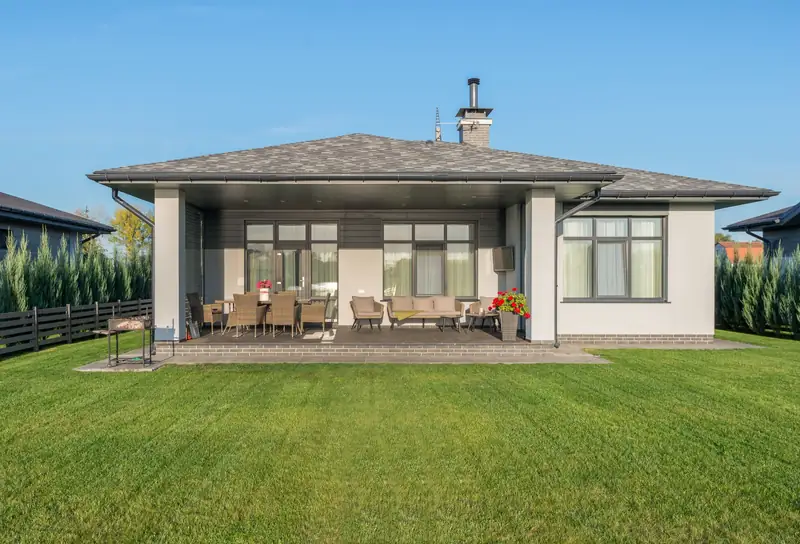
Say a Windermere household extends a screened lanai with a 14 by 25 foot slab, 350 square feet, on a lot where the house and the existing driveway already sit close to the town's 0.45 impervious ceiling. Multiplying that footage by $6–$13 per sq ft installed puts the addition between $2,100 and $4,550, settling nearer $2,450 to $3,500 inside the typical $7–$10 band for a broom finish. Before the forms go up, that 350 square feet gets weighed against the lot's current impervious total instead of priced in isolation, since every other paved feature on the property is drawing from that identical 45 percent.
A low lot near the lakes changes which way the slab has to pitch
A backyard running down toward Lake Down or Lake Butler rarely stays flat all the way to the water, so a patio there needs its slope checked against the yard's real grade rather than assumed level. A concrete pool deck on the same lot works through an identical grading question, since both features are shedding storm runoff toward the same low ground near the shoreline either way.
Why 'No License for Driveways' Doesn't Settle a Patio Job
Florida law bars local governments from requiring a license specifically for driveway installation, but patios are not named in that same carve-out, and whether a given Windermere patio job needs a state-certified contractor can come down to a judgment call about whether it matches the structural masonry scope that covers slabs, footers and walls. Assuming a patio gets the same blanket exemption a driveway does, especially once footings for a lanai are part of the scope, is a mistake that surfaces at permitting, not before. Asking the local building department how it classifies a specific patio scope, rather than guessing from the driveway rule, avoids a permit application that gets kicked back.
Why a Patio's Base Doesn't Need a Driveway's Depth
A patio never carries a car's rolling weight, which is why paver base guidance calls for at least 4 inches of compacted aggregate on well-drained soil under a patio or walkway, against 6 inches under a residential driveway. Florida's residential code still treats the ground under a Windermere patio the same as any other slab on the ground: fill compacted for uniform support, topped with at least 4 inches of clean graded sand, gravel or crushed stone. On flatwoods soils like Myakka, Smyrna or EauGallie, which hold a water table within 18 inches of the surface part of the year, that lighter design load doesn't make the base work optional, only right-sized for what will actually sit on it.
Tying Into an Existing Patio Is a Two-Day Job
Extending an existing Windermere patio is not a single pour: the first day usually goes to breaking out or grinding the old slab's edge so new concrete has a clean, known surface to tie into, and grading the new section's subgrade to match. Only once that transition edge is prepped and the forms are set does the new concrete get ordered for a second visit, rather than trying to do demolition, pour prep and finishing all in one day. Treating the tie-in edge as its own step, rather than rushing straight to the truck, is what keeps the new section's elevation and joint layout lined up with the slab it is meeting.
Checking Where the Downspout Actually Lands Today
A downspout that was aimed fine when the landscaping was last redone can drift or get knocked out of position over the years, and checking where it actually discharges today, not where it was pointed when the Windermere patio was poured, is worth doing at least once a year. A head draining straight onto a compacted patio edge wets that same strip of base every time it rains, which works against the base the same way standing water from poor grading would, just more predictably and over a longer stretch of time. Redirecting a drifted downspout costs almost nothing and protects years of base work that is otherwise sound.
Frequently asked questions
Does a concrete patio count against Windermere's impervious surface limit?
Yes. The town's code names patios directly inside its definition of impervious surface, capped at 0.45 of the lot, alongside the driveway, pool deck and any other paved feature on the property.
Does a patio in Windermere need its own permit from PDCS?
Private-property patio work is reviewed through the town's building office, PDCS, separately from the Right-of-Way Use Application that covers driveway aprons in the public strip.
Why does a patio near Lake Down or Lake Butler need extra grading?
Because the lot isn't flat all the way to the shoreline. A patio near either lake has its pitch checked against the actual grade down to the water so runoff clears the house rather than pooling against it.
Sources
- PDCS — Windermere
- Town of Windermere/PDCS — Right-of-Way Use Application 2.2024
- Town of Windermere — Municode LDC Art. VI §6.01
- Census Bureau PEP, City and Town Population Totals, Vintage 2025 (July 1, 2025)
- Census Reporter, Windermere FL (ACS 2020-2024 5-yr, B25035)
- Orange County Division of Building Safety
- Orange County — Do I Need a Permit
- Orange County — Residential Pavers
- Orange County — A Guide for Residential Plan Approval
- Orange County — Residential Lot Grading Policy 2023
- Orange County, Horizon West
- SJRWMD Watering Restrictions
- Florida Administrative Code — Rule 62-308.100, Synthetic Turf (effective May 19, 2026)
- Florida Statutes §125.572 — synthetic turf on single-family lots
- Florida Senate Interim Report 2011-104 (sinkhole insurance)
- FDEP / Florida Geological Survey Sinkhole FAQ
- Wikipedia, Windermere, Florida
- Wikipedia, Isleworth, Florida
- Wikipedia, Lake Down
- Wikipedia, List of Outstanding Florida Waters
- FDEP, Outstanding Florida Waters fact sheet
- ClickOrlando, a Windermere dirt-road stormwater pilot
- Orange Observer, the cost of keeping Windermere's roads dirty
Ready for a price on your project?
Request a free estimate
Tell us about the project and we'll call to set up a free site visit.