
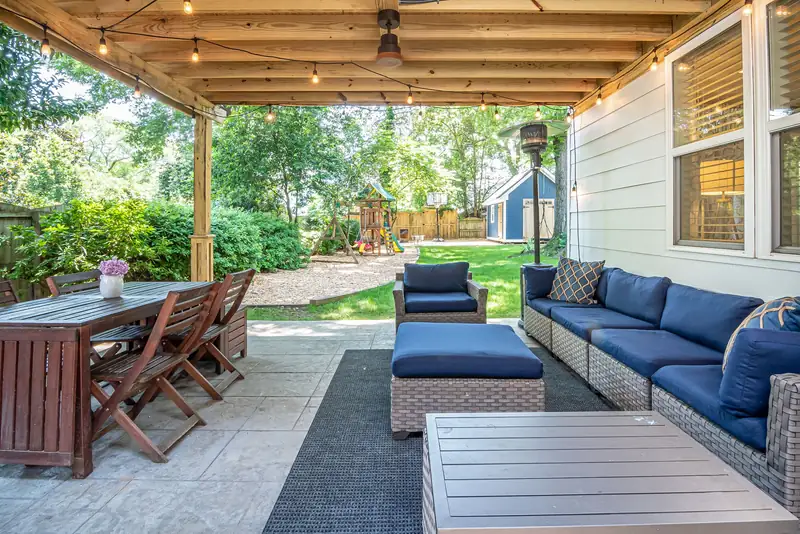
Paver Patios & Walkways · Dr. Phillips, FL
Paver Patios and Walkways Near the Butler Chain
A paver patio in Dr. Phillips runs $10–$17 per sq ft installed as of October 2026. Where a lot in Bay Hill or Phillips Landing backs onto Lake Tibet-Butler, the shoreline isn't an ordinary retention pond; it's part of the Butler Chain, a water body the state has flagged for extra protection.
By the Opera Concrete & Pavers estimating team · Updated October 1, 2026
Get a free estimate
Tell us about the project and we'll call to set up a free site visit.
An Outstanding Florida Water designation sets the backdrop for lakefront grading
The Butler Chain, which forms Dr. Phillips' western edge along Bay Hill and Phillips Landing, carries Florida's Outstanding Florida Water designation, a classification the state applies specifically to keep new development from lowering water quality that's already considered exceptional (FDEP, Outstanding Florida Waters fact sheet). A paver patio graded toward that shoreline needs its slope planned to carry runoff into the yard's existing drainage path rather than straight at the water, a detail that matters less on a patio a half-mile from any lake.
Grading a patio to slope away from the house
Before any base goes in, we set the finished grade so water runs away from the foundation and off the paver field, typically a slope of about 1 inch for every 8 to 10 feet of patio. That matters here: Dr. Phillips sees most of its roughly 50 inches of annual rain packed into a rainy season running from late May into October, often as a hard afternoon downpour rather than a gentle soak. A patio graded flat, or tipped back toward the house, holds that water against the slider or the lanai threshold instead of carrying it into the yard. Getting the slope right in the base is cheaper than fixing it after the pavers are down.
Phillips Landing's build-out years shape what a patio ties into
Phillips Landing's waterfront homes were built mostly between 2003 and 2012 (MarketConnect Realty, Phillips Landing homes), newer construction than much of the rest of Dr. Phillips, so a paver patio project there is more often tying into a deck or pool cage from that same build era than matching decades of prior settling. The county's standard permit for the work still applies regardless of the home's age (Orange County, Do I Need a Permit).
Choosing a pattern for a patio instead of a driveway
A paver pattern on a patio does a different job than the same pattern on a driveway. Herringbone resists the shifting caused by turning tires, a force a dining table and a few chairs never apply, so a Dr. Phillips patio has more room to run a running bond, basketweave or soldier-course border purely for the look homeowners want rather than for load distribution. We still keep cut pavers out of high-wear zones like the path from the back door to the grill, since small cut pieces are the first to work loose regardless of the overall pattern. The edge restraint, not the pattern, carries most of the structural work on a pedestrian surface.
A lakefront paver patio graded away from Lake Tibet-Butler, worked out in square feet
Say a Phillips Landing home adds a 340 square foot paver patio between the pool cage and the seawall, with the grade set to shed water toward a side yard swale instead of the lake itself. At $10–$17 per sq ft installed, that patio runs roughly $4,080 to $5,440, with the drainage plan reviewed before the base goes in given the shoreline's protected status.
Day one on a paver patio job: layout and excavation
We start by staking the patio's actual footprint against the house, string lines pulled tight so the excavation depth accounts for base, bedding sand and paver thickness all at once rather than guessing and correcting later. Excavation on a Dr. Phillips lot usually goes a few inches past the planned finished grade to leave room for that full section, and we haul spoil off site the same day rather than stockpiling it on the lawn, since piled fill kills grass fast in Florida heat. By the end of day one the subgrade is cut, sloped and ready for whatever compaction the soil underneath needs.
Settling versus a sinkhole: telling the difference
A sunken corner of a patio unsettles people faster than it should, and in the vast majority of cases it's ordinary settling, not a sinkhole. True ground-cover collapse is a sudden, dramatic event tied to structural damage, while a paver patio dishing an inch over a year is almost always a base that lost compaction or washed out at an edge. Even counties on the state's higher sinkhole-claim list see settling far more often than an actual collapse, and counties like Sarasota and Manatee aren't on that list at all. A Dr. Phillips homeowner with a low spot should expect a base repair, not a geological survey.
Keeping ants and weeds out of the joints
Compacted, properly topped-off joint sand is the simplest defense against both ants nesting and weed seed germinating between pavers, since loose or thin sand gives both something to work with. A quick sweep to clear organic debris like leaf litter and grass clippings off a Dr. Phillips patio before it decomposes into the joints also removes the organic matter weeds actually need to sprout. For an established ant problem in the joints, treating the colony directly works better than repeatedly re-sanding over it, since the ants will just re-excavate fresh sand the same way they did the old.
Frequently asked questions
Does a lakefront patio in Bay Hill need extra review because of the Butler Chain?
The county's standard permit still applies, but because the Butler Chain carries the state's Outstanding Florida Water designation, the grading plan is worth checking carefully so runoff is directed away from the shoreline rather than into it.
Are Phillips Landing homes newer than the rest of Dr. Phillips?
Many of the waterfront lots there were built between 2003 and 2012, which is newer than a lot of the community's earlier 1980s and 1990s sections, so patio work there more often ties into a deck or pool cage from that later build era.
Does being near a lake change the paver patio permit itself in Dr. Phillips?
Not the permit category. The same county review applies lakefront or not; what changes is how carefully the grading and drainage plan accounts for the nearby shoreline.
Sources
- Orange County Division of Building Safety
- Orange County — Do I Need a Permit
- Orange County — Residential Pavers
- Orange County — ROW Utilization Permit directory
- Orange County — Municode Ch. 21 Art. VI ROW Utilization
- Orange County — Residential Lot Grading Policy 2023
- Orange County — A Guide for Residential Plan Approval
- Orange County, Tree Removal Permit
- SJRWMD Watering Restrictions
- Florida Administrative Code — Rule 62-308.100, Synthetic Turf (effective May 19, 2026)
- Florida Statutes §125.572 — synthetic turf on single-family lots
- F.S. 720.3045 (2026) Installation, display, and storage of items
- Florida Senate Interim Report 2011-104 (sinkhole insurance)
- NRCS OSD Candler
- NRCS OSD Tavares
- NRCS OSD Myakka
- NRCS OSD Smyrna
- Wikipedia, Dr. Phillips, Florida
- Census Reporter, Doctor Phillips, FL (ACS 2024 5-yr)
- Florida Neighborhood Realty, Restaurant Row in Dr. Phillips
- MarketConnect Realty, Phillips Landing homes
- FDEP, Outstanding Florida Waters fact sheet
- Point2Homes, Doctor Phillips demographics
Ready for a price on your project?
Request a free estimate
Tell us about the project and we'll call to set up a free site visit.