
Concrete Driveways · Clermont, FL
Pouring or Replacing a Concrete Driveway in Clermont
Expect $6–$15 per sq ft installed for a new or replacement concrete driveway in Clermont, current Florida pricing heading into late 2026. Inside the city limits, that job goes through a zoning approval rather than a building permit, and in the R-1 zoning that covers most of Clermont's neighborhoods, the driveway shares a 45-percent impervious ceiling with the house itself and the walkways.
By the Opera Concrete & Pavers estimating team · Updated October 1, 2026
Get a free estimate
Tell us about the project and we'll call to set up a free site visit.
A zoning approval, a survey and a $45 fee replace the building permit
Clermont's own permit checklist states that driveway or sidewalk work on private property doesn't need a building permit, only a zoning approval: a notarized application plus a survey showing the lot's dimensions and impervious surface, filed for a flat $45 fee with no inspection required (City of Clermont, Permit Checklists). Call Building Services at 352-241-7315 to confirm which documents a specific lot needs before a crew is scheduled. Work that crosses into the apron at the street is a separate submission: the same $45 fee, but this time with a required city driveway inspection, built to the city's own apron standard rather than left to the installer's judgment (City of Clermont, Applications & Forms).
The 45-percent sub-cap is the number that decides how wide a driveway can go
In Clermont's R-1 district, total impervious coverage on a lot tops out at 55 percent, and within that figure, the principal building plus the driveway and walkways together can't exceed 45 percent (City of Clermont, Municode Ch. 125 Div. 5, R-1). That cap isn't theoretical: in 2026 the City Council denied a homeowner's request to widen a paver driveway on Sky Ridge Road once the plan pushed past the 55 percent impervious limit and crowded a side setback, and set a 90-day window to pull the surface back under the cap (Citizen Portal, Sky Ridge Road paver variance). A survey showing how much of that 45 percent a lot has already used, before a widened driveway or a paver conversion gets designed, saves a redesign later.
What a Flatwoods Lot Means for the Subgrade
Much of Greater Orlando and the Suncoast sits on flatwoods soil series like Myakka, Smyrna, Immokalee, EauGallie and Pomona, which hold a water table within 18 inches of the surface for one to four months most years. That is workable ground for a driveway, but only if we test it before pouring instead of assuming it behaves like the lot next door. Wet, weak native soil will not compact to a stable subgrade no matter how long a plate compactor runs over it. On a Clermont property with this kind of soil, we remove the saturated layer and build up with compacted fill rather than forming directly on soggy ground, which is what keeps the slab from settling unevenly within a few years.
The Paperwork That Happens Before Anyone Touches a Shovel
On a job with a direct contract over $2,500, Florida law requires a Notice of Commencement recorded and posted before work actually starts, with permit cards carrying a warning that skipping this step can mean paying twice. For a Clermont homeowner, part of the process happens at a desk, not on the driveway: paperwork gets filed and the notice gets posted at the job site before the crew mobilizes. It has nothing to do with concrete chemistry and everything to do with protecting the homeowner's right to the property if a dispute ever comes up later.
A driveway replacement and widening, worked out in square feet
A Clermont homeowner widening a cracked 20 by 20 foot driveway into a 20 by 25 foot pour picks up 500 total square feet to fit a second vehicle alongside the garage. Multiplying that by the $6–$15 per sq ft installed range puts the pour somewhere between $3,000 and $7,500, not counting demolition of the old slab. On a lot where the house already sits close to the R-1 district's 45 percent sub-cap, the extra 100 or so square feet from the widening is exactly the kind of addition worth checking against a current survey first, the same math that tripped up the Sky Ridge Road expansion before it ever reached pavers.
Control Joints Aren't Decoration, They're Where We Want It to Crack
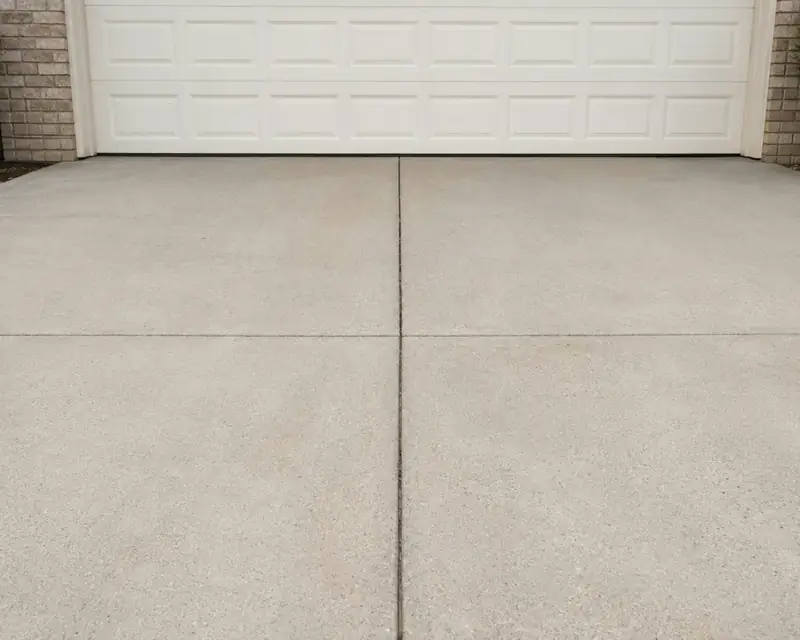
Concrete cracks as it shrinks while curing, and a control joint is cut into the slab specifically to decide where that crack happens instead of leaving it to chance. Industry guidance puts joint spacing at roughly 24 to 36 times the slab's thickness, which works out to about 8 to 12 feet apart on a standard 4-inch driveway, and never past about 15 feet even on a wider Clermont pour. Each panel should come out close to square rather than long and narrow, and the groove itself needs to reach at least a quarter of the slab's depth to actually control the crack instead of just marking the surface.
No License Required Doesn't Mean No Rules Apply
Florida law bars local governments from requiring a license specifically for driveway installation, but that exemption does not do away with permits, and a Clermont jurisdiction can still require one for the work. It is narrower than it sounds at first. Separately, as of the 2026 statutes, an HOA cannot require a building permit to already be issued before it will even review a project, which changes the order some homeowners assume these steps happen in. Treating a license exemption as blanket permission is how a driveway project runs into a stop-work order or an HOA dispute that proper sequencing would have avoided.
Watching for Root Heave Before It Becomes a Crack
A slab edge that starts to tent or lift slightly near a mature oak is an early sign of root growth underneath, worth noticing before it turns into a full crack. Orlando and Winter Park both regulate trees at 6 inches in diameter by ordinance, so the right first move in a Clermont yard with a protected tree nearby is checking the local rule, not reaching for a shovel or a saw. Catching heave early sometimes lets a contractor address the slab section without disturbing the root system at all, where waiting until the crack is severe narrows the options considerably.
Frequently asked questions
Does Clermont require a building permit for a concrete driveway?
Not a building permit, on private property: it's a zoning approval instead, a notarized application and survey for a flat $45 fee with no inspection. A driveway apron that reaches into the city right-of-way carries the same fee but adds a required city inspection.
What is Clermont's impervious surface ratio limit for a driveway?
In the R-1 district, total lot coverage tops out at 55 percent, and the house plus the driveway and walkways together can't pass 45 percent of that. A survey showing how much of that figure a lot has already used comes before a wider driveway is designed.
What happens if a driveway exceeds Clermont's impervious cap?
The city can deny the design, as it did with a 2026 paver driveway expansion on Sky Ridge Road that crossed the 55 percent limit. The homeowner in that case was given 90 days to narrow the surface, swap part of it for a gravel or two-strip section, and resubmit under the cap.
Sources
- City of Clermont — Building Services FAQ
- City of Clermont — Permit Checklists
- City of Clermont — Applications & Forms
- City of Clermont — Permit Type Descriptions
- City of Clermont — Municode Ch. 125 Div. 5 R-1
- City of Clermont, Economic Information
- Census Bureau PEP, City and Town Population Totals, Vintage 2025 (July 1, 2025)
- Census Reporter, Clermont FL (ACS 2020-2024 5-yr, B25035)
- Wikipedia, Sugarloaf Mountain (Florida)
- Lake County — Residential Work Exempt from Permits
- Lake County — Residential Driveway Apron Permit
- Lake County — LDR Appendix A Transportation Standards
- Lake County — Right-of-Way Permit
- Lake County — Building Services
- NRCS OSD Candler
- NRCS OSD Tavares
- NRCS OSD Astatula
- SJRWMD Watering Restrictions
- Florida Administrative Code — Rule 62-308.100, Synthetic Turf (effective May 19, 2026)
- Florida Statutes §125.572 — synthetic turf on single-family lots
- Florida Senate Interim Report 2011-104 (sinkhole insurance)
- Citizen Portal, Clermont City Council meeting summary — Sky Ridge Road paver variance
- Kings Ridge Community, Frequently Asked Questions
Ready for a price on your project?
Request a free estimate
Tell us about the project and we'll call to set up a free site visit.