
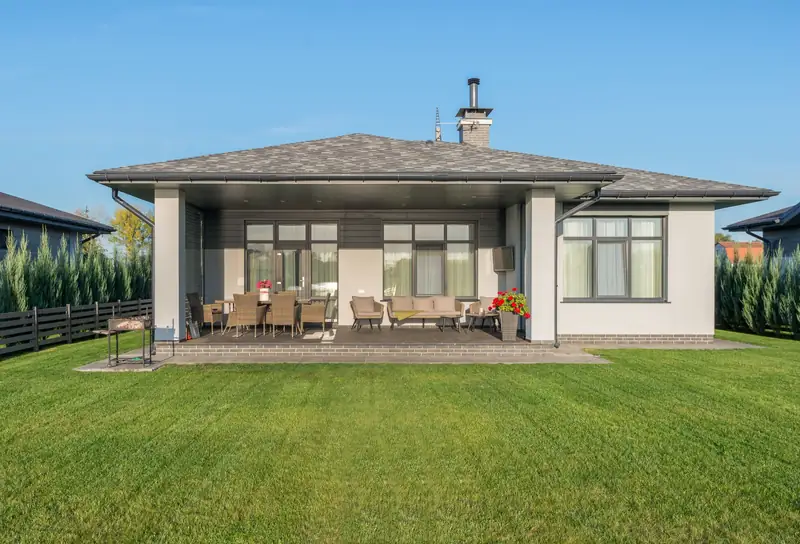
Concrete Patios · Clermont, FL
Building a Concrete Patio in Clermont
Clermont homeowners pricing a concrete patio should plan on $6–$13 per sq ft installed, the Florida range tracked this October 2026. A patio doesn't fall under the city's narrower 45-percent sub-cap for the house, driveway and walkways, but it still counts toward the overall 55-percent impervious ceiling on an R-1 lot, and on a lot that slopes toward Sugarloaf Mountain's hills, grading the patio away from the house matters as much as that math.
By the Opera Concrete & Pavers estimating team · Updated October 1, 2026
Get a free estimate
Tell us about the project and we'll call to set up a free site visit.
A patio counts toward the 55-percent total, even though it skips the 45-percent sub-cap
Clermont's R-1 zoning caps total impervious surface at 55 percent of the lot, and while the city specifically names the building, driveway and walkways under its tighter 45-percent sub-cap, a patio still adds to that broader 55-percent figure once it's poured (City of Clermont, Municode Ch. 125 Div. 5, R-1). Call Building Services at 352-241-7315 to confirm where a new patio's square footage lands against a lot's current survey before the forms go in, particularly on a lot that already carries a pool cage or a wide driveway.
Why a Patio's Base Doesn't Need a Driveway's Depth
A patio never carries a car's rolling weight, which is why paver base guidance calls for at least 4 inches of compacted aggregate on well-drained soil under a patio or walkway, against 6 inches under a residential driveway. Florida's residential code still treats the ground under a Clermont patio the same as any other slab on the ground: fill compacted for uniform support, topped with at least 4 inches of clean graded sand, gravel or crushed stone. On flatwoods soils like Myakka, Smyrna or EauGallie, which hold a water table within 18 inches of the surface part of the year, that lighter design load doesn't make the base work optional, only right-sized for what will actually sit on it.
A sloped lot changes which way a patio has to shed water
Clermont sits near Sugarloaf Mountain, 312 feet above sea level and the highest point on the Florida peninsula, part of a ridge of sand hills that runs through this part of Lake County (Wikipedia, Sugarloaf Mountain (Florida)). A backyard that drops several feet from the house to the rear property line sheds water differently than a flat lot does, so a patio's pitch gets checked against the yard's actual slope rather than assumed flat, especially where a retaining wall or a terraced step already breaks up the grade nearby.
A Lanai's Footers Aren't Sized Like the Slab Around Them
A screen enclosure's support posts need footings sized for that structure, not for the patio slab around them, and several Clermont-area permitting offices draw a formal line between a plain slab and a slab with footers for exactly that reason. The footer's depth and width come from what the enclosure manufacturer or an engineer specifies for the posts, independent of the 4-inch flatwork thickness used for the rest of the patio. Pouring the footers as their own element, rather than trying to build extra thickness into the surrounding slab and call it enough, is what lets the posts carry wind and structural loads the slab itself was never designed to take.
A patio addition on a sloped lot, worked out in square feet
A 15 by 15 foot patio off the back of a Clermont house works out to 225 square feet, on a lot that drops about 3 feet from the rear door to the back fence line. That square footage against the $6–$13 per sq ft installed range prices the pour between roughly $1,350 and $2,925, before a stamped or decorative finish changes the number. Before the forms go up, the crew checks the patio's square footage against the lot's current impervious total and grades the slab to carry water sideways along the slope rather than straight down toward the foundation.
Why a Backyard Pour Sometimes Needs a Pump Truck
A driveway sits right at the street, where a ready-mix truck can back up and chute concrete straight into the forms, but a Clermont patio tucked behind a fence, a pool cage or a narrow side yard often cannot be reached that way at all. On jobs like that, the truck parks at the curb and a concrete pump delivers the mix through a hose to wherever the forms are, a different piece of equipment and a different scheduling conversation than a straightforward driveway pour. Confirming access before pour day, not after the truck is already on site, is what keeps a tight backyard from turning into a delay nobody planned for.
A Tie-In Seam Without a Plan Cracks Worse Than a Joint
A patio extension poured directly against an existing slab without an isolation joint, or without matching the two sections' elevation carefully, does not settle evenly as both pieces age, and the seam between old and new concrete in Clermont often ends up as the single worst crack or trip edge on the whole patio. That kind of damage looks worse, and reads as a more serious problem, than the ordinary hairline cracking a slab develops along its own control joints, even though the underlying cause, two pours moving independently, was foreseeable from the start. Planning the tie-in detail before the second pour, not patching the seam after it cracks, is the cheaper path by a wide margin.
Timing New Landscaping Around a New Patio's Watering Exemption
New landscaping planted around a freshly poured Clermont patio usually qualifies for a temporary watering exemption, daily for the first 30 days and then every other day for the next 30 under the Orlando-area rules, or a similar new-plant schedule under the Sarasota side's current restrictions, rather than the standard once- or twice-a-week limits that apply to established beds. Timing new sod or shrubs around the patio to go in right after the pour, while that exemption window is open, gets new plants established without the irrigation overspray that a fully restricted schedule can leave on fresh concrete edges. Checking which district's rules apply to a specific address is worth doing before the planting date, not after.
Frequently asked questions
Does a concrete patio count toward Clermont's impervious limit?
Yes, it adds to the overall 55 percent impervious ceiling on an R-1 lot, even though the city's tighter 45-percent sub-cap only names the house, driveway and walkways by name. Checking the current survey before pouring avoids a surprise at the zoning review.
Why does a sloped Clermont lot need extra grading for a patio?
Because the yard itself isn't flat. On a lot that drops toward the rear property line, a patio's pitch has to work with that existing slope to carry rainwater sideways rather than toward the house, which takes more site-specific planning than a patio on level ground.
Does a patio in Clermont need a permit or just a zoning approval?
Patio work on private property follows the same path as a driveway: a zoning approval and survey rather than a full building permit, filed with Building Services before the forms go in.
Sources
- City of Clermont — Building Services FAQ
- City of Clermont — Permit Checklists
- City of Clermont — Applications & Forms
- City of Clermont — Permit Type Descriptions
- City of Clermont — Municode Ch. 125 Div. 5 R-1
- City of Clermont, Economic Information
- Census Bureau PEP, City and Town Population Totals, Vintage 2025 (July 1, 2025)
- Census Reporter, Clermont FL (ACS 2020-2024 5-yr, B25035)
- Wikipedia, Sugarloaf Mountain (Florida)
- Lake County — Residential Work Exempt from Permits
- Lake County — Residential Driveway Apron Permit
- Lake County — LDR Appendix A Transportation Standards
- Lake County — Right-of-Way Permit
- Lake County — Building Services
- NRCS OSD Candler
- NRCS OSD Tavares
- NRCS OSD Astatula
- SJRWMD Watering Restrictions
- Florida Administrative Code — Rule 62-308.100, Synthetic Turf (effective May 19, 2026)
- Florida Statutes §125.572 — synthetic turf on single-family lots
- Florida Senate Interim Report 2011-104 (sinkhole insurance)
- Citizen Portal, Clermont City Council meeting summary — Sky Ridge Road paver variance
- Kings Ridge Community, Frequently Asked Questions
Ready for a price on your project?
Request a free estimate
Tell us about the project and we'll call to set up a free site visit.