
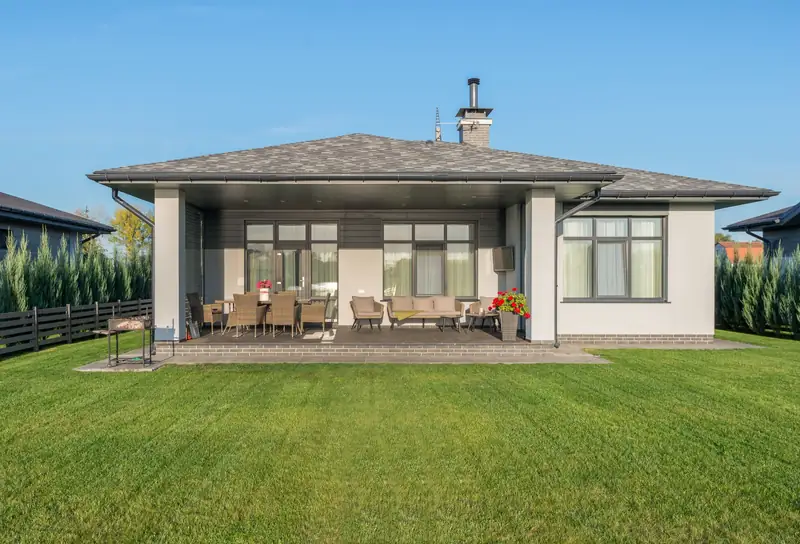
Concrete Patios · Minneola, FL
Concrete Patios for Minneola Homes
A concrete patio in Minneola is priced at $6–$13 per sq ft installed, the current Florida range for late 2026. With the median home here dating to 2007, a good number of Minneola's original patio slabs are old enough now that resurfacing, not a fresh pour, is the more common call.
By the Opera Concrete & Pavers estimating team · Updated October 1, 2026
Get a free estimate
Tell us about the project and we'll call to set up a free site visit.
A median build year nearly two decades old changes the typical request
Minneola's population has nearly doubled since 2020, but the city's median home was still built back in 2007 (Census Bureau PEP, Vintage 2025; Census Reporter, Minneola FL). A patio poured around that time has had close to twenty years of Central Florida sun and summer rain to work on it, long enough for joint sealant to fail and for the surface to start pitting, which is a different conversation than the first-pour work going in on a brand-new lot off Hancock Road.
Patio work still answers to the city's own permit desk
A patio slab, new or replaced, falls under Minneola's Building Department rather than Lake County's office, the same as a driveway (City of Minneola, Building Department). On an older lot, the department may ask to see what's already there before approving a full tear-out, since a patio that's settled unevenly sometimes needs more than a simple resurfacing to fix.
Footers for a Lanai Go in Before the Patio Slab
A lanai or screen enclosure attached to a new patio needs its own footings for the support posts, sized and poured as a separate structural element from the flatwork around them. Several Minneola-area permit categories draw exactly that line: a plain patio slab without footers often clears a lighter review than a slab with footers, because adding footings changes what the job is in the eyes of the permitting office. Practically, that means the footer holes get excavated, formed and poured before the surrounding patio base goes in, not worked in afterward around a finished slab. Treating the footers as an afterthought is how a screen enclosure crew shows up to a patio that isn't ready for posts.
Tying Into an Existing Patio Is a Two-Day Job
Extending an existing Minneola patio is not a single pour: the first day usually goes to breaking out or grinding the old slab's edge so new concrete has a clean, known surface to tie into, and grading the new section's subgrade to match. Only once that transition edge is prepped and the forms are set does the new concrete get ordered for a second visit, rather than trying to do demolition, pour prep and finishing all in one day. Treating the tie-in edge as its own step, rather than rushing straight to the truck, is what keeps the new section's elevation and joint layout lined up with the slab it is meeting.
Resurfacing an aging patio, added up by the square foot
A 16 by 18 foot patio poured around 2007, now showing surface pitting and a hairline crack along one edge, covers 288 square feet. At $6–$13 per sq ft installed, a full replacement lands between $1,728 and $3,744, while a resurfacing overlay on the same footprint typically comes in under that range. Deciding between the two usually comes down to whether the slab underneath has settled enough to need a fresh pour instead of just a new face.
The Vapor Retarder Question an Open-Air Patio Raises
Code requires a 6-mil polyethylene vapor retarder under most slabs on the ground, with exceptions carved out for garages and unheated accessory structures, a rule written mainly with conditioned interior floors in mind. An open-air Minneola patio is not conditioned living space, but it is not quite a garage or accessory structure either, so whether it falls on one side of that exception or the other is worth confirming with the local building official rather than assuming either answer. Getting it wrong in either direction, skipping a retarder code actually requires, or adding one where it serves no purpose, is an easy mistake to avoid by just asking before the pour.
A Downspout Corner Is Where a Base Softens First
A downspout left draining onto one corner of a Minneola patio's footprint through construction, or relocated incorrectly after the pour, repeatedly saturates that one section of subgrade in a way the rest of the compacted base never experiences. Over a full rainy season, Orlando averages roughly 51.45 inches of rain and Sarasota-Bradenton about 49.05, that uneven wetting is exactly the kind of condition that leads to a soft spot settling unevenly while the rest of the slab stays flat. The crack or dip that shows up a year or two later usually traces straight back to that one downspout, which is why checking gutter discharge points is part of finishing the job, not an afterthought.
A Hairline Crack Near a Footer Isn't Automatically a Problem
A hairline crack running along or near a control joint close to a lanai's footer is typically ordinary shrinkage, not a sign the footer itself has a problem, especially on a Minneola patio with a few years on it. What is worth a call is a sudden, visible depression near the footer paired with cracking that reaches toward the structure rather than staying in the patio surface, since that combination looks more like a foundation issue than routine settlement. For most homeowners, the practical rule is the same one that applies to any slab: gradual change over months is normal monitoring, and anything abrupt near a structural element is worth a quicker look.
Frequently asked questions
Is a 2007 concrete patio in Minneola due for replacement?
Not automatically, but it's at an age where pitting, faded color and failing joint sealant are common enough that a close look is worth it before assuming a simple cleaning will fix the surface.
Does Minneola treat patio repairs differently from a new patio permit?
The same Building Department reviews both, though a repair on an older, unevenly settled slab sometimes needs more documentation than a straightforward new pour on a vacant lot.
Are most Minneola patios newer or older than the city's median home age?
It varies by neighborhood. Streets built up before the Turnpike interchange opened in 2017 tend to track closer to the city's 2007 median build year, while subdivisions along the newer corridor skew much younger.
Sources
- Census Bureau PEP, City and Town Population Totals, Vintage 2025 (July 1, 2025)
- SJRWMD Watering Restrictions
- Florida Administrative Code — Rule 62-308.100, Synthetic Turf (effective May 19, 2026)
- Florida Statutes §125.572 — synthetic turf on single-family lots
- Lake County — Residential Work Exempt from Permits
- NRCS OSD Candler
- NRCS OSD Tavares
- City of Minneola, Building Department
- Wikipedia, Minneola, Florida
- Wikipedia, Clermont chain of lakes
- Wikipedia, Florida Turnpike
- Wikipedia, South Lake Trail
- ClickOrlando, How Minneola handles rapid growth without raising taxes
- Census Reporter, Minneola FL (ACS 2020-2024 5-yr, B25035)
Ready for a price on your project?
Request a free estimate
Tell us about the project and we'll call to set up a free site visit.