
Concrete Driveways · Winter Park, FL
Pouring a Concrete Driveway in Winter Park
A concrete driveway in Winter Park runs $6–$15 per sq ft installed as of October 2026. The city reviews it as a building or miscellaneous permit, not a zoning sign-off, and the application has to show the slab keeping its own stormwater on the property rather than sheeting toward the street.
By the Opera Concrete & Pavers estimating team · Updated October 1, 2026
Get a free estimate
Tell us about the project and we'll call to set up a free site visit.
A building permit, filed before the first form goes up
Winter Park's permitting guide lists “driveway” directly among the hard-surface work that needs a building or miscellaneous permit, and it warns that pouring first and applying later triples the fee (City of Winter Park, Do I Need a Permit). The driveway worksheet that goes with the application calls for 2-foot minimum side and rear setbacks, confirmation that runoff from the new slab stays on site, and an inspection call placed 24 hours ahead of the pour (City of Winter Park, Driveway Permit Requirements). A new curb or sidewalk section where the apron meets the street is reviewed separately by the Engineering Division (City of Winter Park, Right of Way FAQ).
Control Joints Aren't Decoration, They're Where We Want It to Crack
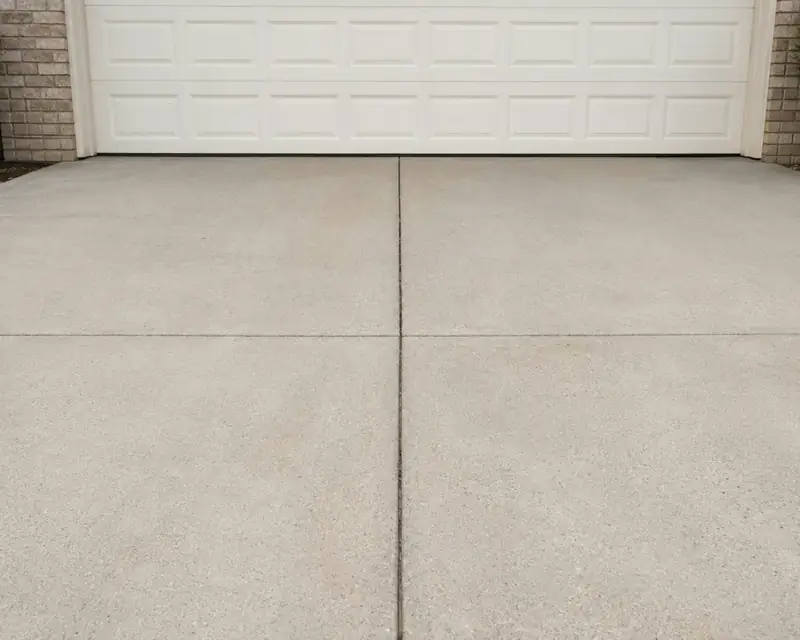
Concrete cracks as it shrinks while curing, and a control joint is cut into the slab specifically to decide where that crack happens instead of leaving it to chance. Industry guidance puts joint spacing at roughly 24 to 36 times the slab's thickness, which works out to about 8 to 12 feet apart on a standard 4-inch driveway, and never past about 15 feet even on a wider Winter Park pour. Each panel should come out close to square rather than long and narrow, and the groove itself needs to reach at least a quarter of the slab's depth to actually control the crack instead of just marking the surface.
A replacement driveway on a 1970s Winter Park lot, worked out in square feet
Say a home built in 1976, the city's own median construction year, replaces a cracked 10 by 20 foot driveway, 200 square feet, with a straight repour at the same footprint. At $6–$15 per sq ft installed, that lands between roughly $1,200 and $3,000 before the permit fee or any apron work in the right-of-way is added. A wider 24 by 24 foot two-car layout, 576 square feet, scales the same per-square-foot range to roughly $3,456 to $8,640, and on a lot already close to the 50 percent coverage ceiling, that extra width is worth checking against the worksheet before the design is finalized.
The §58-65 ceiling applies to the whole lot, not just the driveway
Section 58-65 caps impervious coverage, buildings, patios, decks and drives together, at 50 percent of the entire lot, on top of the separate rule that at least half of the front yard specifically stays pervious and landscaped (City of Winter Park, Sec. 58-65 R-1A districts). That whole-lot framing is broader than a cap written around the front yard alone, so a wide new driveway on a lot that already carries a pool deck or an expanded patio can run into the ceiling faster than the driveway's own footprint would suggest. We run that math on the survey before quoting a width.
What Salt Air Does to a Driveway Near the Coast
A driveway close enough to the Gulf for salt air to reach it ages differently than one further inland: airborne salt speeds up corrosion of any exposed rebar or wire mesh at a crack or an edge, which can widen that crack faster than plain weathering would on its own. Coastal stretches of Sarasota and Manatee also carry FEMA AE and VE flood zone designations in places, which affects more than the driveway but is worth knowing before planning concrete work there. If Winter Park sits in one of those coastal pockets, it is worth asking how that factors into the reinforcement and finish choices for the job.
Ridge Sand Doesn't Behave Like Flatwoods Soil
The sand ridge soils west of Orlando, Candler, Astatula and Tavares, drain almost too well: the water table can sit more than 80 inches down. That sounds like easier ground to build on, but loose, excessively drained sand does not hold a compactor's pass the way a firmer soil does, and it can shift under the plate instead of locking together. On a ridge lot in Winter Park, we wet the material enough to bind it, then compact in shallow lifts rather than one deep pass. Skip that step and the driveway can still settle later, just for the opposite reason a flatwoods lot would.
What a Permit Inspection Actually Checks Before the Pour
Where Winter Park or the county requires a permit for the work, an inspector typically looks at the job before concrete gets poured, not after, checking things like form layout, base material and any reinforcement going in. That review happens at the forming stage, which is one more reason forming and base work take real time rather than getting rushed. A failed or delayed inspection pushes the pour date back, so we schedule the inspection early in the process to protect the rest of the timeline. Jurisdictions differ in exactly what gets checked, so confirming the local process before we mobilize avoids a surprise delay.
What Coastal Salt Air Means for Long-Term Upkeep
A driveway in reach of salt air, which applies to parts of coastal Sarasota and Manatee more than it does to the Orlando side of the service area, benefits from an occasional close look at any exposed rebar or wire mesh near a crack or a chipped edge, since airborne salt speeds up corrosion once metal is exposed to it. In a flood-prone coastal pocket in Winter Park, that inspection matters more than it would further inland, simply because the exposure is more constant. Catching a small chip before salt air reaches the reinforcement underneath costs far less than dealing with a corroded edge later.
Frequently asked questions
Does a straight driveway repour in Winter Park still need a permit?
Yes, the city's guide lists driveway work as a permit item regardless of whether the new slab is wider than the old one, and starting the pour first triples the fee once the permit is filed after the fact.
What setback does a Winter Park driveway need from the side property line?
The driveway worksheet sets a 2-foot minimum side and rear setback. A separate right-of-way application covers the portion of the apron that meets the curb or sidewalk.
Does the whole lot count toward Winter Park's impervious coverage limit, or just the front yard?
Both. Section 58-65 caps the entire lot at 50 percent impervious coverage across buildings, patios, decks and drives together, and layers a second requirement that at least half of the front yard specifically stays pervious.
Sources
- City of Winter Park — Do I Need a Permit
- City of Winter Park — Sec. 58-65 R-1A districts
- City of Winter Park — Driveway Permit Requirements
- City of Winter Park — Setback/Coverage Worksheet
- City of Winter Park — Right of Way FAQ
- City of Winter Park Ordinance 3320-24 (tree preservation)
- City of Winter Park, Tree Removal Permit Application
- SJRWMD Watering Restrictions
- F.S. 720.3045 (2026) Installation, display, and storage of items
- Florida Statutes §125.572 — synthetic turf on single-family lots
- Florida Administrative Code — Rule 62-308.100, Synthetic Turf (effective May 19, 2026)
- Census Reporter, Winter Park, FL (ACS 2024 5-yr)
- Census Reporter API, Winter Park median year structure built (B25035)
- City of Winter Park, Street Brick Policy
Ready for a price on your project?
Request a free estimate
Tell us about the project and we'll call to set up a free site visit.