
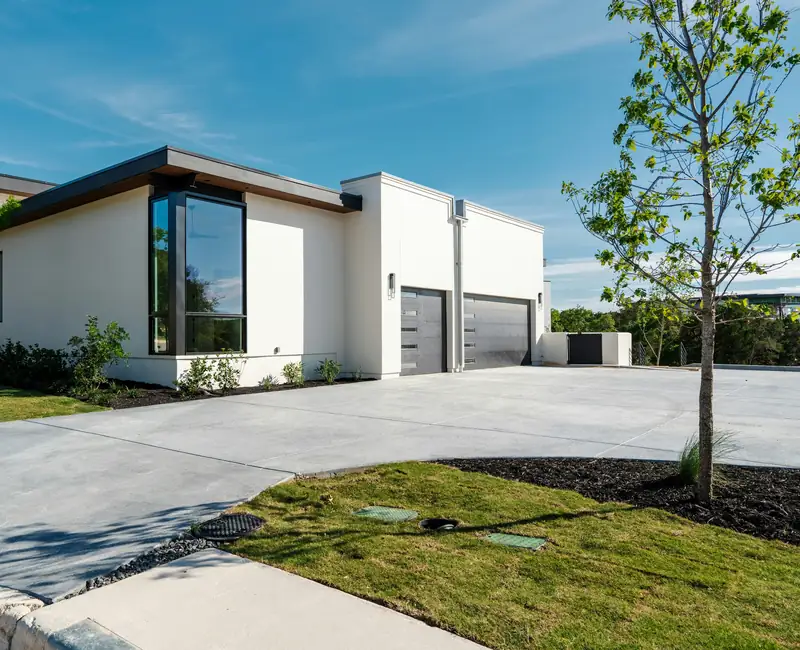
Concrete Driveways · Venice, FL
Pouring or Replacing a Concrete Driveway in Venice
A new or replacement concrete driveway in Venice runs $6–$15 per sq ft installed as of October 2026. Before the apron gets poured, the city's Engineering Department checks it against the Right-of-Way Use Permit the project needs and the number of openings a lot's street frontage allows under LDR §3.1.
By the Opera Concrete & Pavers estimating team · Updated October 1, 2026
Get a free estimate
Tell us about the project and we'll call to set up a free site visit.
A two-opening driveway on a wide Venice lot, worked out in square feet
Say a lot carries 140 feet of street frontage, over the 80-foot line but under 200, qualifying it for two driveway openings under LDR §3.1 rather than one. The main apron to the garage measures 18 by 40 feet, 720 square feet, and a second, narrower opening for a side parking pad adds 10 by 20 feet, 200 square feet, for 920 square feet combined. At $6–$15 per sq ft installed, that full scope runs $5,520 to $13,800, narrowing to roughly $7,360 to $11,040 in the typical $8–$12 band. Both openings still need their own Right-of-Way Use Permit sign-off from Engineering where they cross into the public strip, reviewed together rather than as two separate applications.
Why the opening count depends on your lot's street frontage
Venice's Land Development Regulations cap how many driveway openings a residential lot gets, tied directly to frontage: under 80 feet of frontage allows one opening per street, 80 to 200 feet allows two, and each additional 100 feet past 200 adds one more Venice LDR §3.1. A corner lot or a wide Gulf-side parcel can clear that 80-foot line without much extra width, which matters on a property planning a second apron for a boat trailer or a side motor court rather than widening the one cut it already has. Before pricing a paver driveway alternative or a second concrete opening, we measure the actual frontage against that table rather than assume a figure that applies elsewhere in the unit.
Florida's Minimum Isn't What We Build a Driveway To
Florida's residential code sets 3 1/2 inches as the minimum thickness for a slab on the ground, but that number is written for ordinary floors, not a surface that takes a car's full weight every day. For daily passenger traffic, we build a Venice driveway a full 4 inches thick, poured at a strength in the 3,000 to 4,000 psi range. The extra half inch over the code minimum is not padding: it gives the slab room to carry point loads, like a jack stand or a trailer tongue, without stressing the edge of what code treats as acceptable. Garage floors and carports fall under the same code section but carry their own strength requirement by weathering exposure.
The Right-of-Way Use Permit is separate from the private slab
Anything built or placed in the public right-of-way, the curb cut and apron included, needs its own Right-of-Way Use Permit from the Engineering Department before construction starts, defined in code as authorization required ahead of 'any placement or maintenance of facilities in the public rights-of-way' Venice LDR §9.1. The Engineering Department's permits page describes that review running ahead of the private portion of the job, and the city keeps its own Paver Installation Guidelines for an apron built in pavers rather than poured concrete City of Venice Engineering, Permits, Forms and Applications. The Building Department, at 941-882-7547, takes applications online only; paper submissions aren't accepted Venice Building Division FAQ.
Ridge Sand Doesn't Behave Like Flatwoods Soil
The sand ridge soils west of Orlando, Candler, Astatula and Tavares, drain almost too well: the water table can sit more than 80 inches down. That sounds like easier ground to build on, but loose, excessively drained sand does not hold a compactor's pass the way a firmer soil does, and it can shift under the plate instead of locking together. On a ridge lot in Venice, we wet the material enough to bind it, then compact in shallow lifts rather than one deep pass. Skip that step and the driveway can still settle later, just for the opposite reason a flatwoods lot would.
A Driveway Can Lift Years After the Tree Was Already There
Live oak roots keep growing long after a driveway is poured, and a root that was not a problem at install can lift a slab edge five or ten years later. Orlando, Winter Park and Sarasota all protect larger trees by ordinance, and cutting into a protected root system without a permit can be a code violation even if the tree itself looks like it is just dropping leaves on the driveway. A Venice homeowner who notices a slab edge starting to tent near a mature tree is better off checking the local tree ordinance before calling anyone with a saw, since the fix has to account for the tree's status, not just the concrete.
Working Around Afternoon Storms Instead of Through Them
Central Florida's rainy season typically runs from late May into October, with afternoon storms that build fast on a summer day. Scheduling a Venice pour during that stretch, we plan around the forecast rather than hoping the rain holds off, because fresh concrete caught in a downpour before it sets can wash out the surface finish or dilute the top layer. Morning pours give the slab more time to firm up before a typical afternoon storm arrives. Outside the rainy season, the schedule has more flexibility, but we watch the forecast the same way on every job regardless.
Pressure Washing Without Driving the Sand Out of the Joints
Pressure washing is a normal part of keeping a driveway's finish looking like it did on pour day, and sizing the job is straightforward: a single-car driveway runs roughly 200 to 400 square feet, a two-car 400 to 700, and anything larger climbs from there. What is easy to overlook on a Venice driveway is that a wand aimed straight down a control joint can blast out sand or stabilizer that was doing a job, leaving the joint more open to weeds and debris than it was before. Angling the spray across the joint rather than into it keeps the cleaning from undoing maintenance that was already done.
Frequently asked questions
How many driveway openings can a Venice lot have?
It depends on street frontage under LDR §3.1: one opening for a lot under 80 feet, two for 80 to 200 feet, and one additional opening for every extra 100 feet beyond that, per street the lot fronts.
Does a straight driveway replacement in Venice need a permit?
The portion in the public right-of-way does, under a Right-of-Way Use Permit from the Engineering Department. The city's own online portal is the only way to apply; paper applications aren't accepted.
Can I add a second driveway opening in Venice?
Only if the lot's street frontage supports it under LDR §3.1's table. A lot with at least 80 feet of frontage on a given street qualifies for two openings; narrower lots are limited to one.
Sources
- Venice LDR §9.1 Defined Terms (Right-of-Way Use Permit)
- Venice LDR §3.1 General Development Standards
- Venice LDR §3.8 Fences, Walls, Berms, and Retaining Walls
- Venice Engineering — Permits, Forms and Applications (search excerpt)
- Venice Building Division FAQ (search excerpt)
- Venice Building Permit Guidelines (3rd-party copy, FBC 2014 era)
- Census Bureau PEP, City and Town Population Totals, Vintage 2025 (July 1, 2025)
- Census Reporter, Venice FL (ACS 2020-2024 5-yr, B25035)
- Wikipedia, John Nolen Plan of Venice Historic District
- SWFWMD District Water Restrictions
- FDOT Structures Design Guidelines Vol. 1, §1.3.2 environmental classification
- FEMA - Features of Flood Insurance Rate Maps in Coastal Areas
- FDEP Coastal Construction Control Line Program
- FDEP — Apply for a CCCL permit
- Florida Senate Interim Report 2011-104 (sinkhole insurance)
- Sarasota County Code §124-255 Additional Provisions (culverts)
- Sarasota County Code §124-76 District Development Standards
- Sarasota County Code §22-63 (retaining walls > 4 ft engineered)
- Sarasota County Online Permitting
- Florida Administrative Code — Rule 62-308.100, Synthetic Turf (effective May 19, 2026)
- Florida Statutes §125.572 — synthetic turf on single-family lots
- Venetian Golf & River Club POA, ACC Application
- Sarasota County / USF Water Atlas, Intracoastal Waterway (Venice)
- Sarasota County / USF Water Atlas, Roberts Bay (Venice)
Ready for a price on your project?
Request a free estimate
Tell us about the project and we'll call to set up a free site visit.