
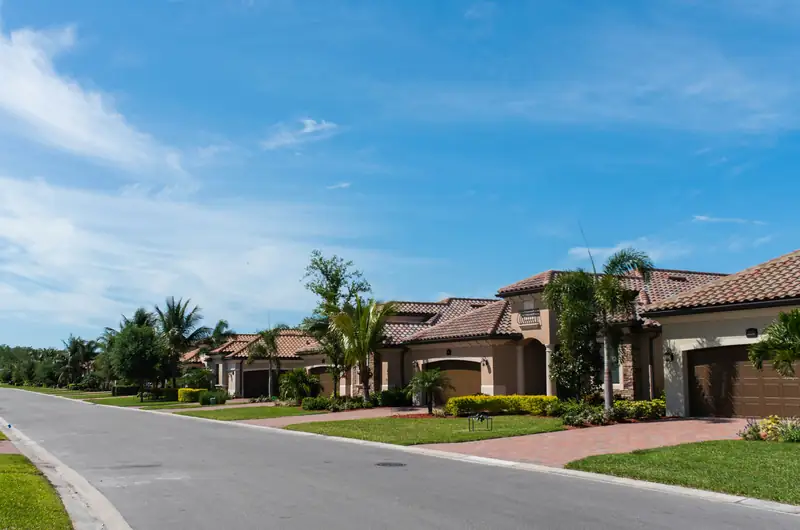
Paver Driveways · Venice, FL
Paver Driveway Installation in Venice
A paver driveway in Venice runs $10–$30 per sq ft installed as of October 2026. Where the apron sits in the public right-of-way, the city treats pavers differently from a fresh concrete pour, with its own Paver Installation Guidelines and a License Agreement hardship exception for pavers laid over an existing slab.
By the Opera Concrete & Pavers estimating team · Updated October 1, 2026
Get a free estimate
Tell us about the project and we'll call to set up a free site visit.
Pavers over an existing apron go through a License Agreement, not a standard permit
The Engineering Department's own guidance singles out paver work as an exception case: a License Agreement is granted for hardship or special circumstances, and the department's own example is 'pavers installed over concrete per city details,' built to the city's separate Paver Installation Guidelines City of Venice Engineering, Permits, Forms and Applications. That matters on a driveway that already has a sound concrete base and just needs a paver finish over it, since the review path differs from a brand-new opening cut into the right-of-way. The underlying Right-of-Way Use Permit requirement still applies to any work in that strip Venice LDR §9.1; the License Agreement is the mechanism for the paver-over-concrete case specifically.
Pavers don't push a lot toward Venice's coverage limit
A paver driveway counts the same as any other paving for Venice's lot-coverage review, but the city's own definition limits that coverage to building footprint and expressly excludes 'paved areas such as parking lots, pools, driveways or pedestrian walkways' Venice LDR §3.1, with no separate residential impervious-surface percentage found in LDR Chapter 87. A homeowner widening a two-car paver driveway to three cars, or adding a side motor court, isn't working against the per-zone paving ceiling some neighboring cities apply, though the frontage-based opening count under §3.1 and the right-of-way review still govern how the apron itself gets built.
What a 98 percent Proctor reading actually means for a Venice driveway
ICPI calls for the compacted subgrade and the aggregate base under a driveway to reach at least 98 percent of standard Proctor density, tested against ASTM D698, with vehicular areas held to the stricter modified Proctor instead. That number comes from a plate compactor working the base in lifts of 4 to 6 inches, not one pass over the whole excavation. Skipping a lift, or compacting a lift that's too thick, is how a base looks finished on the surface and still settles under Venice traffic within a season. The spec also sets a surface tolerance of plus or minus three-eighths of an inch over 10 feet, tighter than it sounds once pavers sit on top of it.
Cutting pavers at the edges takes longer than laying the field
Laying full pavers across the open middle of a driveway moves fast once the bedding sand is screeded flat, course after course set tight against the last one. The borders are a different job: every paver that meets an edge restraint, a garage apron, or an angled property line has to be measured and cut to fit, and a Venice driveway with a curved edge or an angled approach can have more border cuts than field pavers in some sections. That work happens with a wet saw, one piece at a time, which is why a crew's pace visibly slows near the edges of a job even though the material and the base underneath haven't changed at all.
Relaying a concrete apron in pavers, worked out in square feet
Say a 540 square foot two-car driveway has a sound concrete base but a worn, stained surface, and the plan is to relay it in pavers rather than tear it out. At $10–$30 per sq ft installed, that runs $5,400 to $16,200, narrowing to roughly $6,480 to $10,800 in the typical $12–$20 band depending on the paver and whether the old slab needs grinding or patching first. Where the driveway crosses into the right-of-way, the paver-over-concrete scope goes through Engineering's License Agreement process rather than a standard new-opening review, built to the city's Paver Installation Guidelines.
60 mm or 80 mm: picking paver thickness for a driveway
Pavers come in two standard thicknesses for the jobs a homeowner deals with. A 2⅜-inch (60 mm) unit is the standard spec for pedestrian areas and residential driveways under normal car traffic, while a 3⅛-inch (80 mm) unit is reserved for heavier loads, like streets, industrial pavement, or a driveway that regularly carries something bigger than a sedan. The two aren't interchangeable just because they look similar from the sidewalk: the thicker unit spreads load over a larger area and resists point loading better, which matters every time a tire turns in the same spot. For a typical Venice two-car driveway, 60 mm pavers on a properly compacted base is the standard choice; the 80 mm jump is a conversation for anyone with heavier equipment.
What happens when joint sand washes out before it sets
Dry joint sand has to be swept in and compacted to actually lock a paver field together, and until that happens it's just loose material sitting in an eighth-inch gap. A heavy downpour that hits before the compaction pass, a real risk during a wet season that runs roughly late May through mid-October, can wash that sand partway out of a Venice driveway before it ever gets the chance to set. The result isn't just cosmetic: without sand holding the joints, individual pavers can shift and rock under tire loads, which accelerates wear at the exact spots where the sand is thinnest. Re-sanding a washed-out joint is a straightforward fix, but it's one more trip that careful sequencing avoids.
Keeping sprinklers off the paver surface
A sprinkler head aimed across a driveway instead of at the lawn keeps a strip of pavers damp well after the surrounding ground has dried, exactly the kind of shaded, constantly wet condition that lets moss and algae take hold in the joints. It's worth checking head direction and spray pattern on any Venice property where a zone borders the driveway, particularly since both the Orlando-area and Suncoast water districts restrict watering to specific days and hours, so a misaimed head is often running on a schedule nobody is watching closely. Redirecting or swapping the head is a small fix compared with the joint maintenance a chronically wet strip ends up needing.
Frequently asked questions
Can I put pavers over my existing Venice driveway without tearing it out?
Often, yes, through the Engineering Department's License Agreement process for hardship or special cases, which names pavers installed over concrete as its own example, built to the city's Paver Installation Guidelines.
Does a paver driveway count differently than concrete for Venice's lot coverage?
No. The city's lot-coverage definition excludes paved areas, driveways and pedestrian walkways from the count either way, since coverage is measured by building footprint only, not by total paving.
Do I still need the frontage-based opening count for a paver driveway in Venice?
Yes. LDR §3.1's table on driveway openings per street frontage applies regardless of whether the surface is concrete or pavers.
Sources
- Venice LDR §9.1 Defined Terms (Right-of-Way Use Permit)
- Venice LDR §3.1 General Development Standards
- Venice LDR §3.8 Fences, Walls, Berms, and Retaining Walls
- Venice Engineering — Permits, Forms and Applications (search excerpt)
- Venice Building Division FAQ (search excerpt)
- Venice Building Permit Guidelines (3rd-party copy, FBC 2014 era)
- Census Bureau PEP, City and Town Population Totals, Vintage 2025 (July 1, 2025)
- Census Reporter, Venice FL (ACS 2020-2024 5-yr, B25035)
- Wikipedia, John Nolen Plan of Venice Historic District
- SWFWMD District Water Restrictions
- FDOT Structures Design Guidelines Vol. 1, §1.3.2 environmental classification
- FEMA - Features of Flood Insurance Rate Maps in Coastal Areas
- FDEP Coastal Construction Control Line Program
- FDEP — Apply for a CCCL permit
- Florida Senate Interim Report 2011-104 (sinkhole insurance)
- Sarasota County Code §124-255 Additional Provisions (culverts)
- Sarasota County Code §124-76 District Development Standards
- Sarasota County Code §22-63 (retaining walls > 4 ft engineered)
- Sarasota County Online Permitting
- Florida Administrative Code — Rule 62-308.100, Synthetic Turf (effective May 19, 2026)
- Florida Statutes §125.572 — synthetic turf on single-family lots
- Venetian Golf & River Club POA, ACC Application
- Sarasota County / USF Water Atlas, Intracoastal Waterway (Venice)
- Sarasota County / USF Water Atlas, Roberts Bay (Venice)
Ready for a price on your project?
Request a free estimate
Tell us about the project and we'll call to set up a free site visit.