
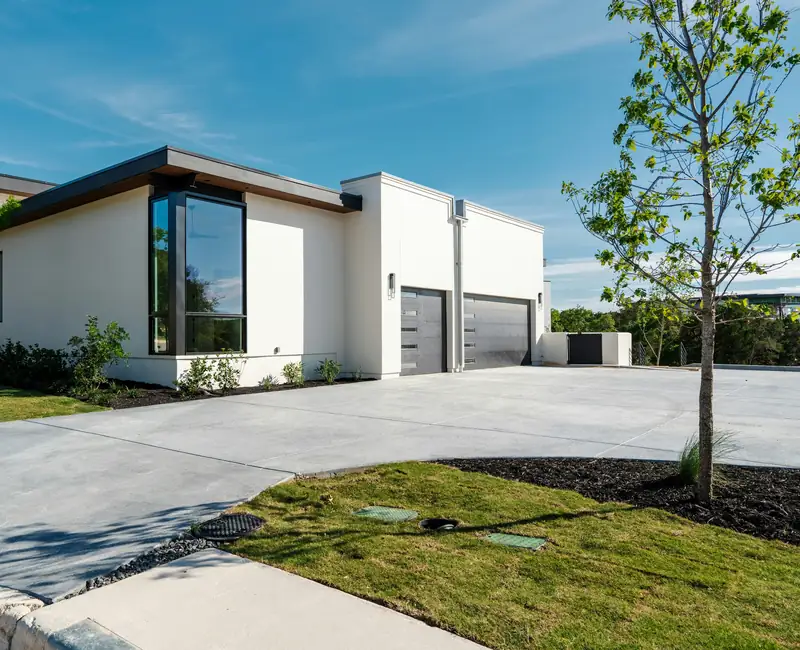
Concrete Driveways · Lake Nona, FL
Pouring a Concrete Driveway in Lake Nona
A concrete driveway in Lake Nona runs $6–$15 per sq ft installed as of October 2026, the same Orlando-wide market range. Because Lake Nona sits inside Orlando, the driveway goes through the city's engineering permit, and because much of the community is recently built, the subgrade under a new pour is often engineered fill rather than native flatwoods soil.
By the Opera Concrete & Pavers estimating team · Updated October 1, 2026
Get a free estimate
Tell us about the project and we'll call to set up a free site visit.
An engineering permit, with a couple of clauses that matter here specifically
Orlando's Permitting Services Division reviews a Lake Nona driveway exactly the way it reviews one anywhere else in the city, as an engineering permit rather than a building permit (City of Orlando, Apply for an Engineering Permit). Two clauses in the city's construction manual come up more often on a newer grid of streets like this one: no single-family driveway can sit inside an intersection's radius return, and a curb opening can't exceed the driveway's own width by more than 3 feet on either side (City of Orlando, Engineering Standards Manual §8.11). The 2026 state exemption for work under $7,500 doesn't reach this engineering review (the HB 803 exemption guide).
Ridge Sand Doesn't Behave Like Flatwoods Soil
The sand ridge soils west of Orlando, Candler, Astatula and Tavares, drain almost too well: the water table can sit more than 80 inches down. That sounds like easier ground to build on, but loose, excessively drained sand does not hold a compactor's pass the way a firmer soil does, and it can shift under the plate instead of locking together. On a ridge lot in Lake Nona, we wet the material enough to bind it, then compact in shallow lifts rather than one deep pass. Skip that step and the driveway can still settle later, just for the opposite reason a flatwoods lot would.
New-construction lots mean a different subgrade conversation
A Lake Nona address built within the past few years often sits on ground that was graded, filled and compacted as part of a CDD-funded subdivision build-out rather than left as undisturbed native soil (ClickOrlando, Dowden Central CDD approval). That changes the pre-pour conversation: on an older Orlando lot the question is usually how deep the original fill goes, while on a freshly platted Lake Nona street it's whether the engineered base under the road extends far enough into the driveway apron to be relied on, or whether the driveway's own subgrade needs its own compaction pass.
The Plastic Sheet Most People Never See Under a Slab
Code calls for a 6-mil polyethylene vapor retarder under most slabs on the ground, lapped at least 6 inches at the seams, before the concrete goes down. It is one of the few parts of a driveway build nobody sees again once the pour is finished, but it keeps ground moisture from migrating up through the slab over time. Garages and unheated accessory structures get some exceptions to this rule, so what is required under a Lake Nona driveway next to an attached garage can differ from what is required under a detached slab a few feet away. It is a small material cost for a step that is hard to add back in later.
A new-construction driveway in a Lake Nona village, worked out in square feet
Say a newly built single-family home in one of Lake Nona's newer phases pours a 20 by 20 foot driveway, 400 square feet, as part of the original build rather than a later replacement. At $6–$15 per sq ft installed, that lands between roughly $2,400 and $6,000 before any builder-grade upgrade such as a broom border or a wider apron at the street. On a corner lot near one of the community's newer intersections, the driveway's placement also has to clear the radius-return rule before the layout is finalized.
Curing Starts the Moment the Finish Work Ends
The pour is the visible part of the job, but curing is where the slab actually gains its strength. Once finishing is done, the surface needs to stay moist, whether through a curing compound or wet curing, for at least 3 days, and a white-pigmented compound helps by reflecting heat rather than absorbing it. A Lake Nona driveway poured in summer loses moisture faster than one poured in a mild week, so we adjust the curing method to the weather instead of using the same approach year-round. Rushing this step does not save any real time and is the fastest way to weaken a slab that looked fine on pour day.
No License Required Doesn't Mean No Rules Apply
Florida law bars local governments from requiring a license specifically for driveway installation, but that exemption does not do away with permits, and a Lake Nona jurisdiction can still require one for the work. It is narrower than it sounds at first. Separately, as of the 2026 statutes, an HOA cannot require a building permit to already be issued before it will even review a project, which changes the order some homeowners assume these steps happen in. Treating a license exemption as blanket permission is how a driveway project runs into a stop-work order or an HOA dispute that proper sequencing would have avoided.
A Driveway on Flatwoods Soil Needs Drainage Checked Every Wet Season
Flatwoods soils like Myakka and Smyrna hold water close to the surface for months at a stretch during the wetter part of the year, which means a driveway built on that kind of lot depends on its original grading continuing to shed water the way it was designed to. Mulch beds, new landscaping or a few years of settling can quietly change how water moves across a Lake Nona yard and start directing runoff back toward the slab instead of away from it. Checking that the grading still slopes the right way each time the yard changes is cheap insurance against the kind of slow saturation that got the base into trouble in the first place.
Frequently asked questions
Does Lake Nona have its own driveway permit process separate from Orlando?
No. Lake Nona sits inside the Orlando city limits, so the same engineering permit and Permitting Services Division that reviews a driveway anywhere else in the city reviews one here.
Why would a new Lake Nona driveway need extra subgrade work if the lot was just built?
Recently platted streets sit on fill and compaction work tied to the subdivision's own build-out, which doesn't always extend fully into the driveway apron itself, so a site check confirms the base under the slab is compacted on its own before pouring.
Can a driveway be placed anywhere on a Lake Nona corner lot?
Not quite. Orlando's construction manual bars a single-family driveway from sitting inside an intersection's radius return, a rule that comes up more often on Lake Nona's newer corner lots than on older, established blocks.
Sources
- City of Orlando — Apply for an Engineering Permit
- City of Orlando — Engineering Standards Manual, 5th ed.
- City of Orlando — Residential Permitting Requirements
- City of Orlando — HB803 Residential Building Permit Exemption Guide
- City of Orlando — Apply for a Right-of-Way Permit
- Lake Nona, About
- Laureate Park Master Association FAQ
- Florida Administrative Code — Rule 62-308.100, Synthetic Turf (effective May 19, 2026)
- Florida Statutes §125.572 — synthetic turf on single-family lots
- F.S. 720.3045 (2026) Installation, display, and storage of items
- SJRWMD Watering Restrictions
- NorthLake Park at Lake Nona, Community Portal (ARC approval)
- Lake Nona, NorthLake Park neighborhood page
- Orange County Water Atlas, Lake Nona
- ClickOrlando, Dowden Central CDD approval
- Wikipedia, Lake Nona, Orlando, Florida
Ready for a price on your project?
Request a free estimate
Tell us about the project and we'll call to set up a free site visit.