
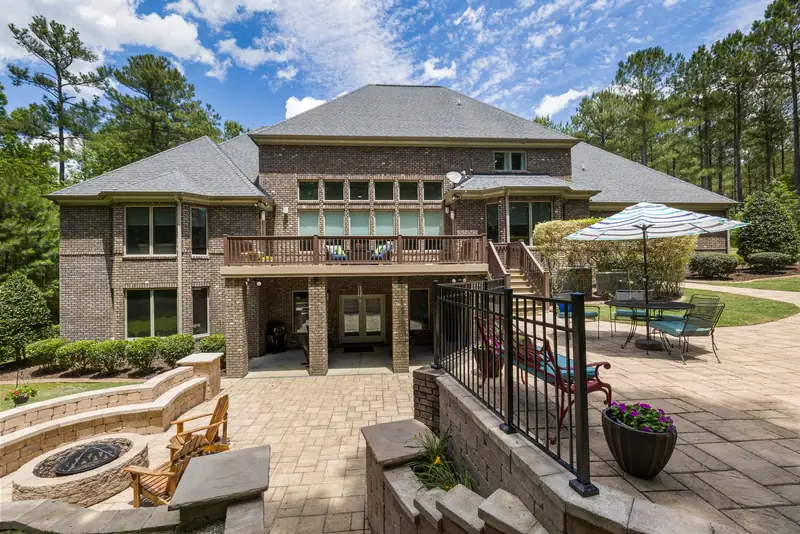
Paver Patios & Walkways · Altamonte Springs, FL
Paver Patios and Walkways for Altamonte Springs Yards
A paver patio in Altamonte Springs runs $10–$17 per sq ft installed as of October 2026. Most of the city sits on sandy, well-drained ridge soil above the 100-year flood plain, with the main exception running along the Little Wekiva River, where erosion has become serious enough for a standing state flood management plan.
By the Opera Concrete & Pavers estimating team · Updated October 1, 2026
Get a free estimate
Tell us about the project and we'll call to set up a free site visit.
Ridge soil drains fast almost everywhere except the river corridor
The city's own land-use plan describes its natural ground as sandy and well drained, with “marginally undulating” topography left over from a landscape once covered in citrus groves (City of Altamonte Springs, Future Land Use Element DIA). That drains faster than the flatwoods soil common elsewhere in Seminole County, which is good news for a paver patio's base, though a lot backing onto the Little Wekiva River corridor is a different story, since the riverbanks there have seen erosion serious enough that SJRWMD maintains a dedicated Little Wekiva River Flood Management Plan.
The patio permit still runs through the drainage-plan checklist
A paver patio falls under the same Building Permit Application Checklist a concrete one does, with a drainage plan required whenever the project adds impervious area (City of Altamonte Springs, Building Permit Application and Checklist). On a lot near the Little Wekiva, that drainage plan carries more weight than it would farther from the river, since it has to account for how the new paved area interacts with ground that's already prone to erosion nearby.
Base work where a screen enclosure sits on the patio
When a pool cage or screen enclosure shares the same patio, its footers are a different animal from the paver field around them. Enclosure posts typically land on isolated concrete footers set below the compacted base, not on the paver base itself, so the paver courses can settle or be lifted for maintenance without disturbing the structure overhead. On a Altamonte Springs job we lay out those footer locations before compacting the surrounding base, because cutting an isolated footing through finished aggregate later wastes a day and leaves a patch that compacts differently than the base around it. Coordinating the two scopes up front keeps the whole patio behaving as one surface.
The last day: inspection, cleanup and the final walk
If the jurisdiction reviewing the job requires a permit or inspection for the patio, that typically happens after base compaction and before pavers are set, so the base stays visible for the inspector. Once joints are swept and compacted, we do a final walk across the whole surface checking for any paver that rocks or sits proud, resetting it in its sand bed before calling the job finished rather than after. On a Altamonte Springs patio, cleanup also means clearing excess joint sand and any base material off adjacent grass or planting beds, since leftover aggregate smothers turf within a couple of weeks.
A paver patio set back from the Little Wekiva River corridor
A home backing onto a greenbelt along the Little Wekiva adds a 240 sq ft paver patio well clear of the riverbank itself, on sandy soil that drains quickly after rain. Figured at $10–$17 per sq ft installed, the job runs about $2,880 to $3,840 depending on the paver pattern. Because the lot sits near, but not inside, the areas the city flags for flood-plain structures, the drainage plan submitted with the permit focuses mainly on keeping new runoff from adding to the erosion already documented along that stretch of riverbank.
Building a walkway or a run of stepping pavers
A connecting walkway, say from a Altamonte Springs driveway to the front porch, usually runs 3 to 4 feet wide, narrow enough that a full paver base and bedding sand bed still apply but the material list shrinks fast. Large-format stepping pavers set individually in a lawn, spaced by a comfortable stride, are a lighter-duty option for an informal path across a side yard, each unit bedded in its own patch of sand and gravel rather than a continuous paver field. The two approaches use the same base principles at different scales, and mixing them, a formal paver walkway near the house that transitions to stepping pavers farther out, is a common way to control cost over a longer path.
What happens when the base is skipped or under-compacted
The most common failure on a paver patio isn't a cracked unit, it's a low spot where the base underneath was never compacted to spec. On flatwoods soils with a seasonal high water table within 18 inches of the surface, an under-compacted base settles unevenly as the ground saturates and dries through the year, and the pavers simply follow it down. A Altamonte Springs patio built on a thin or skipped base might look fine the day it's finished and show the first dish-shaped low spot after one full rainy season. There's no fix for this short of pulling the affected pavers, correcting the base and resetting them.
Keeping ants and weeds out of the joints
Compacted, properly topped-off joint sand is the simplest defense against both ants nesting and weed seed germinating between pavers, since loose or thin sand gives both something to work with. A quick sweep to clear organic debris like leaf litter and grass clippings off a Altamonte Springs patio before it decomposes into the joints also removes the organic matter weeds actually need to sprout. For an established ant problem in the joints, treating the colony directly works better than repeatedly re-sanding over it, since the ants will just re-excavate fresh sand the same way they did the old.
Frequently asked questions
Does Altamonte Springs' soil drain well for a paver patio base?
Generally, yes. The city's own planning documents describe its natural soil as sandy and well drained outside the Little Wekiva River corridor, which is better-draining ground than the flatwoods soil common across much of the rest of Seminole County.
Is there a flood plan specific to the Little Wekiva River in Altamonte Springs?
Yes. The St. Johns River Water Management District maintains a Little Wekiva River Flood Management Plan addressing erosion along the riverbanks, which the city coordinates with on nearby projects.
Does a paver patio near the Little Wekiva need extra permitting?
Not a separate permit, but the drainage plan required for any project adding impervious area gets more scrutiny on a lot near documented erosion than it would on one farther from the river.
Sources
- Census Bureau PEP, City and Town Population Totals, Vintage 2025 (July 1, 2025)
- SJRWMD Watering Restrictions
- Florida Dept. of State - State Soil
- Florida Administrative Code — Rule 62-308.100, Synthetic Turf (effective May 19, 2026)
- Florida Statutes §125.572 — synthetic turf on single-family lots
- City of Altamonte Springs, Driveway Construction Permit Application (rev. 3/1/2024)
- City of Altamonte Springs, Building Permit Application and Checklist (rev. 3/1/2024)
- City of Altamonte Springs Land Development Code §3.7.8, R-1 Lot Coverage (via Zoneomics)
- City of Altamonte Springs, Future Land Use Element, Data Inventory and Analysis, City Plan 2030
- City of Altamonte Springs, Project APRICOT
- Wikipedia, Altamonte Springs, Florida
- Census Reporter, Altamonte Springs, FL (ACS 2024 5-yr, B25035)
Ready for a price on your project?
Request a free estimate
Tell us about the project and we'll call to set up a free site visit.