
Paver Patios & Walkways · Osprey, FL
Paver Patios and Walkways Near Osprey
A paver patio near Osprey runs $10–$17 per sq ft installed as of October 2026. On a lot reaching toward Little Sarasota Bay, a path's route matters as much as its square footage, since a paved surface can't cross a drainage easement on its way to the water.
By the Opera Concrete & Pavers estimating team · Updated October 1, 2026
Get a free estimate
Tell us about the project and we'll call to set up a free site visit.
A paver patio and path near Little Sarasota Bay, worked out in square feet
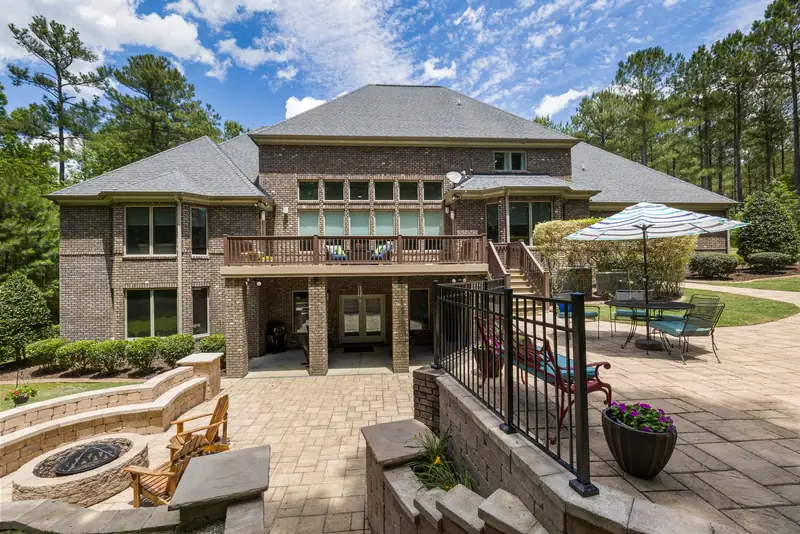
A 310 square foot paver patio and connecting path goes in behind an Osprey home a few lots from Little Sarasota Bay, routed to avoid a drainage easement that runs along the rear property line. At $10–$17 per sq ft installed, that prices between $3,100 and $5,270, narrowing to roughly $3,720 to $4,960 inside the typical $12–$16 band. Keeping the layout clear of the easement adds a bend to the path's route rather than a straight shot, a tradeoff the county's own rule makes non-negotiable on this particular lot.
Routing a walkway around the easement, not through it
Sarasota County's culvert code bars any walkway, driveway or other paved surface from occupying a drainage easement outright Sarasota County Code §124-255, a rule that comes up on an Osprey lot where the shortest line from the patio to the dock crosses exactly that kind of easement. A path that stays on private ground skips the county's Right-of-Way Use Permit review, but one reaching toward the street doesn't Sarasota County UDC §124-48.
Why edge restraint isn't optional on a patio
Every paver field needs a continuous edge restraint around the perimeter and anywhere the paving material changes, whether that's plastic, aluminum or steel. The spikes that hold it down drive into the compacted aggregate base, not into the native soil beneath it, since soil alone won't hold a spike against the outward push of thousands of interlocking pavers. A strip of plastic landscape edging meant for a flower bed is not a substitute; it isn't rated for that job. On a Osprey patio bordered by turf or mulch, a proper restraint is what keeps the outer courses from creeping outward season after season until the edge joints open up.
Where the new paving lands on the coverage ledger
A paver patio on a standard RSF lot doesn't touch the county's 35 percent building-coverage cap, since that figure counts the house alone Sarasota County Code §124-76. On a pre-1975 platted parcel, the same square footage counts directly toward the stricter 50 percent impervious limit instead Sarasota County Code §124-283. A concrete walkway on that older lot runs into the identical ceiling.
Why ridge sand doesn't get a free pass on base work
On the sandy ridge soils found west of Orlando, in series like Candler, Astatula and Tavares, water drains so fast that the ground rarely holds a puddle, and some installers assume that means the base can be thinner. It can't. Florida's residential code still limits how deep fill can go without engineering review: no more than 24 inches of clean sand or gravel, or 8 inches of earth fill. Excessively drained sand also shifts underfoot more than people expect once pavers carry chairs and daily foot traffic, so a Osprey patio on ridge sand still gets full-depth, properly compacted aggregate rather than a thin leveling layer over native sand.
Settling versus a sinkhole: telling the difference
A sunken corner of a patio unsettles people faster than it should, and in the vast majority of cases it's ordinary settling, not a sinkhole. True ground-cover collapse is a sudden, dramatic event tied to structural damage, while a paver patio dishing an inch over a year is almost always a base that lost compaction or washed out at an edge. Even counties on the state's higher sinkhole-claim list see settling far more often than an actual collapse, and counties like Sarasota and Manatee aren't on that list at all. A Osprey homeowner with a low spot should expect a base repair, not a geological survey.
Locking the joints and setting the edge restraint
With the field laid, we sweep dry joint sand across the surface and run a plate compactor fitted with a protective pad over the whole patio two or three passes, which both seats the pavers into the bedding sand and drives sand up into the joints. Edge restraint goes in along the perimeter before or during this step, spiked into the base rather than the sand. A final sweep clears excess sand off the paver faces so it doesn't haze in the Florida sun. On a Osprey job, this compaction and joint-sand stage is usually the last full working day before cleanup.
When to reseal a paver patio
ICPI's own technical guidance gives no fixed resealing interval for paver sealers, saying only that they need reapplication after a period of wear and weather and that acrylic sealers generally last a few years before a recoat is due. Rather than sealing on a calendar, the better signal on a Osprey patio is watching the surface: water that used to bead now soaks in, or the color has gone flat and faded, both mean the old coat has worn through. A paver patio that's never been sealed can go years without a problem, since sealing is about appearance and stain resistance more than structural need.
Frequently asked questions
Can a paver path cross a drainage easement on an Osprey lot?
No. County code specifically bars any paved surface, a walkway included, from sitting inside a drainage easement, which sometimes means routing the path around it rather than straight through.
Does a paver patio need a right-of-way permit in Osprey?
Only the portion that reaches into the county's right-of-way does. A patio or walkway kept entirely on private ground doesn't trigger that particular review.
Does a paver patio count against an older Osprey lot's coverage limit?
It can, specifically on ground still carrying its pre-1975 plat, where the county's impervious-surface math catches every paved square foot. A current RSF lot's cap only reaches the house footprint, leaving the patio's own area untouched by that calculation.
Sources
- Sarasota County Code §124-48 Right-of-Way Use Permit
- Sarasota County Code §98-3 Driveway culvert / ROW use permit fees
- Sarasota County Code §124-255 Additional Provisions (culverts)
- Sarasota County Code §124-76 District Development Standards
- Sarasota County Code §124-283 Nonconforming Lots of Record
- Sarasota County Code §22-63 (retaining walls > 4 ft engineered)
- Sarasota County Online Permitting
- Sarasota County Building (search excerpt; 403 to direct fetch)
- FEMA - Features of Flood Insurance Rate Maps in Coastal Areas
- FDEP Coastal Construction Control Line Program
- SWFWMD District Water Restrictions
- FDOT Structures Design Guidelines Vol. 1, §1.3.2 environmental classification
- Florida Senate Interim Report 2011-104 (sinkhole insurance)
- NRCS OSD EauGallie
- NRCS OSD Immokalee
- NRCS OSD Pomello
- Florida Administrative Code — Rule 62-308.100, Synthetic Turf (effective May 19, 2026)
- Florida Statutes §125.572 — synthetic turf on single-family lots
- F.S. 720.3045 (2026) Installation, display, and storage of items
- Palmer Ranch Master Association
- Census Reporter, Osprey CDP, FL (ACS 2020-2024 5-yr, B01003/B25035)
- Wikipedia, Osprey, Florida
- Wikipedia, Historic Spanish Point
- Selby Gardens, Visit Historic Spanish Point
- Wikipedia, Oscar Scherer State Park
Ready for a price on your project?
Request a free estimate
Tell us about the project and we'll call to set up a free site visit.