
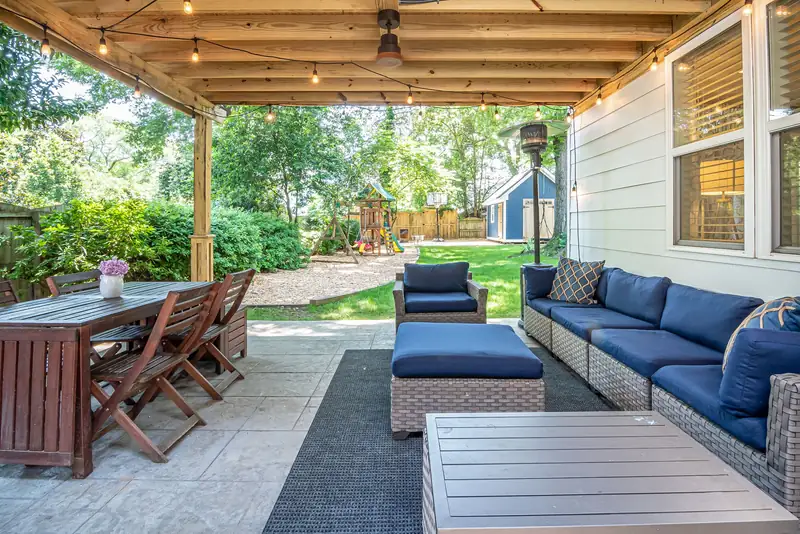
Paver Patios & Walkways · Lakewood Ranch, FL
Paver Patios for Lakewood Ranch Lake and Golf-Course Lots
A paver patio in Lakewood Ranch runs $10–$17 per sq ft installed as of October 2026. On the Sarasota side of the community, the county's own building page doesn't name patios or pavers one way or the other, so confirming the permit question directly is part of the job on that side of the line.
By the Opera Concrete & Pavers estimating team · Updated October 1, 2026
Get a free estimate
Tell us about the project and we'll call to set up a free site visit.
On the Sarasota side, call before you lay the base
Sarasota County's Right-of-Way Use Permit covers work inside the county right-of-way, not a patio set back on private ground (Sarasota County Code §124-48). A search summary of the county's own building page describes a residential patio without footings as possibly not needing a separate building permit, but the page couldn't be read in full to confirm it, so we treat that as a question for Planning & Development Services at 941-861-5000, not an answer (Sarasota County Building). On the Manatee side of the line, by contrast, a non-structural patio is confirmed on the county's own no-permit list.
Paver patios on a lake or golf-course lot
A lot of paver-patio work here goes in on a lot that backs onto one of the community's lakes or a golf-course fairway rather than a plain fence line, and that changes two things about the build: the edge restraint nearest the water or the course has to hold against irrigation overspray from the CDD's own common-area system, and the paver pattern often wraps around an existing drainage swale rather than running in a straight rectangle. Both are site-specific enough that a walk-through before pricing matters more here than on an interior lot.
Why a paver patio's base isn't the same as a driveway's
Patios and driveways both sit on a compacted aggregate base, but the two bases aren't built to the same spec. ICPI Tech Spec 2 calls for at least 4 inches of compacted base under a patio or walkway on well-drained soil, compared with at least 6 inches under a residential driveway, because a dining set and a grill load the ground far more lightly than a parked car. We still compact that base in lifts and check it against 98 percent of standard Proctor density before the bedding sand goes down. Skip that step on a Lakewood Ranch lot and the first rainy season finds every soft spot for you.
How a walkway job differs from a full patio build
A connecting walkway or a run of stepping pavers moves faster than a full patio because the footprint is smaller and the layout is usually a single straight or gently curved line rather than a shape with multiple cut angles. On a Lakewood Ranch property, a straightforward front-walk job can go from excavation to swept joints in a single day, where a comparable square footage of open patio with a border pattern takes closer to two. The base and compaction standards don't change for the smaller job, only the time it takes to move through each stage of it.
A paver patio on a golf-course lot, worked out in square feet
Say a 300 square foot paver patio extends a screened lanai toward a golf-course fairway on a Lakewood Ranch lot. At $10–$17 per sq ft installed, that runs $3,000 to $5,100, or roughly $3,600 to $4,800 in the typical $12–$16 band depending on the paver size and pattern. Because the patio's outer edge sits close to the course's irrigation line, the edge restraint and joint sand get specified for regular overspray rather than the standard residential spec, and the layout is checked against any drainage swale the CDD maintains along that side of the lot before the base is cut.
Where a screen enclosure track meets the paver field
A pool cage or screen room usually has an aluminum track anchored to its own footer, and the paver field has to meet that track cleanly without trapping water against it. We set a control joint there in practice, a slightly wider sand joint backed by a rigid edge restraint, right where the pavers meet the enclosure's base plate, so the two systems move independently without cracking the enclosure's footer or heaving the nearest paver course. On a Lakewood Ranch lanai addition, matching that transition elevation precisely keeps the screen door swinging freely instead of dragging on a paver that settled a quarter inch high.
That white haze on new pavers: efflorescence
New concrete pavers can develop a whitish, chalky film called efflorescence, a calcium carbonate deposit that can appear within 60 days of installation and sometimes doesn't show at all until the paver's first wet season if it was laid during a dry stretch. It does not affect the strength or durability of the paver itself. On a Lakewood Ranch patio, the bloom typically fades with normal weathering and rinsing over time, and sealing too early can sometimes trap it rather than help it wear off. It's worth knowing this before the first efflorescence shows up, because it looks alarming and almost never is.
When to reseal a paver patio
ICPI's own technical guidance gives no fixed resealing interval for paver sealers, saying only that they need reapplication after a period of wear and weather and that acrylic sealers generally last a few years before a recoat is due. Rather than sealing on a calendar, the better signal on a Lakewood Ranch patio is watching the surface: water that used to bead now soaks in, or the color has gone flat and faded, both mean the old coat has worn through. A paver patio that's never been sealed can go years without a problem, since sealing is about appearance and stain resistance more than structural need.
Frequently asked questions
Does a paver patio need a permit on the Sarasota side of Lakewood Ranch?
The county's published guidance doesn't say directly either way for a patio on private ground, so we confirm with Sarasota County Planning & Development Services at 941-861-5000 before pricing a job on that side of the community.
Does backing onto a golf course change how a paver patio is built?
It can. The edge restraint and joint sand closest to the course are worth specifying for regular irrigation overspray, and the layout gets checked against any drainage swale the CDD maintains along that property line.
Do I need Community Association Services' approval for a paver patio?
A patio is the kind of exterior change the community's Modification Request Form covers, separate from either county's permit question. Our Lakewood Ranch ARC guide covers the submission process.
Sources
- Census Reporter, Lakewood Ranch CDP FL (ACS 2020-2024 5-yr, B01003/B25035)
- Census Reporter geography parents, Lakewood Ranch CDP
- Census 2024 Gazetteer, Florida places
- Lakewood Ranch / Schroeder-Manatee Ranch, About Us
- Lakewood Ranch Town Hall, CEVA Homeowners' Manual 2022
- Lakewood Ranch CEVA Modification Request Form
- Lakewood Ranch GBVA-SRVA Modification Request Form
- Manatee County LDC §1004.2 Access and Drainage Permit
- Manatee Driveway and Culvert Application (2022)
- Manatee — Request a Driveway or Culvert Permit
- Manatee — Inspections Required for Paver Driveways
- Manatee — What Does Not Require a Permit (6-16-26)
- Manatee County LDC §511.16 Swimming Pools, Spas, Screen Enclosures
- Sarasota County Code §124-48 Right-of-Way Use Permit
- Sarasota County Code §98-3 Driveway culvert / ROW use permit fees
- Sarasota County Code §124-255 Additional Provisions (culverts)
- Sarasota County Code §22-63 (retaining walls > 4 ft engineered)
- Sarasota County Building (search excerpt; 403 to direct fetch)
- SWFWMD District Water Restrictions
- Manatee County - Modified Phase III water shortage restrictions
- NRCS OSD Myakka
- NRCS OSD EauGallie
- NRCS OSD Immokalee
- Florida Administrative Code — Rule 62-308.100, Synthetic Turf (effective May 19, 2026)
- Florida Statutes §125.572 — synthetic turf on single-family lots
- F.S. 720.3045 (2026) Installation, display, and storage of items
Ready for a price on your project?
Request a free estimate
Tell us about the project and we'll call to set up a free site visit.