
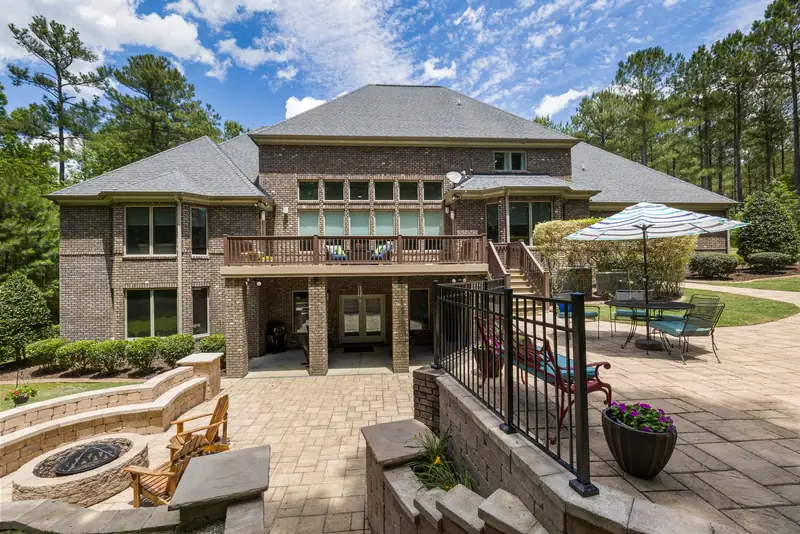
Paver Patios & Walkways · Parrish, FL
Paver Patios and Walkways in Parrish
Paver patio pricing in Parrish lands at $10–$17 per sq ft installed, a market range that held through October 2026. Most of the lots behind that number are recent builds, so a paver patio job here usually starts from a modern footprint rather than untangling decades of prior additions.
By the Opera Concrete & Pavers estimating team · Updated October 1, 2026
Get a free estimate
Tell us about the project and we'll call to set up a free site visit.
Building on a newer lot's clean grading
Census Reporter's current five-year estimate puts the median year a Parrish-area home was built at 2011, newer than Palmetto, Bradenton or Ellenton across the river Census Reporter, Parrish CCD. A paver patio project on that recent a build usually ties into a lanai or pool cage threshold set during original construction rather than an older addition poured a decade after the house went up, which tends to simplify how the new surface's elevation is matched.
Fort Hamer Bridge and why that matters for scheduling
Fort Hamer Bridge's 2017 opening gave Parrish a direct link across the Manatee River to the Lakewood Ranch side of East County Wikipedia, Fort Hamer Bridge, shortening material and crew travel time for jobs on the Fort Hamer Road corridor compared with routing around through US 301. That shorter run is less about the permit itself, which still follows the same county access and drainage rule for any portion touching the right-of-way, and more about keeping a multi-day paver job on schedule.
Why ridge sand doesn't get a free pass on base work
On the sandy ridge soils found west of Orlando, in series like Candler, Astatula and Tavares, water drains so fast that the ground rarely holds a puddle, and some installers assume that means the base can be thinner. It can't. Florida's residential code still limits how deep fill can go without engineering review: no more than 24 inches of clean sand or gravel, or 8 inches of earth fill. Excessively drained sand also shifts underfoot more than people expect once pavers carry chairs and daily foot traffic, so a Parrish patio on ridge sand still gets full-depth, properly compacted aggregate rather than a thin leveling layer over native sand.
Screeding sand and setting pavers
Once the base passes inspection, we screed bedding sand to a uniform 1 inch using pipe rails as a guide, then set pavers straight off the base without compacting that sand layer first, since compacting it before the units are down would leave the sand too dense for the pavers to settle in evenly. Laying typically runs from a fixed edge, like the house wall, outward toward the restraint line, with border pieces cut and set last once the field pattern is established. On a Parrish patio of average size this stage usually takes a full day or two depending on the pattern and how much cutting the layout requires.
Say an 18 x 24 ft paver patio backing up to a retention pond on a Parrish lot comes to 432 sq ft
Say an 18 x 24 ft paver patio backing up to a retention pond on a Parrish lot comes to 432 sq ft. At $10–$17 per sq ft, that runs $4,320 to $7,344 across the full range, tightening to about $5,184 to $6,912 inside the typical $12–$16 band, with the spread mostly tracking paver grade. Since the lot's grading dates to the 2010s or later, the slope running toward the pond usually follows the plan the subdivision's engineer already set, sparing the crew a fresh drainage study that an older, re-graded Manatee County lot might need first.
Where a screen enclosure track meets the paver field
A pool cage or screen room usually has an aluminum track anchored to its own footer, and the paver field has to meet that track cleanly without trapping water against it. We set a control joint there in practice, a slightly wider sand joint backed by a rigid edge restraint, right where the pavers meet the enclosure's base plate, so the two systems move independently without cracking the enclosure's footer or heaving the nearest paver course. On a Parrish lanai addition, matching that transition elevation precisely keeps the screen door swinging freely instead of dragging on a paver that settled a quarter inch high.
Ants and weeds moving into the joints
Dry joint sand is an easy place for ants to excavate a nest and for windblown weed seed to germinate, especially in joints that were never compacted tight or that have washed thin over time. On a Parrish patio in a shaded or irrigated corner, both problems tend to show up together, since loose, damp sand is friendlier to ants and seedlings than sand that's been properly compacted and kept topped off. Re-sanding and compacting the joints removes the loose material both are living in, and it's a maintenance task, not a sign the patio was built wrong, though neglected joints make it worse.
Keeping ants and weeds out of the joints
Compacted, properly topped-off joint sand is the simplest defense against both ants nesting and weed seed germinating between pavers, since loose or thin sand gives both something to work with. A quick sweep to clear organic debris like leaf litter and grass clippings off a Parrish patio before it decomposes into the joints also removes the organic matter weeds actually need to sprout. For an established ant problem in the joints, treating the colony directly works better than repeatedly re-sanding over it, since the ants will just re-excavate fresh sand the same way they did the old.
Frequently asked questions
Is Parrish's housing newer than nearby Manatee communities?
It runs newer on paper: the ACS five-year figure for the Parrish area lands at 2011, well ahead of Palmetto, Bradenton or Ellenton, so a paver patio crew here is usually working around fewer original-era quirks than those other towns present.
Does a paver patio near a retention pond need special review in Parrish?
The pond itself is usually part of the subdivision's original stormwater design rather than a separate review trigger; the patio still follows the same county no-permit rule for non-structural work, with the setback measured from the actual rear lot line.
Does the Fort Hamer Bridge affect paver patio pricing in Parrish?
No, prices don't change by location within the market area. The bridge mainly affects how quickly a crew and materials can reach a Fort Hamer Road corridor job from the East County side.
Sources
- Manatee County LDC §1004.2 Access and Drainage Permit
- Manatee — Request a Driveway or Culvert Permit
- Manatee Driveway and Culvert Application (2022)
- Manatee — Inspections Required for Paver Driveways
- Manatee — What Does Not Require a Permit (6-16-26)
- Manatee County LDC §511.16 Swimming Pools, Spas, Screen Enclosures
- Manatee County - Modified Phase III water shortage restrictions
- SWFWMD District Water Restrictions
- FEMA Flood Map Service Center
- NRCS OSD Myakka
- NRCS OSD EauGallie
- NRCS OSD Felda
- Florida Administrative Code — Rule 62-308.100, Synthetic Turf (effective May 19, 2026)
- Florida Statutes §125.572 — synthetic turf on single-family lots
- F.S. 720.3045 (2026) Installation, display, and storage of items
- Census Reporter, Parrish CCD, Manatee County FL (ACS 2020-2024 5-yr, B01003/B25035)
- Wikipedia, Fort Hamer Bridge
- USGS Water Data, Gamble Creek at County Road 675 near Parrish FL (Station 02300017)
- USF Water Atlas, Gamble Creek
- Your Observer, Big projects to keep an eye on in Parrish
Ready for a price on your project?
Request a free estimate
Tell us about the project and we'll call to set up a free site visit.