
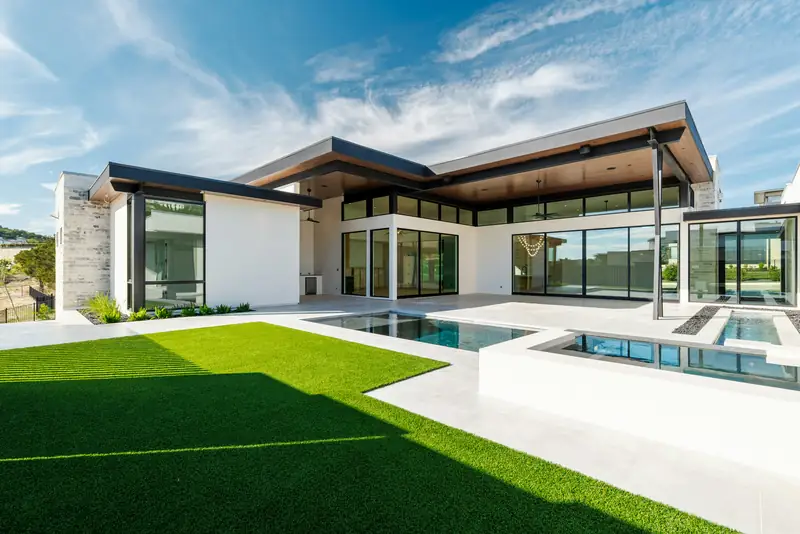
Concrete Pool Decks · Parrish, FL
Concrete Pool Deck Installation in Parrish
Figure $5–$15 per sq ft installed for a concrete pool deck in Parrish, the market range as of October 2026. Stretching a deck past the cage a builder installed is one of the most common add-ons here, and the county measures its own setback the same way whether that cage is five years old or thirty.
By the Opera Concrete & Pavers estimating team · Updated October 1, 2026
Get a free estimate
Tell us about the project and we'll call to set up a free site visit.
Why a builder's pool cage isn't the last word on deck size
Manatee County's code doesn't treat a pool, a screen enclosure or an on-grade deck as encroaching on a side or rear yard as long as the edge stays 5 feet clear of the lot line or the shoreline Manatee LDC Sec. 511.16. That 5-foot figure is measured from the surveyed property line itself, so on a Parrish lot backing to a retention pond or a conservation buffer, the pond's edge doesn't move the number closer, a detail worth confirming with a survey before an owner assumes the deck can stretch all the way to the water view.
Bullnose and Cantilever Coping: Two Ways to Finish the Pool Edge
A cantilevered concrete coping, poured as a thickened, rounded edge of the deck itself that overhangs the pool's bond beam by a couple of inches, is the standard detail on a poured concrete deck, finished smooth enough to be comfortable against bare skin. Some Parrish homeowners instead set a separate precast bullnose coping unit at the pool's edge and pour the field deck up to it, which gives a sharper material contrast but adds another joint to detail correctly. Either approach still needs the same isolation gap between the coping and the bond beam underneath it; the coping style doesn't change that requirement.
Say a Parrish homeowner extends a builder-installed screen cage by 600 sq ft of new pool deck
Say a Parrish homeowner extends a builder-installed screen cage by 600 sq ft of new pool deck. At $5–$15 per sq ft, that spans $3,000 to $9,000 across the full range, tightening to roughly $4,200 to $7,200 inside the typical $7–$12 band, with a cool-touch textured coating pushing toward the top of that band over a plain broom finish. A survey confirms the extension's new edge still clears the 5-foot line before the forms go up, and the crew tests the native soil past the original slab rather than assuming it compacts the same as the engineered pad the builder graded under the house.
Checking the subgrade, not just the setback
EauGallie and Felda, both mapped across parts of the Parrish area, carry a water table inside roughly 18 inches of grade for one to four months most years NRCS EauGallie soil series NRCS Felda soil series, which is the kind of ground that catches an owner off guard on a lot where the house itself is only a few years old but the backyard still sits on unimproved native soil past the original slab's footprint.
Skipping the Isolation Joint and What It Costs Later
A deck poured tight against the pool's bond beam with no isolation joint looks fine the day it's finished, since the crack it's setting up doesn't show until the two structures settle at different rates. Once that happens, the crack runs the length of the coping rather than staying contained to one panel, and fixing it after the fact means cutting a joint into cured concrete rather than forming one while the deck was still fresh. A Parrish homeowner who notices a crack tracking the pool's outline, as opposed to one running across an open section of deck, should treat that as an isolation joint problem rather than ordinary shrinkage.
The Isolation Joint Starts in the Base, Not Just the Pour
A concrete pool deck is never tied structurally to the pool's bond beam, and that separation starts before the first truck shows up. We set a compressible material against the bond beam, resting on the compacted base, so the base itself stops a few inches short of bearing directly on the pool structure. On a Parrish job, getting that gap consistent around every curve of the pool is more about careful base prep than anything done once concrete is in the forms. A base compacted tight against the bond beam, with no gap at all, gives the isolation joint above it nothing to flex against.
Why We Start Early on a Hot, Open Pour
A pool deck usually sits wide open to direct sun with no roof or tree cover until the screen cage goes up, which pushes evaporation rates higher than a shaded driveway pour sees on the same morning. Hot-weather guidance calls for avoiding the hottest part of the day and getting curing started as soon as finishing wraps up, and that matters more on a deck than almost anywhere else on a Parrish property, since there's so little shade working in the crew's favor. Starting before sunrise on a summer pour buys real working time before the surface starts drying faster than the slab underneath can gain strength.
Resealing or Recoating a Deck on Its Own Schedule
There's no fixed resealing interval for a concrete sealer or an acrylic coating like Kool Deck, the same way ICPI gives no set number of years for paver sealers, so the better signal on a Parrish deck is watching the surface rather than counting calendar years. Water that used to bead now soaks in, color that's gone chalky or faded, or a texture worn smoother than it used to feel underfoot all point to a coating or sealer that's due. A deck that sees heavy pool traffic and constant chlorine or salt exposure typically needs that attention sooner than a shaded patio ever would.
Frequently asked questions
Can I extend a builder-installed pool deck in Parrish right up to a retention pond?
No. The required 5-foot clearance runs from the surveyed rear property line, not from the pond's edge, so a deck extension still has to stop short of the line even on a lot that backs to open water.
Does extending an existing pool deck in Parrish need a new permit?
Yes. Enlarging a deck already attached to a builder-installed cage still goes through the same county review as a standalone pool deck project.
Why would a newer Parrish home still have drainage issues in the backyard?
Because the engineered pad under the house and driveway doesn't necessarily extend into the rest of the yard. EauGallie and Felda soil, both common in the area, can hold water close to the surface on that untouched native ground even behind a recently built house.
Sources
- Manatee County LDC §1004.2 Access and Drainage Permit
- Manatee — Request a Driveway or Culvert Permit
- Manatee Driveway and Culvert Application (2022)
- Manatee — Inspections Required for Paver Driveways
- Manatee — What Does Not Require a Permit (6-16-26)
- Manatee County LDC §511.16 Swimming Pools, Spas, Screen Enclosures
- Manatee County - Modified Phase III water shortage restrictions
- SWFWMD District Water Restrictions
- FEMA Flood Map Service Center
- NRCS OSD Myakka
- NRCS OSD EauGallie
- NRCS OSD Felda
- Florida Administrative Code — Rule 62-308.100, Synthetic Turf (effective May 19, 2026)
- Florida Statutes §125.572 — synthetic turf on single-family lots
- F.S. 720.3045 (2026) Installation, display, and storage of items
- Census Reporter, Parrish CCD, Manatee County FL (ACS 2020-2024 5-yr, B01003/B25035)
- Wikipedia, Fort Hamer Bridge
- USGS Water Data, Gamble Creek at County Road 675 near Parrish FL (Station 02300017)
- USF Water Atlas, Gamble Creek
- Your Observer, Big projects to keep an eye on in Parrish
Ready for a price on your project?
Request a free estimate
Tell us about the project and we'll call to set up a free site visit.