
Paver Patios & Walkways · Davenport, FL
Paver Patios and Walkways for Davenport Homes
Paver patios in Davenport price between $10–$17 per sq ft installed, Florida figures current for October 2026. Census survey data shows a meaningfully higher share of Davenport housing marked for seasonal or occasional use than a typical year-round suburb, which is part of why so many backyard paver patios here are built around guest turnover rather than a single family's routine.
By the Opera Concrete & Pavers estimating team · Updated October 1, 2026
Get a free estimate
Tell us about the project and we'll call to set up a free site visit.
A higher share of "seasonal, recreational, or occasional use" housing than most Orlando-unit towns
Of the 630 housing units the Census Bureau's survey counted as vacant in Davenport, 343 of them, about 54 percent, fall into the "seasonal, recreational, or occasional use" category rather than for-sale or for-rent housing sitting empty between tenants (Census Reporter, Davenport FL). That category covers both a snowbird's second home and a managed short-term rental, and it points to a backyard layout built around turning the space over to a new set of guests every week or two rather than a yard one family uses the same way all year.
The permit and setback rules don't change based on who is using the backyard
Whether a house is occupied by its owner every night or by a rotating set of renters, a paver patio addition still goes through the same site-plan and setback review Davenport or Polk County applies to any other backyard project (City of Davenport, Building Department). What changes is the layout brief more than the paperwork: a fire-pit seating area or a second dining zone built for groups of eight or ten shows up more often here than it would on a quieter residential street.
Base work where a screen enclosure sits on the patio
When a pool cage or screen enclosure shares the same patio, its footers are a different animal from the paver field around them. Enclosure posts typically land on isolated concrete footers set below the compacted base, not on the paver base itself, so the paver courses can settle or be lifted for maintenance without disturbing the structure overhead. On a Davenport job we lay out those footer locations before compacting the surrounding base, because cutting an isolated footing through finished aggregate later wastes a day and leaves a patch that compacts differently than the base around it. Coordinating the two scopes up front keeps the whole patio behaving as one surface.
Scheduling a patio job around the rainy season
Central and southwest Florida both see a rainy season running roughly from late May into October, often arriving as a sharp afternoon storm rather than steady rain, which changes how a crew sequences the work. We try to get base compaction and bedding sand finished before midday on a Davenport job scheduled during those months, since a sudden downpour on exposed, uncompacted aggregate can wash fines out and force a section to be redone. Paver laying itself tolerates a light rain better than the base stage does, but joint-sand sweeping and compacting still wants a dry window to lock the sand in properly.
Extending the patio for a crowd, square foot by square foot
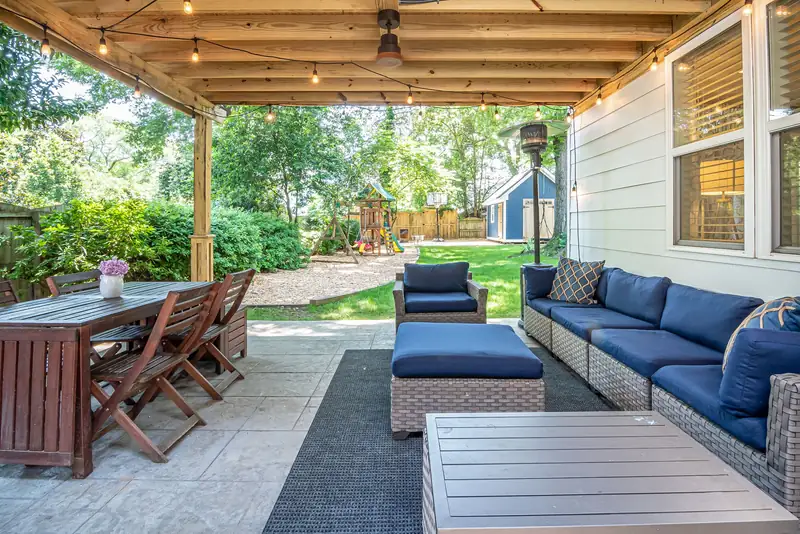
A 24 by 20 foot paver patio extension off the back of a Davenport-area house, built to seat a larger group than a typical family patio would, comes to 480 square feet. At $10–$17 per sq ft installed, that addition falls somewhere between $4,800 and $8,160. Sizing that patio for turnover-driven use, enough seating and walking space for a full house of guests rather than a nightly routine for two or three people, is often the detail that changes the layout more than the budget does.
Travertine pavers versus concrete pavers for a patio
Travertine and concrete pavers solve the same problem with different materials. Travertine is a natural stone that stays noticeably cooler underfoot in direct sun than a dark concrete paver, which matters on an uncovered Davenport patio in summer, though we won't put a number on the temperature difference since no verified measurement exists for Florida conditions. It's also more porous, so sealing matters more over time. Market ranges for installed paver patios run about $10 to $17 per square foot, and travertine typically prices above the top of that range because of material cost. Concrete pavers come in more colors and patterns and cost less to replace if one cracks.
Treating landscape edging as a real edge restraint
Plastic or metal edging sold for flower beds is not rated to hold back a paver field, but it gets substituted in on budget jobs often enough that ICPI's own technical guidance specifically calls it out as unacceptable. Without a proper restraint spiked into the compacted base, the outer courses of a Davenport patio creep outward a little at a time, usually from weight shifting as people walk the perimeter or furniture gets dragged across it, and the joints near the edge start opening within a year or two. Replacing bed edging with a real restraint after the fact means pulling and resetting the whole border course.
Caring for travertine differently than concrete pavers
Travertine's porous surface takes in water, oils and tannin stains from leaves and pine straw faster than a denser concrete paver does, so a Davenport patio in travertine benefits from a sealer that's actually maintained on schedule rather than treated as optional. It also stays noticeably cooler underfoot in direct sun, part of why homeowners choose it around a pool, though we won't attach an unverified number to that difference. Day to day, the cleaning routine is the same as concrete, a mild cleaner and a regular rinse, just with less tolerance for letting stains sit before treating them.
Frequently asked questions
Does the Census Bureau track how many Davenport homes are vacation rentals?
Not by that exact label, but its survey category for housing "for seasonal, recreational, or occasional use" captures both second homes and short-term rentals, and it covers about 54 percent of the vacant housing units counted in Davenport (Census Reporter, Davenport FL).
Does a backyard built for rental guests need a different paver permit?
No. The site-plan and setback review that Davenport or Polk County applies to a backyard paver project is the same regardless of whether the house is owner-occupied or managed as a rental.
Why are Davenport-area paver patios often larger than a typical family patio?
A lot of the backyard work here is built around groups of renters rather than a single household's daily routine, so seating and walking space get sized for eight or ten people instead of two or three.
Sources
- Census Bureau PEP, City and Town Population Totals, Vintage 2025 (July 1, 2025)
- Florida Senate Interim Report 2011-104 (sinkhole insurance)
- SWFWMD District Water Restrictions
- NRCS OSD Candler
- NRCS OSD Astatula
- Florida Administrative Code — Rule 62-308.100, Synthetic Turf (effective May 19, 2026)
- Florida Statutes §125.572 — synthetic turf on single-family lots
- City of Davenport, Building Department
- Polk County, Building FAQ
- Wikipedia, Davenport, Florida
- Wikipedia, Four Corners, Florida
- Wikipedia, Lake Wales Ridge National Wildlife Refuge
- Census Reporter, Davenport FL (ACS 2020-2024 5-yr, B25035 & B25004)
Ready for a price on your project?
Request a free estimate
Tell us about the project and we'll call to set up a free site visit.