
Artificial Turf · South Venice, FL
Artificial Turf for South Venice Canal Lots
A South Venice turf lawn costs $10–$25 per sq ft installed as of this October. With canals running behind so many lots in this subdivision, the state's water-setback rule for turf is one of the first things we check before sketching out a layout.
By the Opera Concrete & Pavers estimating team · Updated October 1, 2026
Get a free estimate
Tell us about the project and we'll call to set up a free site visit.
Swapping a canal-lot lawn for turf behind an existing seawall, worked out in square feet
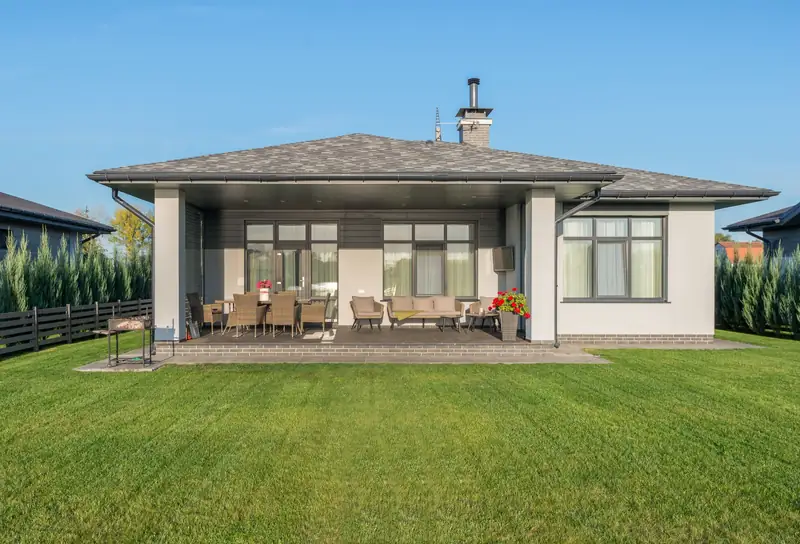
A homeowner on a South Venice canal lot wants 340 square feet of backyard converted to turf, backed by a seawall that's lined the canal edge since the 1960s. At $10–$25 per sq ft installed, the full range runs $3,400 to $8,500, landing closer to $4,080–$6,120 inside the usual $12–$18 window once backing and pile height are chosen. A wall built that long ago already marks the property line on paper, so the state's 10-foot buffer drops out of the math entirely, and the turf can run the full depth of the yard without a setback cut into it.
Measuring from the seawall, not the fence line
DEP Rule 62-308.100 keeps a synthetic lawn at least 10 feet from open water unless a seawall already sets the property line, and requires a washed-rock base with natural infill wherever the turf does go in DEP Rule 62-308.100. On a canal lot platted back in the 1950s, that buffer gets measured off the actual bulkhead rather than a fence that may sit a few feet closer to or farther from the water than the property line itself, and the rule leaves no room for a local variance to loosen it F.S. 125.572.
What the turf itself is made of, under Florida's new rule
Residential turf sold and installed in Florida has to clear DEP Rule 62-308.100's material standard: the turf, its backing and its infill can't contain heavy metals or intentionally added PFAS, and all of it has to be disposable at a landfill. Infill is limited to clean silica sand, rock, shell or other natural material, or silica sand with a non-toxic coating; loose rubber crumb is allowed only inside the footprint of playground equipment, not across a South Venice lawn. Pile height and backing weight vary by product line, but the infill rule doesn't, it's the same whether the turf goes in a front yard or a side yard.
An older lawn against a tighter watering schedule
South Venice sits inside SWFWMD's Modified Phase III shortage order, which has cut sprinkler use to a single assigned day a week through March 31, 2027 SWFWMD district restrictions. On a lot whose sod has thinned out after decades of mowing and the occasional drought, that one weekly slot rarely brings a struggling lawn back on its own, which is a common reason turf comes up here instead of a fresh re-sod attempt. A turf panel installed where it can't be seen from the street or an adjoining lot also carries the HOA protection F.S. 720.3045 grants as of 2026 F.S. 720.3045.
What a dog run's base has to do that a lawn's doesn't
A pet area turf base starts from the same rule as the rest of the yard, washed crushed rock or crushed concrete, never limerock or road base with fines, but it carries more liquid in one place over and over. Fines-heavy base material binds and seals, which is exactly what traps urine at the surface instead of letting it drain through; a properly washed, open-graded base keeps that liquid moving down and away. On a South Venice lot, the run is also graded so rinse water drains off the pad rather than pooling at a low corner, since a dog run gets hosed down far more often than the rest of the lawn.
Why compacting the base too hard can be its own mistake
The instinct on a sandy South Venice lot is to compact the base as hard as it'll go, since a firm surface feels like a better foundation for turf. Florida's turf rule caps that instinct: the subgrade can't be compacted tight enough to stop water percolating through it, and a local government may set a specific maximum permeability standard the installed system has to meet. A base compacted past that point behaves almost like the fines problem, water that should move through the soil instead collects at the surface, under the turf, where nobody sees it until the yard starts smelling or feeling spongy underfoot.
Fitting a turf accent into an existing paver layout
Where turf goes in alongside pavers already set in South Venice, the process starts with removing a strip of pavers and bedding sand rather than grading an open yard. The exposed subgrade is excavated a little deeper to fit the washed aggregate base for the turf, then compacted against the paver's existing edge restraint so the two systems tie together instead of shifting independently. The turf panel is cut to the exact width of the removed strip and seamed along its paver-side edge before the field edge is finished. Removed pavers are either reused elsewhere on the property or set aside for the homeowner.
Keeping septic access clear under a turf lawn
DEP Rule 62-308.100 requires septic tank access to stay reachable even with turf installed over or near the drain field, which in practice means the access lid location on a South Venice property is marked and either left turf-free or fitted with a removable panel rather than nailed down like the rest of the lawn. Pump-out crews need to reach that lid without cutting turf to find it, so marking the location clearly at installation saves a repair later. A turf panel nailed solid over a septic lid turns a routine pump-out into an unplanned turf repair.
Frequently asked questions
Does a South Venice canal lot need special clearance for turf?
No more than the statewide rule already requires everywhere: a 10-foot gap from the water, run from whatever bulkhead lines the canal. A property whose seawall already sits on the boundary line skips that gap requirement entirely.
Why does turf come up so often for older South Venice lawns?
A lawn that's been mowed and watered on this same canal-lot grid for seven decades often thins out faster than the district's one-day-a-week limit lets it recover, and at that point turf stops being a cosmetic swap and becomes the lower-maintenance fix.
Does the South Venice Civic Association have its own turf rule?
We haven't found a published architectural-review document from the association covering turf specifically, so a South Venice turf project generally answers to the county and state rules covered above; a homeowner in a separately deed-restricted pocket of the subdivision should still check that community's own documents.
Sources
- Sarasota County Code §124-48 Right-of-Way Use Permit
- Sarasota County Code §98-3 Driveway culvert / ROW use permit fees
- Sarasota County Code §124-255 Additional Provisions (culverts)
- Sarasota County Code §124-76 District Development Standards
- Sarasota County Code §124-283 Nonconforming Lots of Record
- Sarasota County Code §22-63 (retaining walls > 4 ft engineered)
- Sarasota County Online Permitting
- Sarasota County Building (search excerpt; 403 to direct fetch)
- SWFWMD District Water Restrictions
- NRCS OSD EauGallie
- NRCS OSD Felda
- Florida Administrative Code — Rule 62-308.100, Synthetic Turf (effective May 19, 2026)
- Florida Statutes §125.572 — synthetic turf on single-family lots
- F.S. 720.3045 (2026) Installation, display, and storage of items
- Wikipedia, South Venice, Florida
- Census Reporter, South Venice, FL (ACS 2020-2024 5-yr, B01003/B25035)
- South Venice Beach, History of South Venice Beach
- South Venice Beach, Beach Ferry
- My Suncoast, Sarasota County launches $25 million Alligator Creek restoration project
- Your Sun, County's plan to eliminate septic tanks on hold
Ready for a price on your project?
Request a free estimate
Tell us about the project and we'll call to set up a free site visit.