
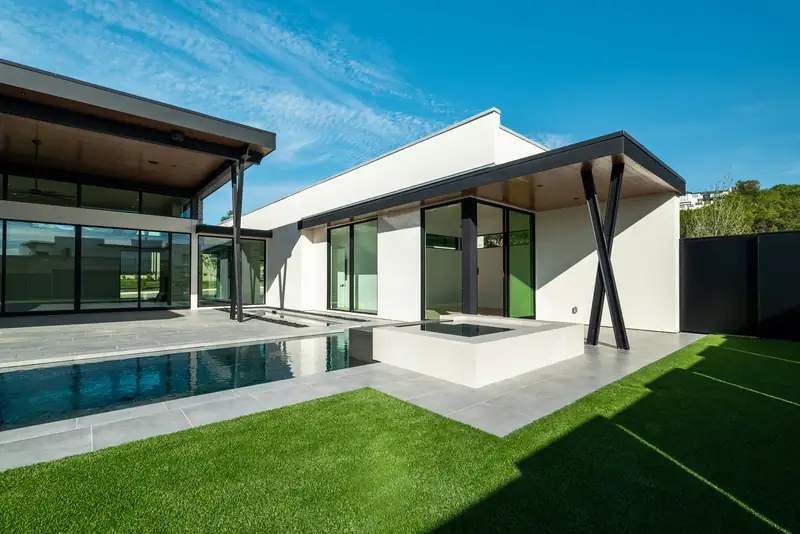
Artificial Turf · Lake Nona, FL
Artificial Turf for Lake Nona Yards
Artificial turf in Lake Nona runs $10–$25 per sq ft installed as of October 2026. Because the community is built around a 587-acre lake and a network of stormwater ponds, the city's 50-foot water-body setback for turf comes up on more Lake Nona lots than it would in a typical Orlando neighborhood.
By the Opera Concrete & Pavers estimating team · Updated October 1, 2026
Get a free estimate
Tell us about the project and we'll call to set up a free site visit.
Water is closer than it looks on a typical Lake Nona lot
Lake Nona itself covers 587 acres and sits inside Orange County's Lake Hart Watershed, with the community's newer villages laced with smaller stormwater ponds that feed into it (Orange County Water Atlas, Lake Nona). Orlando's own rule keeps artificial turf at least 50 feet from any water body, tighter than the state Department of Environmental Protection's 10-foot baseline that applies where a city hasn't set something stricter (City of Orlando, Residential Permitting Requirements; DEP Rule 62-308.100). A lot backing onto one of the community's ponds needs that distance measured before a turf layout is finalized, not assumed.
Does a sandy ridge lot near Lake Nona still need a compacted base
Not every yard needs the same treatment. On the excessively drained ridge sands west of Orlando, water already moves through the sand profile in minutes, and some homeowners assume bare native sand is base enough. It isn't. DEP Rule 62-308.100 still calls for a defined subgrade of washed crushed rock or crushed concrete, compacted enough to carry foot traffic without being packed so tight that it blocks water from moving through, which the same rule prohibits. Around Lake Nona, that usually means a thinner lift than a flatwoods lot needs, built from the same washed material rather than whatever fill happens to be on site.
HOA visibility rules stack on top of the city's setback
Most Lake Nona villages also require their own sign-off on an exterior change like a turf lawn, on top of the city's distance rule, and under state law as of 2026 an HOA can only restrict turf that's actually visible from the street frontage or an adjoining lot (F.S. 720.3045). A 2025 state law otherwise limits how far a local government can go in regulating residential turf beyond the standard DEP already sets (F.S. 125.572).
Laying out turf in a narrow side yard to cut down on seams
A side yard that's only a few feet wide doesn't leave much room to hide a seam, so the roll is oriented to run the full length of the space whenever the width allows it, rather than being pieced together in short sections. Edge restraint runs along both the house and the fence line, since a narrow strip has two fixed edges instead of one open perimeter. On a Lake Nona lot, gate hardware, hose bibs and utility meters in a side yard all get cut around individually, and each cut edge gets the same fastening as the outer perimeter so nothing works loose where foot traffic is heaviest.
Backyard turf near a Lake Nona stormwater pond, worked out in square feet
Say a home backing onto one of Lake Nona's retention ponds replaces 450 square feet of struggling sod with artificial turf, keeping the new lawn's edge measured back from the water. At $10–$25 per sq ft installed, that lands between roughly $4,500 and $11,250 depending on the pile height and backing, with the 50-foot setback checked against the pond's edge before the layout is finalized rather than the property line alone.
The extra steps a backyard putting green adds to the schedule
A putting green needs more passes at the base stage than a lawn panel does, since the subgrade gets screeded and checked for a true plane rather than just a consistent compacted depth. Contours, breaks or tiers built into the green are shaped at this stage, before any turf goes down, because they can't be adjusted once the surface is seamed. Cup locations and the fringe transition are marked and cut after the main green panel is placed on a Lake Nona green, not before, so the hole positions land where the finished surface actually breaks. The fringe area around the cups is seamed and infilled last.
Why turf gets hot enough to matter in full Florida sun
Dark-colored turf fiber and infill both heat up fast in direct sun, and a panel installed with no shade at all across a Lake Nona yard will get noticeably hotter underfoot than the surrounding pavers or lawn by mid-afternoon. Bare feet, paws and pets lying down on it are the real complaint, not the turf material itself failing. A quick hose-down before use cools the surface for a while without running afoul of the rule against in-ground irrigation on turf, since hand-watering with a hose isn't the same system the rule restricts. Shade structures and tree cover, where the drip-line rule allows them, help more than any turf product choice does.
Keeping septic access clear under a turf lawn
DEP Rule 62-308.100 requires septic tank access to stay reachable even with turf installed over or near the drain field, which in practice means the access lid location on a Lake Nona property is marked and either left turf-free or fitted with a removable panel rather than nailed down like the rest of the lawn. Pump-out crews need to reach that lid without cutting turf to find it, so marking the location clearly at installation saves a repair later. A turf panel nailed solid over a septic lid turns a routine pump-out into an unplanned turf repair.
Frequently asked questions
How close to Lake Nona's lake or ponds can artificial turf be installed?
No closer than 50 feet under Orlando's own rule, which applies to the community's namesake lake as well as the smaller stormwater ponds built throughout its newer villages.
Is the water-body setback for turf different in Lake Nona than elsewhere in Orlando?
The rule itself is the same citywide 50-foot standard, but it comes up more often in Lake Nona because the community has more water features, the lake plus its stormwater ponds, within reach of a typical lot.
Does a Lake Nona HOA need to approve turf even where the city allows it?
Usually yes. Most villages review exterior changes including a new turf lawn, and as of 2026 state law limits an HOA to restricting turf that's visible from the street or an adjoining property.
Sources
- City of Orlando — Apply for an Engineering Permit
- City of Orlando — Engineering Standards Manual, 5th ed.
- City of Orlando — Residential Permitting Requirements
- City of Orlando — HB803 Residential Building Permit Exemption Guide
- City of Orlando — Apply for a Right-of-Way Permit
- Lake Nona, About
- Laureate Park Master Association FAQ
- Florida Administrative Code — Rule 62-308.100, Synthetic Turf (effective May 19, 2026)
- Florida Statutes §125.572 — synthetic turf on single-family lots
- F.S. 720.3045 (2026) Installation, display, and storage of items
- SJRWMD Watering Restrictions
- NorthLake Park at Lake Nona, Community Portal (ARC approval)
- Lake Nona, NorthLake Park neighborhood page
- Orange County Water Atlas, Lake Nona
- ClickOrlando, Dowden Central CDD approval
- Wikipedia, Lake Nona, Orlando, Florida
Ready for a price on your project?
Request a free estimate
Tell us about the project and we'll call to set up a free site visit.