
Artificial Turf · St. Cloud, FL
Artificial Turf for St. Cloud Yards
Installing artificial turf in St. Cloud costs $10–$25 per sq ft installed as of October 2026. Florida's DEP standard holds synthetic grass back at least 10 feet from a water body unless a seawall sits between the yard and the lake or canal, and since nothing under the turf needs irrigation, it never has to answer to Toho Water Authority's watering clock at all.
By the Opera Concrete & Pavers estimating team · Updated October 1, 2026
Get a free estimate
Tell us about the project and we'll call to set up a free site visit.
One state rule sets the floor; nobody can write a looser one
Rule 62-308.100, Florida's DEP standard for synthetic turf, took effect in May 2026 and spells out what an installation needs: a washed aggregate base, natural infill rather than crumb rubber, no in-ground irrigation line buried underneath, and that 10-foot gap from any water body unless a seawall stands between the lawn and the water (Florida Administrative Code, Rule 62-308.100). Lawmakers capped local add-ons the same cycle, so neither St. Cloud nor Osceola County can stack a stricter turf rule on top of that state floor (Florida Statutes §125.572), and F.S. §720.3045 keeps most HOA turf restrictions from reaching a panel nobody can actually see from the street or the next lot over. For a yard touching East Lake Tohopekaliga or a canal, the 10-foot gap is the number to measure first.
An installed lawn never has to check St. Cloud's watering calendar
St. Cloud's older utility accounts still run on a tiered Toho Water Authority schedule tied to the last digit of the address, in windows as narrow as two and a half hours (Toho Water Authority, Watering Days and Times). Turf has no stake in any of that math, because the ground beneath it never needs a drop once the compacted base goes in. An owner running a rental or a second home from out of state gets to skip tracking which of St. Cloud's nine or ten windows applies to that address.
Does a sandy ridge lot near St. Cloud still need a compacted base
Not every yard needs the same treatment. On the excessively drained ridge sands west of Orlando, water already moves through the sand profile in minutes, and some homeowners assume bare native sand is base enough. It isn't. DEP Rule 62-308.100 still calls for a defined subgrade of washed crushed rock or crushed concrete, compacted enough to carry foot traffic without being packed so tight that it blocks water from moving through, which the same rule prohibits. Around St. Cloud, that usually means a thinner lift than a flatwoods lot needs, built from the same washed material rather than whatever fill happens to be on site.
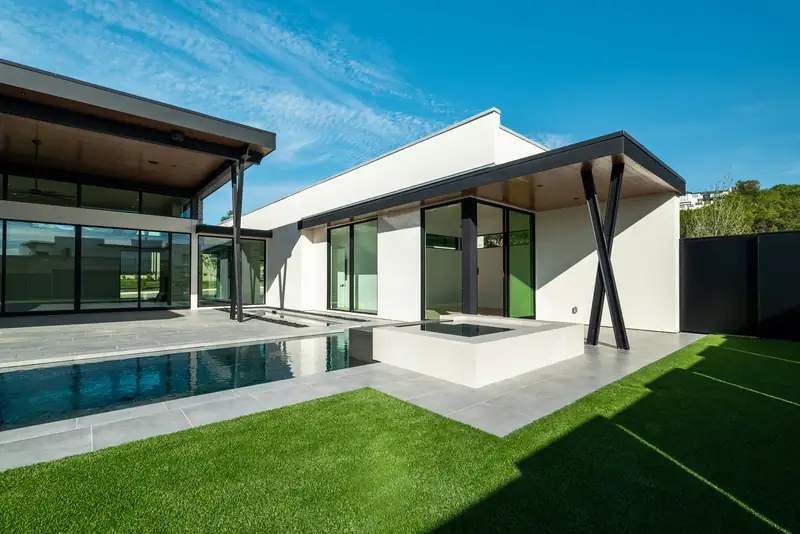
Working turf installation around a functioning pool
A pool deck install has to protect the coping and the water itself through every stage, so base material and turf offcuts get kept off the pool surface and out of the skimmer, and equipment pads stay covered while grading happens nearby. On a St. Cloud pool deck, the final seam at the coping is usually placed last, once the rest of the panel is set and trimmed, so the most exposed joint in the whole job gets the most attention and the least foot traffic during cure. Pool chemicals and standing water near the work area also push drying and seaming steps later in the day than they'd run elsewhere in the yard.
Backyard turf on a lot near a canal, worked out in square feet
Say a St. Cloud home near a canal feeding East Lake Tohopekaliga swaps out 550 square feet of struggling lawn for artificial turf, keeping the full layout a safe 10 feet back from the waterline. Multiply that footage by $10–$25 per sq ft installed and the job lands between roughly $5,500 and $13,750, depending on pile height and infill. Staying outside that buffer means the seawall exception never has to be invoked; a layout planned any closer to the canal would need that condition confirmed before the first roll goes down.
Fitting turf panels into a paver pattern as an accent, not a patch
Turf set as a band inside a paver driveway or alongside a walkway gets its own edge restraint where it meets the pavers, tying into the paver's existing restraint rather than relying on the turf's perimeter nails alone. The panel is cut narrower than a full lawn roll and seamed along one or both long edges instead of four, which keeps the seam count down on a short run. Around St. Cloud, this kind of inset strip usually runs the width of a driveway or along one side of a front walk, with the turf sitting slightly proud of the paver surface so mowing or trimming never touches it.
What a hurricane season does to turf that wasn't anchored right
Wind-driven rain gets under a loose turf edge faster than most homeowners expect, and once it does, the same gust that lifted the edge can peel a seam open across a St. Cloud yard if the nailing or seam tape underneath wasn't set to the rule's standard for anchoring against wind and flooding. Oak leaves, pine needles and other storm debris then work their way into the open seam, which both looks bad and blocks the drainage the base below is supposed to provide. Checking every seam and the full perimeter after a named storm catches a lifted edge before the next one makes it worse.
Rinsing a pet area without relying on the sprinkler system
Because DEP Rule 62-308.100 bars using in-ground irrigation on turf, a dog run's rinse routine has to run on a hose instead of a zone on the controller, which is actually closer to how the open, perforated backing in a pet area is designed to work. A quick rinse after use moves waste and odor through the backing and into the base below rather than letting it sit on the infill surface. On a St. Cloud property, keeping a hose bib within reach of the pet area makes that rinse routine realistic to keep up with, rather than something that only happens occasionally.
Frequently asked questions
How close to East Lake Tohopekaliga can artificial turf go?
The state standard draws the line at 10 feet from the water, with an exception for lots where a seawall separates the yard from the lake or canal. The same rule calls for a washed base, natural infill and no in-ground irrigation line under the turf.
Does artificial turf follow St. Cloud's watering schedule?
No, neither the citywide Toho pattern nor the older tiered schedule still used for legacy St. Cloud accounts applies to turf. Both govern irrigated grass, and an installed turf system has nothing left to irrigate.
Can an HOA in St. Cloud ban artificial turf outright?
Not outright. State law sets a ceiling on how far a local government's own turf rules can reach, and a separate statute keeps most HOA restrictions from applying to a turf panel nobody can see from the frontage or an adjacent lot. A specific community's design guidelines are still worth checking first.
Sources
- City of St. Cloud — Permit Information
- City of St. Cloud — Public Works Fees
- Census Bureau PEP, City and Town Population Totals, Vintage 2025 (July 1, 2025)
- Census Reporter, St. Cloud, FL (ACS 2020-2024 5-yr, B25035)
- NRCS OSD Smyrna
- NRCS OSD Myakka
- NRCS OSD Basinger
- Osceola County — Parking Ordinance, Ch. 22 Art. II (Sec. 22-50.6)
- Florida Administrative Code — Rule 62-308.100, Synthetic Turf (effective May 19, 2026)
- Florida Statutes §125.572 — synthetic turf on single-family lots
- Florida Statutes §720.3045 — items not visible from the frontage or an adjacent parcel
- Toho Water Authority, Watering Days and Times
- Toho Water Authority, St. Cloud Utility Integration News Release
- Wikipedia, St. Cloud, Florida
Ready for a price on your project?
Request a free estimate
Tell us about the project and we'll call to set up a free site visit.