
Artificial Turf · Dr. Phillips, FL
Artificial Turf for Dr. Phillips Yards
Artificial turf in Dr. Phillips runs $10–$25 per sq ft installed as of October 2026. Between the Butler Chain along Bay Hill's western edge and the Sand Lake chain running through the community's center, more Dr. Phillips lots sit within reach of open water than a typical inland Orlando neighborhood, which puts the state's turf setback in play more often here.
By the Opera Concrete & Pavers estimating team · Updated October 1, 2026
Get a free estimate
Tell us about the project and we'll call to set up a free site visit.
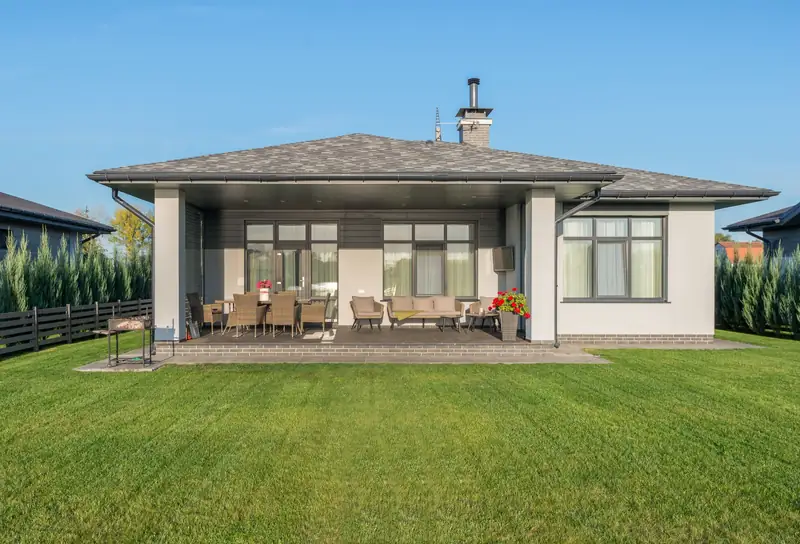
Backyard turf set back from a Sand Lake chain shoreline, worked out in square feet
Say a Sand Lake Point home replaces 400 square feet of struggling St. Augustine sod with turf, with the lawn's edge pulled back 10 feet from the water rather than run to the property line. At $10–$25 per sq ft installed, that comes to roughly $4,000 to $10,000 depending on pile height and backing, with the setback measured from the actual shoreline before the layout is ordered.
Two lake chains mean the setback comes up on more than just waterfront lots
Florida's rule for synthetic turf keeps it at least 10 feet back from a pond, lake or canal, unless a seawall forms that edge, and requires a washed-stone base with natural infill rather than buried irrigation underneath (the DEP turf rule). With the Butler Chain forming Dr. Phillips' western boundary near Bay Hill and the Sand Lake chain cutting through its center (Wikipedia, Dr. Phillips, Florida), a meaningfully larger share of lots here back onto open water than in a community built around a single retention pond, so that 10-foot line gets checked against the actual shoreline before a turf layout is drawn.
Choosing and setting turf around a pool deck
Turf around a pool gets fastened tight to the deck's edge restraint or coping bead, since that joint takes more foot traffic and more splash than any other seam in the yard. Chlorinated water and sunscreen residue don't break down most turf backings, but a seam placed right at the coping wears faster than a seam set back from the water, so the layout is planned to keep joints away from the busiest edge wherever it's practical. Infill still has to meet the state's natural-material rule even in a pool surround. On a Dr. Phillips deck, drain lines and skimmer equipment get built around, with turf cut to the equipment rather than equipment moved to fit the turf.
An HOA still gets the final say on visible turf, where one exists
As of 2026, state law limits a homeowners association to restricting artificial turf only where it's actually visible from the street frontage or an adjoining lot (F.S. 720.3045), and a separate 2025 law caps how far local governments can go in regulating residential turf beyond the state's own DEP standard (F.S. 125.572). Gated communities such as Bay Hill and Phillips Landing run their own architectural review for an exterior change like a new lawn, so that approval runs alongside, not instead of, the state rule and the county's water-body setback.
Does a sandy ridge lot near Dr. Phillips still need a compacted base
Not every yard needs the same treatment. On the excessively drained ridge sands west of Orlando, water already moves through the sand profile in minutes, and some homeowners assume bare native sand is base enough. It isn't. DEP Rule 62-308.100 still calls for a defined subgrade of washed crushed rock or crushed concrete, compacted enough to carry foot traffic without being packed so tight that it blocks water from moving through, which the same rule prohibits. Around Dr. Phillips, that usually means a thinner lift than a flatwoods lot needs, built from the same washed material rather than whatever fill happens to be on site.
Why 'the HOA can't stop me' isn't quite true for turf
Florida's statute preempting local governments from restricting compliant turf, F.S. 125.572, regulates city and county rules, not HOA architectural review, an association in Dr. Phillips can still apply its own approval process to a turf project. Separately, F.S. 720.3045 only protects turf that isn't visible from the parcel's frontage, an adjacent parcel or a community golf course; a front yard facing the street doesn't qualify just because the material itself is allowed under state law. Checking the HOA's documents before digging saves a redo that the DEP rule alone won't prevent.
How a standard turf install runs from start to finish
The old lawn or landscaping comes out first, down to bare soil, followed by grading and compaction of the washed aggregate base in thin lifts rather than one thick pour. Turf rolls go down once the base passes a level check, get trimmed to the perimeter, and are seamed where two rolls meet before infill goes in and gets worked into the pile with a power broom. On a typical Dr. Phillips yard, the base work and grading usually take longer than placing the turf itself, since a flat, compacted, draining subgrade is what the rest of the job depends on. Perimeter nailing and a final brushing finish the job.
Checking seams and edges after storm season, not just once a year
A seam or edge that was anchored correctly at installation can still work loose over a season of heat cycling, wind and the occasional named storm moving through Dr. Phillips, so a walk around the full perimeter and every seam after a significant storm catches a lifted spot before it grows. Re-securing a loose edge early is a small fix; leaving it through another storm turns it into a bigger one, since each gust that gets under an open edge peels it back a little further. This check costs nothing but time and doesn't require pulling up any turf to do it.
Frequently asked questions
How close to the water can artificial turf go in Dr. Phillips?
At least 10 feet back from a pond, lake or canal under the state's rule, measured from the water's edge itself rather than from a fence line, unless a seawall forms that edge.
Does Dr. Phillips have more lakefront lots than a typical Orlando neighborhood?
Proportionally, yes. Between the Butler Chain along its western edge and the Sand Lake chain running through its center, a larger share of lots here sit within reach of open water than in a community built around a single pond.
Can a Bay Hill or Phillips Landing HOA still block artificial turf?
It can review a visible turf installation under its own architectural standards, but as of 2026 state law limits that review to turf actually visible from the street or an adjoining property, on top of the state's own DEP installation rule.
Sources
- Orange County Division of Building Safety
- Orange County — Do I Need a Permit
- Orange County — Residential Pavers
- Orange County — ROW Utilization Permit directory
- Orange County — Municode Ch. 21 Art. VI ROW Utilization
- Orange County — Residential Lot Grading Policy 2023
- Orange County — A Guide for Residential Plan Approval
- Orange County, Tree Removal Permit
- SJRWMD Watering Restrictions
- Florida Administrative Code — Rule 62-308.100, Synthetic Turf (effective May 19, 2026)
- Florida Statutes §125.572 — synthetic turf on single-family lots
- F.S. 720.3045 (2026) Installation, display, and storage of items
- Florida Senate Interim Report 2011-104 (sinkhole insurance)
- NRCS OSD Candler
- NRCS OSD Tavares
- NRCS OSD Myakka
- NRCS OSD Smyrna
- Wikipedia, Dr. Phillips, Florida
- Census Reporter, Doctor Phillips, FL (ACS 2024 5-yr)
- Florida Neighborhood Realty, Restaurant Row in Dr. Phillips
- MarketConnect Realty, Phillips Landing homes
- FDEP, Outstanding Florida Waters fact sheet
- Point2Homes, Doctor Phillips demographics
Ready for a price on your project?
Request a free estimate
Tell us about the project and we'll call to set up a free site visit.