
Artificial Turf · Horizon West, FL
Artificial Turf for Horizon West Yards
Artificial turf in Horizon West runs $10–$25 per sq ft installed as of October 2026. Every village here was planned with greenbelts and stormwater ponds built in from the start rather than added later, so the state's water-body setback for turf comes up on a larger share of lots than it would in an older, less engineered subdivision.
By the Opera Concrete & Pavers estimating team · Updated October 1, 2026
Get a free estimate
Tell us about the project and we'll call to set up a free site visit.
Backyard turf set back from a village retention pond, worked out in square feet
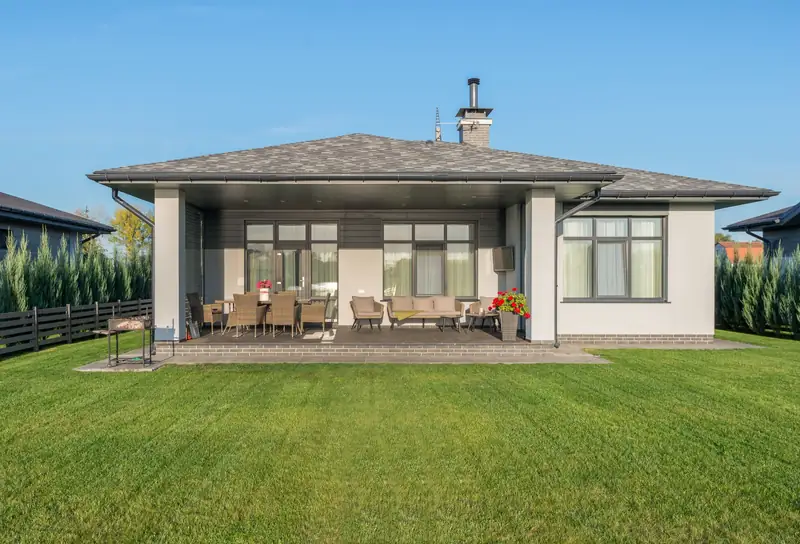
Say a home in one of Horizon West's newer villages backs onto a stormwater pond and wants to replace 420 square feet of new sod that's struggled to take hold with turf instead. Pulling the layout back the required 10 feet from the pond's edge trims the usable area to roughly 370 square feet, which at $10–$25 per sq ft installed runs between about $3,700 and $9,250 depending on pile height and backing.
A layout built around water from day one
Orange County describes Horizon West's villages and Town Center as surrounded by greenbelts (Orange County, Horizon West), and that conservation-and-stormwater framework means retention ponds and buffer strips run through the community at a density an older, piecemeal-built suburb doesn't usually have. None of that changes the state's own turf standard, which calls for a 10-foot buffer off any pond, lake or canal edge not already lined by a seawall, a washed-stone base rather than soil, and no sprinkler lines buried beneath the finished lawn (the DEP turf rule).
How seams and edges are anchored against wind and flooding
Florida's turf rule requires edges and seams to be anchored against wind and flooding, on top of whatever adhesive or seam tape the manufacturer specifies for the product itself. That usually means nail or spike spacing tightens up at the perimeter and along every seam, not just at the corners, so a gust under a loose edge can't start a peel that runs the length of a panel. Around a Horizon West yard, perimeter nailing also has to work around a septic tank's cleanout and lid, which the rule requires stay accessible for pump-outs rather than being nailed over or buried under turf.
A newer lot means measuring the pond edge fresh, not relying on an old survey
On a lot finished within the past year or two, the pond or swale edge nearby was shaped as part of the subdivision's own stormwater design, so the 10-foot line is worth measuring directly off the current grading rather than assumed from a plat drawing that predates the final landscaping. As of 2026, state law also limits a homeowners association to restricting turf only where it's visible from the street or an adjoining lot (F.S. 720.3045).
Why a side-yard turf strip needs its own drainage path
A narrow run of turf between the house and the fence collects more water than a wide-open lawn panel does, because roof runoff, AC condensate and the neighbor's grade all drain toward the same few feet. The base in a side yard at a Horizon West home has to be built with a slight fall away from the foundation, not flat, so water keeps moving instead of sitting under the turf backing. Washed crushed rock is compacted in the same thin lifts used anywhere else on the property, but the finished grade gets checked with a level across the whole run before turf goes down, since there's no second chance to fix a low spot once it's covered.
Why turf gets hot enough to matter in full Florida sun
Dark-colored turf fiber and infill both heat up fast in direct sun, and a panel installed with no shade at all across a Horizon West yard will get noticeably hotter underfoot than the surrounding pavers or lawn by mid-afternoon. Bare feet, paws and pets lying down on it are the real complaint, not the turf material itself failing. A quick hose-down before use cools the surface for a while without running afoul of the rule against in-ground irrigation on turf, since hand-watering with a hose isn't the same system the rule restricts. Shade structures and tree cover, where the drip-line rule allows them, help more than any turf product choice does.
What changes in the process for a pet area install
A dog run or pet area gets the same removal-grading-base sequence as the rest of a Horizon West yard, with one extra step: the perforated or open-weave backing and drainage layer get checked for flow before infill goes in, usually by running water across the pad and watching how fast it clears. Infill is worked into the pile more conservatively than on a show lawn, since a pet area holds more liquid over its life and a lighter infill layer drains and dries faster between uses. The perimeter gets nailed down tight along any edge where digging is likely.
Keeping leaves and storm debris from matting the turf
Oak leaves, pine needles and seed pods are a bigger issue for turf than for a natural lawn, because they don't break down into the surface the way they would in soil, they sit on top of the pile and, left long enough, mat it down and block drainage through the infill. A leaf blower or a stiff broom on a regular pass keeps a Horizon West yard's turf clear without disturbing the infill the way a hard rake can. After a windy stretch or a storm, a full pass matters more than usual, since that's when the most debris ends up pressed into the pile at once.
Frequently asked questions
Are more Horizon West lots near water than in an older Orlando subdivision?
Proportionally, yes. The area's villages were planned with greenbelts and stormwater ponds built into the layout from the start, so a larger share of lots sit within reach of a water body than in an older suburb built without that kind of integrated stormwater design.
Does a newly graded pond edge in Horizon West need to be re-measured for turf setback?
It's worth it. A pond or swale shaped as part of a subdivision's recent build-out can differ slightly from an older plat drawing, so measuring the 10-foot setback off the current grading avoids relying on an outdated line.
Can a Horizon West HOA still restrict artificial turf under state law?
Only turf that's actually visible from the street frontage or an adjoining lot, as of 2026. That's on top of, not instead of, the state's own 10-foot water-body setback and installation standard.
Sources
- Orange County Division of Building Safety
- Orange County — Do I Need a Permit
- Orange County — Residential Pavers
- Orange County — ROW Utilization Permit directory
- Orange County — Municode Ch. 21 Art. VI ROW Utilization
- Orange County — Residential Lot Grading Policy 2023
- Orange County — A Guide for Residential Plan Approval
- Orange County, Tree Removal Permit
- Orange County, Horizon West
- SJRWMD Watering Restrictions
- Florida Administrative Code — Rule 62-308.100, Synthetic Turf (effective May 19, 2026)
- Florida Statutes §125.572 — synthetic turf on single-family lots
- F.S. 720.3045 (2026) Installation, display, and storage of items
- Orange County Planning Division, Horizon West Architectural Design Standards Guidebook (Dec. 2015)
- Wikipedia, Horizon West, Florida
- Census Reporter, Horizon West, FL
- Orange Observer, forecast on Horizon West's newest elementary school
- Horizon West Happenings, school year overcrowding report
Ready for a price on your project?
Request a free estimate
Tell us about the project and we'll call to set up a free site visit.