
Artificial Turf · Winter Garden, FL
Artificial Turf for Winter Garden Yards
Turf installers are pricing Winter Garden jobs at $10–$25 per sq ft installed this fall. A yard that touches Lake Apopka or one of the area's ponds and canals has a state-set buffer to measure before the layout is drawn, and once the base goes in, the sprinkler calendar that governs the rest of the county simply stops applying to that section of the yard.
By the Opera Concrete & Pavers estimating team · Updated October 1, 2026
Get a free estimate
Tell us about the project and we'll call to set up a free site visit.
A shoreline buffer, not a fence line, sets where the turf can start
Florida's rule for synthetic turf keeps it back 10 feet from a pond, lake or canal unless a seawall forms that edge, and bans buried irrigation underneath, specifying a washed stone base and a natural infill instead (the DEP turf rule). Measuring that 10 feet from the actual water's edge, rather than from wherever the backyard fence happens to sit, is what decides the real usable footprint on a lot along Lake Apopka's south shore, where the shoreline and the property line rarely line up exactly.
What goes under artificial turf on Florida soil
Florida's new turf rule treats the base as part of the system, not an afterthought. DEP Rule 62-308.100 requires the subgrade under residential turf to be washed crushed rock or crushed concrete, never limerock or road base with fines, because fines bind together and seal the soil the way a driveway base is supposed to. Most lots around Winter Garden sit on sandy flatwoods soils with a seasonal high water table that can sit within two feet of the surface for part of the year. A compacted aggregate lift that still drains is the only way to keep the lawn from holding water under the turf after a summer storm rolls through.
A sodded lawn still answers to the sprinkler calendar; installed turf stops answering to it
Outside any shortage order, the St. Johns district still limits every Orange County address to two sprinkler days a week and blocks watering between 10 a.m. and 4 p.m. (SJRWMD watering page). New sod has to establish on exactly those two days; once turf is down and the infill is swept in, that calendar no longer has anything to govern on that patch of the yard, which is the appeal for a strip that's struggled to hold grass under the normal schedule.
Choosing and setting turf around a pool deck
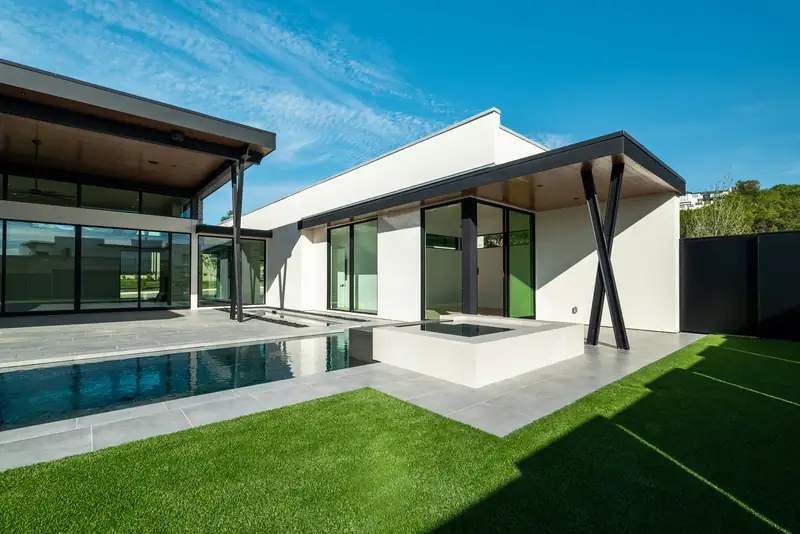
Turf around a pool gets fastened tight to the deck's edge restraint or coping bead, since that joint takes more foot traffic and more splash than any other seam in the yard. Chlorinated water and sunscreen residue don't break down most turf backings, but a seam placed right at the coping wears faster than a seam set back from the water, so the layout is planned to keep joints away from the busiest edge wherever it's practical. Infill still has to meet the state's natural-material rule even in a pool surround. On a Winter Garden deck, drain lines and skimmer equipment get built around, with turf cut to the equipment rather than equipment moved to fit the turf.
Working the lake buffer into a turf layout
Picture a 540-square-foot run of backyard that ends at Lake Apopka's edge: pulling the layout back the required 10 feet from the water trims off roughly 60 square feet, leaving about 480 square feet to actually turf. At the $10–$25 per sq ft installed range, that comes to somewhere between $4,800 and $12,000 once pile height and backing are chosen. Surveying the shoreline first, instead of assuming the fence marks the edge, is what sets the real number before a roll of turf is ordered.
What changes in the process for a pet area install
A dog run or pet area gets the same removal-grading-base sequence as the rest of a Winter Garden yard, with one extra step: the perforated or open-weave backing and drainage layer get checked for flow before infill goes in, usually by running water across the pad and watching how fast it clears. Infill is worked into the pile more conservatively than on a show lawn, since a pet area holds more liquid over its life and a lighter infill layer drains and dries faster between uses. The perimeter gets nailed down tight along any edge where digging is likely.
What a hurricane season does to turf that wasn't anchored right
Wind-driven rain gets under a loose turf edge faster than most homeowners expect, and once it does, the same gust that lifted the edge can peel a seam open across a Winter Garden yard if the nailing or seam tape underneath wasn't set to the rule's standard for anchoring against wind and flooding. Oak leaves, pine needles and other storm debris then work their way into the open seam, which both looks bad and blocks the drainage the base below is supposed to provide. Checking every seam and the full perimeter after a named storm catches a lifted edge before the next one makes it worse.
What a backyard putting green needs that a lawn panel doesn't
A putting surface in Winter Garden gets a light sand topdressing on a schedule rather than infill top-ups the way a lawn panel does, since the goal on a green is a consistent, true roll rather than a filled, upright pile like the surrounding fringe grass. The fringe around the cups is trimmed back periodically so it doesn't creep onto the putting surface and change how a ball breaks near the edge. Cups and flagsticks get checked for wear and a secure fit in the cup liner, since that's hardware a lawn panel never has to maintain at all.
Frequently asked questions
How far back from Lake Apopka does artificial turf have to stay?
At least 10 feet from the water's edge itself, not from a fence or a property line, under the state's synthetic-turf rule. That buffer only goes away where a seawall, rather than open shoreline, forms the edge of the water.
Once turf is installed, does it still need to follow Orange County's watering days?
No. The sprinkler calendar governs irrigated sod and landscaping; a turf section with its base and infill already down has nothing left for that schedule to regulate.
Can a homeowners association near Winter Garden still say no to artificial turf?
An HOA's own design standards aren't touched by the state law that limits city and county turf restrictions, so checking the specific community's rules before buying materials is still worth doing.
Sources
- City of Winter Garden — Building FAQs
- City of Winter Garden — Impervious Area Calculation Worksheet
- City of Winter Garden — Municode R-1A
- City of Winter Garden — Right-of-Way Permit Application
- City of Winter Garden — When is a permit required?
- Census Bureau PEP, City and Town Population Totals, Vintage 2025 (July 1, 2025)
- Census Reporter, Winter Garden FL (ACS 2020-2024 5-yr, B25035)
- Orange County, Horizon West
- SJRWMD Watering Restrictions
- Florida Senate Interim Report 2011-104 (sinkhole insurance)
- Orange County — A Guide for Residential Plan Approval
- NRCS OSD Candler
- NRCS OSD Tavares
- NRCS OSD Astatula
- NRCS OSD Myakka
- NRCS OSD Smyrna
- Florida Administrative Code — Rule 62-308.100, Synthetic Turf (effective May 19, 2026)
- Florida Statutes §125.572 — synthetic turf on single-family lots
- the city history page
- the trail Wikipedia entry
- St. Johns River Water Management District, Lake Apopka Project
Ready for a price on your project?
Request a free estimate
Tell us about the project and we'll call to set up a free site visit.