
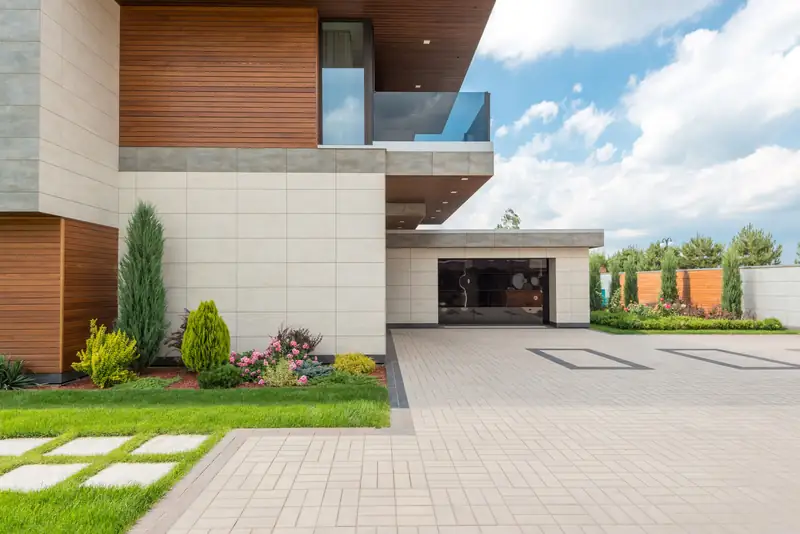
Paver Driveways · Winter Garden, FL
Paver Driveways in and Around Winter Garden
Figure $10–$30 per sq ft installed heading into the last quarter of 2026 for a paver driveway in Winter Garden, the going Florida range. Pavers don't get a lighter review here: the city's own worksheet treats a jointed surface the same as a poured one, and a good share of the ground under the area's older subdivisions is fast-draining ridge sand rather than the wetter flatwoods soil found in other pockets of the unit.
By the Opera Concrete & Pavers estimating team · Updated October 1, 2026
Get a free estimate
Tell us about the project and we'll call to set up a free site visit.
A paver driveway resized against the worksheet, worked out in square feet
A 20-by-24-foot paver driveway comes to 480 square feet, and against the $10–$30 per sq ft installed range, that prices between roughly $4,800 and $14,400 depending on the paver and base depth chosen. Because the worksheet counts every one of those 480 square feet as impervious regardless of the joint pattern, the lot's remaining allowance gets checked against that full number, not against a lower figure some homeowners assume applies to a surface that lets water through at the seams.
The worksheet is blunt about what a jointed surface counts as
Winter Garden's impervious-area worksheet spells it out without qualification: “NOTE: PAVERS ARE IMPERVIOUS,” under the definition in Code §106-2 (impervious worksheet). That line surprises homeowners who assume a paver surface drains and therefore doesn't count toward a lot's limit the way a solid slab would; the worksheet doesn't distinguish between the two, so a paver driveway and a poured one use up the same allowance square foot for square foot.
Joint sand or polymeric sand: what the spec leaves open
ICPI's own spec treats joint sand plainly: dry sand swept into the eighth-inch joints and compacted in place, with sealers or joint sand stabilizers listed as optional rather than required. Polymeric sand is the common stabilizer choice, meant to bind in the joint and resist the ordinary washout that plain sand can see over time, but the spec doesn't mandate it for a standard residential driveway. That leaves it as a real decision for a Winter Garden homeowner rather than a box every crew checks the same way: plain sand costs less and can be swept back in after a pressure wash, while a stabilized joint holds up longer between resweeps but costs more up front. Either way the joint itself keeps the same eighth-inch tolerance.
Ridge sand under much of the city drains fast and compacts differently than flatwoods ground
Candler, Tavares and Astatula soils, all excessively to moderately well drained with a water table well below the surface, are common across much of west Orange County, a contrast with the poorly drained Myakka and Smyrna flatwoods soil that holds water closer to grade elsewhere in the Orlando unit (Candler soil survey; Tavares soil survey). On that kind of ground, the compacted aggregate base under a paver driveway is usually managing loose, fast-draining sand rather than a shallow water table, which changes where the crew spends its compaction effort.
Why 6 inches of base isn't automatic under a driveway near Winter Garden
ICPI's own spec sets a residential driveway base at a minimum of 6 inches of compacted aggregate over well-drained soil, while a patio or walkway only needs about 4 inches. That minimum isn't the end of the math: on wet or poorly drained ground, the same spec calls for 2 to 4 inches more before the base is considered done. Around Winter Garden, which number applies depends on what's actually under the topsoil, not on habit. A crew that quotes 6 inches for every lot skipped the step where someone checks the soil, and that's the step that keeps a driveway from settling at the edges a year later.
Live oak roots under or near a paver driveway
A mature live oak's root system can extend well past its canopy, and roots running under a driveway don't stop growing once pavers sit on top of them; a root that thickens over a few years can lift a section of base and the pavers riding on it, usually along a visible seam rather than evenly. Several Central Florida and Sarasota-area cities protect larger live oaks by ordinance, which can limit root pruning or removal near a Winter Garden driveway even when a root is part of the problem. Routing a driveway's base around a known root zone, or accepting a shallower design near a protected tree, is often the more realistic fix than fighting the tree for the space.
Cutting pavers at the edges takes longer than laying the field
Laying full pavers across the open middle of a driveway moves fast once the bedding sand is screeded flat, course after course set tight against the last one. The borders are a different job: every paver that meets an edge restraint, a garage apron, or an angled property line has to be measured and cut to fit, and a Winter Garden driveway with a curved edge or an angled approach can have more border cuts than field pavers in some sections. That work happens with a wet saw, one piece at a time, which is why a crew's pace visibly slows near the edges of a job even though the material and the base underneath haven't changed at all.
Checking edge restraint once a year
Edge restraint sits below grade and out of sight once a driveway is finished, which makes it easy to forget until the joints along the edge start widening or pavers near the perimeter begin creeping outward under traffic. A quick yearly check, pressing along the border by hand or foot near Winter Garden to feel for movement, catches a loosening spike or a section where landscaping work accidentally disturbed the restraint long before the problem reaches the field of pavers. Since the spikes anchor into the compacted base rather than the soil, restraint that's failing usually means something shifted at that connection, not that the whole system needs replacing, which keeps the fix smaller if it's caught early.
Frequently asked questions
Do pavers count less than poured concrete on Winter Garden's impervious worksheet?
No. The worksheet states plainly that pavers are impervious, under the Code §106-2 definition, so a paver driveway uses up the same square footage of a lot's impervious allowance as a solid concrete one would.
What soil is typically under a paver driveway in Winter Garden?
Much of west Orange County sits on excessively drained Candler, Tavares or Astatula sand, different from the wetter flatwoods soil common elsewhere in the Orlando unit. That sand drains fast but still needs real compaction to hold a stable base under vehicle loads.
Does a paver driveway in Winter Garden need the same permit as a poured one?
Yes, the city's review doesn't split driveways by material. Both go through the Building Division and the same impervious-area worksheet before the work is approved.
Sources
- City of Winter Garden — Building FAQs
- City of Winter Garden — Impervious Area Calculation Worksheet
- City of Winter Garden — Municode R-1A
- City of Winter Garden — Right-of-Way Permit Application
- City of Winter Garden — When is a permit required?
- Census Bureau PEP, City and Town Population Totals, Vintage 2025 (July 1, 2025)
- Census Reporter, Winter Garden FL (ACS 2020-2024 5-yr, B25035)
- Orange County, Horizon West
- SJRWMD Watering Restrictions
- Florida Senate Interim Report 2011-104 (sinkhole insurance)
- Orange County — A Guide for Residential Plan Approval
- NRCS OSD Candler
- NRCS OSD Tavares
- NRCS OSD Astatula
- NRCS OSD Myakka
- NRCS OSD Smyrna
- Florida Administrative Code — Rule 62-308.100, Synthetic Turf (effective May 19, 2026)
- Florida Statutes §125.572 — synthetic turf on single-family lots
- the city history page
- the trail Wikipedia entry
- St. Johns River Water Management District, Lake Apopka Project
Ready for a price on your project?
Request a free estimate
Tell us about the project and we'll call to set up a free site visit.