
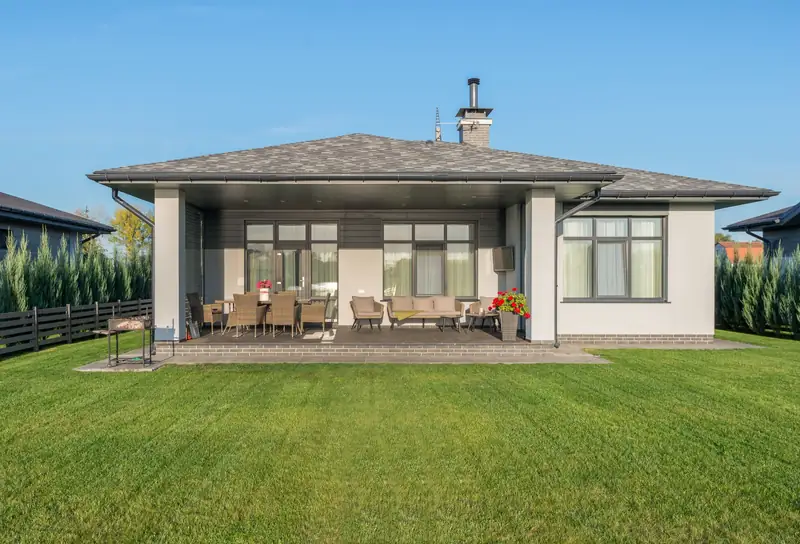
Artificial Turf · Siesta Key, FL
Artificial Turf Installation on Siesta Key
Artificial turf on Siesta Key runs $10–$25 per sq ft installed as of October 2026. The state's own turf standard sets a 10-foot setback from the water that matters on a canal or bayfront lot, and the island's current watering order gives turf one less thing to schedule around.
By the Opera Concrete & Pavers estimating team · Updated October 1, 2026
Get a free estimate
Tell us about the project and we'll call to set up a free site visit.
Picture a 280 sq ft turf strip replacing storm-damaged sod along a canal-front side yard
Picture a 280 sq ft turf strip replacing storm-damaged sod along a canal-front side yard. Pricing it at $10–$25 per sq ft runs $2,800 to $7,000, and a job that lands inside the typical $12–$18 range settles closer to $3,360 to $5,040. The canal frontage is what drives the layout here: the turf stops 10 feet short of the waterline unless an existing seawall already stands between the yard and the water, and the irrigation line that used to feed the old sod gets capped rather than extended into the new turf footprint.
Why the waterbody setback matters more here than inland
DEP's own installation rule, effective May 19, 2026, pairs the turf material spec, natural infill over a washed base, with a hard line near open water: nothing closer than 10 feet to a waterbody unless a seawall stands between the lawn and the water DEP Rule 62-308.100 F.S. §125.572. Siesta Key is mostly shoreline, canal frontage on one side of the island or the next, Roberts Bay on another, so that 10-foot line decides the turf's actual footprint on far more lots here than it would on an inland Orlando-area yard where the nearest open water might be a retention pond nobody built next to on purpose.
Choosing and setting turf around a pool deck
Turf around a pool gets fastened tight to the deck's edge restraint or coping bead, since that joint takes more foot traffic and more splash than any other seam in the yard. Chlorinated water and sunscreen residue don't break down most turf backings, but a seam placed right at the coping wears faster than a seam set back from the water, so the layout is planned to keep joints away from the busiest edge wherever it's practical. Infill still has to meet the state's natural-material rule even in a pool surround. On a Siesta Key deck, drain lines and skimmer equipment get built around, with turf cut to the equipment rather than equipment moved to fit the turf.
What the current watering order leaves out of turf's upkeep
Sarasota County sits inside the Southwest Florida Water Management District's current shortage order, which limits irrigation countywide to one scheduled day a week in an overnight window SWFWMD District Water Restrictions. New sod still has to live inside that calendar after a short initial grace period, but a finished turf lawn drops irrigation from its upkeep list entirely, a detail that carries real weight on a storm-recovery yard where the sod was already replaced once after the 2024 hurricanes and homeowners would rather not do it again.
What a dog run's base has to do that a lawn's doesn't
A pet area turf base starts from the same rule as the rest of the yard, washed crushed rock or crushed concrete, never limerock or road base with fines, but it carries more liquid in one place over and over. Fines-heavy base material binds and seals, which is exactly what traps urine at the surface instead of letting it drain through; a properly washed, open-graded base keeps that liquid moving down and away. On a Siesta Key lot, the run is also graded so rinse water drains off the pad rather than pooling at a low corner, since a dog run gets hosed down far more often than the rest of the lawn.
Why turf gets hot enough to matter in full Florida sun
Dark-colored turf fiber and infill both heat up fast in direct sun, and a panel installed with no shade at all across a Siesta Key yard will get noticeably hotter underfoot than the surrounding pavers or lawn by mid-afternoon. Bare feet, paws and pets lying down on it are the real complaint, not the turf material itself failing. A quick hose-down before use cools the surface for a while without running afoul of the rule against in-ground irrigation on turf, since hand-watering with a hose isn't the same system the rule restricts. Shade structures and tree cover, where the drip-line rule allows them, help more than any turf product choice does.
Why an arborist visit can come before the install crew does
If turf is planned inside a live oak's drip line, the arborist certification required by DEP Rule 62-308.100 has to happen before any grading starts, not as a step folded into the install. Once that certification is in hand, the crew works the root zone by hand, digging and placing base material in small sections instead of trenching or running equipment across roots. On a Siesta Key property with a mature oak close to the planned turf area, this adds a scheduling step up front, but it keeps the install from running into a stop-work problem halfway through a yard that's already been opened up.
Why infill needs occasional top-ups, not just brushing
Infill settles and migrates over years of foot traffic, rain and brushing, and a turf panel that looked fully filled at installation can thin out at high-traffic paths or low spots in a Siesta Key yard well before the turf fibers themselves show wear. A top-up uses the same natural material the rule requires at installation, clean silica sand, rock, shell or coated silica sand, not whatever happens to be on hand, since the material standard doesn't relax for a maintenance pass. Brushing the pile upright after a top-up redistributes the new infill evenly instead of leaving it in a pile at the low point.
Frequently asked questions
How close to the water can I install turf on a Siesta Key canal lot?
At least 10 feet back from the waterline, under Florida's statewide turf rule, unless a seawall already separates the lawn from the water. That's in addition to whatever setback the county's own zoning code requires.
Does turf help with the current water-shortage order on Siesta Key?
Yes. The island is under SWFWMD's countywide order limiting irrigation to one day a week, a schedule new sod still has to follow after a short grace period, while a finished turf lawn has nothing left to irrigate.
Can I run a sprinkler zone to a new turf area?
No. The state's turf standard bars in-ground irrigation run to the turf itself, a separate requirement from the waterbody setback and from any watering-day restriction on the rest of the yard.
Sources
- Sarasota County Code §124-48 Right-of-Way Use Permit
- Sarasota County Code §98-3 Driveway culvert / ROW use permit fees
- Sarasota County Code §124-255 Additional Provisions (culverts)
- Sarasota County Code §124-76 District Development Standards
- Sarasota County Code §124-283 Nonconforming Lots of Record
- Sarasota County Code §54-723 Gulf Beach Setback Line
- Sarasota County Code §22-63 (retaining walls > 4 ft engineered)
- Sarasota County Building (search excerpt; 403 to direct fetch)
- Sarasota County Online Permitting
- FDEP Coastal Construction Control Line Program
- FDEP — Apply for a CCCL permit
- FDOT Structures Design Guidelines Vol. 1, §1.3.2 environmental classification
- Florida Administrative Code — Rule 62-308.100, Synthetic Turf (effective May 19, 2026)
- Florida Statutes §125.572 — synthetic turf on single-family lots
- SWFWMD District Water Restrictions
- USDA NRCS — Web Soil Survey
- USDA NRCS Official Series Description — Canaveral
- Census Reporter, Siesta Key CDP FL (ACS 2020-2024 5-yr, B01003/B25035/B25024)
- Siesta Key Association — History
- Your Observer — Sarasota city commissioners vote to extend a hand to Siesta Key (Jan. 18, 2022)
- Wikipedia — Siesta Beach (Harvard University sand-composition study, TripAdvisor ranking)
- WWSB/Mysuncoast.com — Hurricane Milton landfall near Siesta Key, one year later (Oct. 9, 2025)
Ready for a price on your project?
Request a free estimate
Tell us about the project and we'll call to set up a free site visit.