
Artificial Turf · Clermont, FL
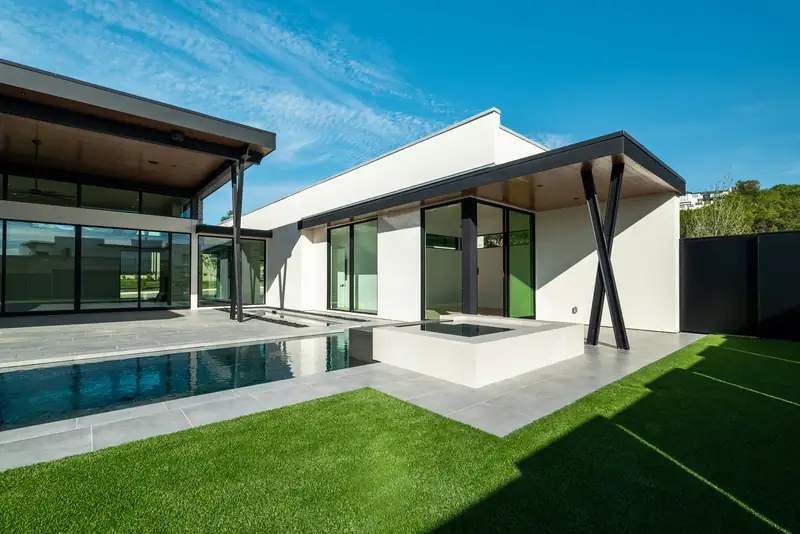
Artificial Turf for Clermont Yards
Artificial turf installation in Clermont is priced between $10–$25 per sq ft installed, current Florida figures for this fall. Under the state's current Phase III order, Lake County addresses water lawns just one day a week, a tighter calendar than the normal twice-weekly schedule, while turf itself sidesteps that calendar entirely once the base is set, and near any of Clermont's lakes, a 10-foot setback from the water still applies.
By the Opera Concrete & Pavers estimating team · Updated October 1, 2026
Get a free estimate
Tell us about the project and we'll call to set up a free site visit.
One day a week makes a sloped sod lawn harder to keep alive
SJRWMD's Phase III Extreme Water Shortage Order limits Lake County to a single watering day, odd addresses on Saturday and even addresses on Sunday, with nothing between 8 a.m. and 6 p.m. (SJRWMD, Watering Restrictions). On a lot that slopes toward Sugarloaf Mountain's hills, water runs off a graded yard faster than it does on flat ground to begin with, so new sod trying to establish on one watering day a week struggles more on a slope than it would on level turf, which is part of why artificial turf comes up as an option for the steepest section of a yard.
A 10-foot setback applies near any of Clermont's lakes
The city describes itself around its “fresh water bodies” among its defining features (City of Clermont, Economic Information), and the state's synthetic-turf standard sets a 10-foot minimum buffer between installed turf and a pond, lake or canal, waived only where a seawall forms the edge; underneath the turf itself, the rule rules out buried irrigation and calls instead for a washed base topped with natural infill (Florida Administrative Code, Rule 62-308.100). A 2025 law layered on top of that limits how far a city or county can push its own turf restrictions further, though it leaves an HOA's own rules untouched (Florida Statutes §125.572).
What goes under artificial turf on Florida soil
Florida's new turf rule treats the base as part of the system, not an afterthought. DEP Rule 62-308.100 requires the subgrade under residential turf to be washed crushed rock or crushed concrete, never limerock or road base with fines, because fines bind together and seal the soil the way a driveway base is supposed to. Most lots around Clermont sit on sandy flatwoods soils with a seasonal high water table that can sit within two feet of the surface for part of the year. A compacted aggregate lift that still drains is the only way to keep the lawn from holding water under the turf after a summer storm rolls through.
Fitting a turf accent into an existing paver layout
Where turf goes in alongside pavers already set in Clermont, the process starts with removing a strip of pavers and bedding sand rather than grading an open yard. The exposed subgrade is excavated a little deeper to fit the washed aggregate base for the turf, then compacted against the paver's existing edge restraint so the two systems tie together instead of shifting independently. The turf panel is cut to the exact width of the removed strip and seamed along its paver-side edge before the field edge is finished. Removed pavers are either reused elsewhere on the property or set aside for the homeowner.
Turf on a sloped lot near the water, worked out in square feet
A backyard sloping toward a neighborhood lake, fenced in at 560 square feet, loses some of that to the required buffer once the turf layout is pulled back from the shoreline, leaving around 520 square feet to actually install. Running that against the $10–$25 per sq ft installed figure prices the job between roughly $5,200 and $13,000, depending on the pile height and backing chosen. Because the lot slopes and sits near the water, the layout is measured against both the buffer and the grade before the base is cut, rather than against the full fenced area originally measured.
How a backyard putting green is built differently from the surrounding lawn
A putting surface uses a shorter, denser nylon or polyethylene face than a lawn-style turf panel, run with little or no infill so the ball rolls true instead of catching on loose sand or rock. Where a fringe of taller turf surrounds the green, that section is built, seamed and sometimes infilled more like a standard lawn, so the two sections meet at a visible but clean line. Florida's rule allows green synthetic turf without restriction on color, which covers both the putting surface and the fringe around it. On a Clermont green, the cup and flagstick positions get set after the base is finished, not before, so the surface isn't disturbed.
Why turf gets hot enough to matter in full Florida sun
Dark-colored turf fiber and infill both heat up fast in direct sun, and a panel installed with no shade at all across a Clermont yard will get noticeably hotter underfoot than the surrounding pavers or lawn by mid-afternoon. Bare feet, paws and pets lying down on it are the real complaint, not the turf material itself failing. A quick hose-down before use cools the surface for a while without running afoul of the rule against in-ground irrigation on turf, since hand-watering with a hose isn't the same system the rule restricts. Shade structures and tree cover, where the drip-line rule allows them, help more than any turf product choice does.
Checking seams and edges after storm season, not just once a year
A seam or edge that was anchored correctly at installation can still work loose over a season of heat cycling, wind and the occasional named storm moving through Clermont, so a walk around the full perimeter and every seam after a significant storm catches a lifted spot before it grows. Re-securing a loose edge early is a small fix; leaving it through another storm turns it into a bigger one, since each gust that gets under an open edge peels it back a little further. This check costs nothing but time and doesn't require pulling up any turf to do it.
Frequently asked questions
Does Clermont's watering order affect new sod differently than turf?
Yes. Sod planted under the one-day-a-week order has less room to recover between waterings, especially on a sloped lot where runoff is faster, while installed turf doesn't need watering at all once the base is set.
How close to a Clermont lake can artificial turf be installed?
The state standard requires a 10-foot buffer between the turf and the water, waived only where the edge is a seawall rather than open shoreline. Underneath the turf itself, buried irrigation is off the table, and the base has to be washed stone topped with natural infill.
Can an HOA in the Clermont area ban artificial turf entirely?
State law limits how far a city or county can restrict residential turf, though an HOA's own design guidelines can still add rules beyond that, which is worth checking with the specific community before installation.
Sources
- City of Clermont — Building Services FAQ
- City of Clermont — Permit Checklists
- City of Clermont — Applications & Forms
- City of Clermont — Permit Type Descriptions
- City of Clermont — Municode Ch. 125 Div. 5 R-1
- City of Clermont, Economic Information
- Census Bureau PEP, City and Town Population Totals, Vintage 2025 (July 1, 2025)
- Census Reporter, Clermont FL (ACS 2020-2024 5-yr, B25035)
- Wikipedia, Sugarloaf Mountain (Florida)
- Lake County — Residential Work Exempt from Permits
- Lake County — Residential Driveway Apron Permit
- Lake County — LDR Appendix A Transportation Standards
- Lake County — Right-of-Way Permit
- Lake County — Building Services
- NRCS OSD Candler
- NRCS OSD Tavares
- NRCS OSD Astatula
- SJRWMD Watering Restrictions
- Florida Administrative Code — Rule 62-308.100, Synthetic Turf (effective May 19, 2026)
- Florida Statutes §125.572 — synthetic turf on single-family lots
- Florida Senate Interim Report 2011-104 (sinkhole insurance)
- Citizen Portal, Clermont City Council meeting summary — Sky Ridge Road paver variance
- Kings Ridge Community, Frequently Asked Questions
Ready for a price on your project?
Request a free estimate
Tell us about the project and we'll call to set up a free site visit.