
Pool Deck Ideas for Florida Homes
Pool deck ideas for Greater Orlando and Sarasota–Manatee homes span poured concrete at $5 to $15 per square foot to travertine pavers that can run $13 to $30, as of October 2026. Material, color and turf accents at the edge all change a deck's look and heat underfoot without changing the slope and drainage every pool deck needs.
By the Opera Concrete & Pavers estimating team · Updated October 1, 2026
What Pool Deck Materials Are Popular in Florida?
Travertine, shell stone, concrete pavers and poured concrete, whether broom, acrylic resurfaced or stamped, cover most of what goes down around a Florida pool, and the choice usually comes down to budget, heat underfoot and how closely the deck needs to match an existing lanai or patio. A poured concrete pool deck runs $5–$15 per sq ft installed in Florida market data (src homeguide-pool-deck), while paver and travertine pool decks run $12–$30 per sq ft installed, a wider range driven mostly by material, with concrete pavers at the low end and travertine at the high end.
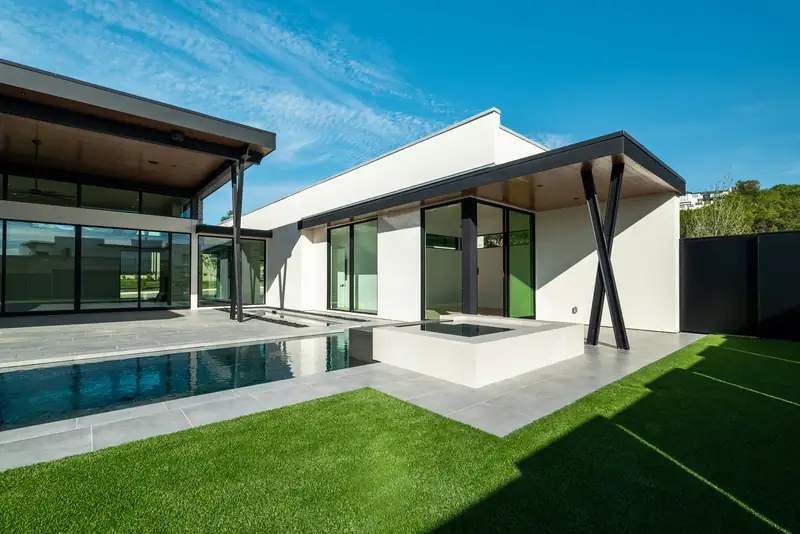
What Do Travertine Pool Deck Ideas Look Like?
Travertine's pale, honed-stone look and irregular natural veining read differently from the uniform gray of a standard concrete paver, which is why it shows up often on resort-style decks that pair the deck material with matching coping and step treads cut from the same stone. The stone is widely described as staying cooler underfoot than dark concrete pavers in direct Florida sun, though no independently verified measured temperature figures exist to print here. Our travertine pool deck care guide covers how the stone's porosity changes cleaning and sealing compared with concrete.
Travertine's main design trade-off against a concrete paver is upfront cost and porosity, both covered in our travertine vs. concrete pavers comparison. A deck can also mix the two: travertine at the coping and the first few feet closest to the water, with a concrete paver field filling the rest of a larger deck.
What Pool Deck Colors Work Well in Florida Sun?
Lighter tans, creams and warm grays absorb less solar heat than a dark charcoal deck surface, consistent with the general principle behind light-colored paving running cooler than dark paving in direct sun (src epa-cool-pavements); that matters more on a pool deck than almost anywhere else on a property, since bare feet stay in constant contact with it. A two-tone deck, a lighter field color with a darker paver or tile accent band at the coping, keeps most of the walking surface in the cooler range while still framing the pool's edge with contrast.
Our cool deck vs. pavers vs. travertine comparison covers how an acrylic resurfacing coating, which can also be tinted light, compares with pavers and natural stone for an existing deck that just needs a color refresh rather than a full tear-out.
Can You Use Artificial Turf Strips or Accents on a Pool Deck?
Yes, and a narrow turf strip or planted-look accent band between paver courses is one way to break up a large deck visually and add a softer surface for bare feet to cross. Florida's 2026 synthetic turf standard sets a real limit worth knowing before planning one in: under the rule, synthetic turf generally stays no closer than a 10-foot buffer measured from the edge of a natural or constructed body of water, unless a seawall or other physical barrier already separates the two (src rule62-308-100-text). A swimming pool is itself a constructed body of water, so that buffer plausibly reaches a turf accent placed too close to the coping; a strip set back along the outer edge of a larger deck is the more workable placement.
Our artificial turf page covers the base and infill spec the rule requires, and our guide to how hot artificial turf gets is worth reading before placing a strip anywhere bare feet will cross it in full sun.
What Is a Sun Shelf, and How Does Deck Design Change Around One?
A sun shelf, also called a tanning ledge or Baja shelf, is a shallow, submerged platform built into the pool itself, typically a few inches of water over a flat shelf near one end, built and waterproofed as part of the pool shell rather than the surrounding deck. What the deck does is tie cleanly into that shelf's edge: a consistent elevation, a slight slope away from the pool for drainage, and often a paver or concrete band that continues the walking surface right up to where the shallow water begins.
Furniture made for a sun shelf, in-water loungers and umbrella bases, sits inside the pool itself rather than on the deck, so the deck's design job is mostly about making the transition from dry deck to shallow water feel continuous rather than like a step down onto a different surface.
Pool Deck Material Options Compared
| Material | Market price range | Note |
|---|---|---|
| Poured concrete | $5–$15 per sq ft installed | Broom, acrylic or stamped finish options |
| Concrete pavers | Low end of paver range | Uniform gray-toned look, lowest paver cost |
| Travertine / shell stone | Up to $30 per sq ft installed | Lighter, cooler-toned; more sealing upkeep |
| Turf accent strip | Priced as artificial turf, small footprint | Must clear the 10-foot waterbody setback |
Figures are Florida market ranges, not quotes.
What Should Sarasota and Manatee Homeowners Consider for a Coastal Pool Deck?
Coastal salt air changes how a deck ages faster than it changes how the deck looks on day one: our guide to saltwater pools and salt air covers sealing frequency and material choices for homes near the Gulf. Our guide to HOA approval for pavers and concrete is worth a read before a deck redesign near a pool cage, since an enclosure or screen often falls under the same architectural review a paver or concrete choice does.
Our pool deck cost guide breaks pricing down by material, and our pavers vs. concrete pool deck comparison goes deeper into the upkeep trade-offs between the two main categories covered here.
Frequently asked questions
Does a lighter pool deck color really stay cooler underfoot?
Lighter colors absorb less solar heat than dark ones, a well-established principle in paving generally, though no verified Florida-specific temperature measurements exist to quote here. The safe planning assumption is that a dark charcoal deck in full sun reads noticeably hotter than a tan or cream one in the same spot.
Can concrete and paver pool decks be mixed on the same project?
Yes. A common approach uses a paver or travertine band at the coping and the first few feet of deck, where appearance and heel-grip matter most, with poured concrete filling a larger surrounding patio area at lower cost.
How close to the pool can artificial turf be installed?
Florida's 2026 turf standard requires at least 10 feet from the water line of a natural or man-made waterbody unless a seawall or similar barrier is present, and a pool reads as a man-made waterbody under that rule, so a turf accent generally needs to sit back from the coping rather than right against it.
Does a sun shelf need a different deck material around it?
Not necessarily. The deck material choice, concrete, pavers or travertine, carries over from the rest of the deck, with the main design consideration being a consistent elevation and slope where the dry deck meets the shelf's shallow water.
Is travertine worth the extra cost over concrete pavers for a pool deck?
It depends on budget and priorities. Travertine costs more upfront and needs more frequent sealing, but it reads lighter and cooler-toned and pairs naturally with coping cut from the same stone, the main reason homeowners choose it over a standard concrete paver.