
Concrete Patio Ideas for Florida Homes
Concrete patio ideas for Greater Orlando and Sarasota–Manatee homes range from a $6 to $13 per square foot broom or salt finish to $8 to $19 stamped concrete with integral color, as of October 2026. A patio extension, a stained surface or a slab shaped to fit a pool cage all sit on the same base and joint plan.
By the Opera Concrete & Pavers estimating team · Updated October 1, 2026
What Concrete Patio Finishes Look Good Beyond a Plain Broom Finish?
A plain broom finish is the budget baseline for a concrete patio, priced at $6–$13 per sq ft installed in Florida market data (src homeguide-concrete-patio), and most of the decorative options below sit on that same slab rather than a different base or thickness. Stamped concrete is the most involved step up, running $8–$19 per sq ft installed, but a salt finish, an integral color or a surface stain each add a lighter decorative touch for less than a full stamped pattern costs.
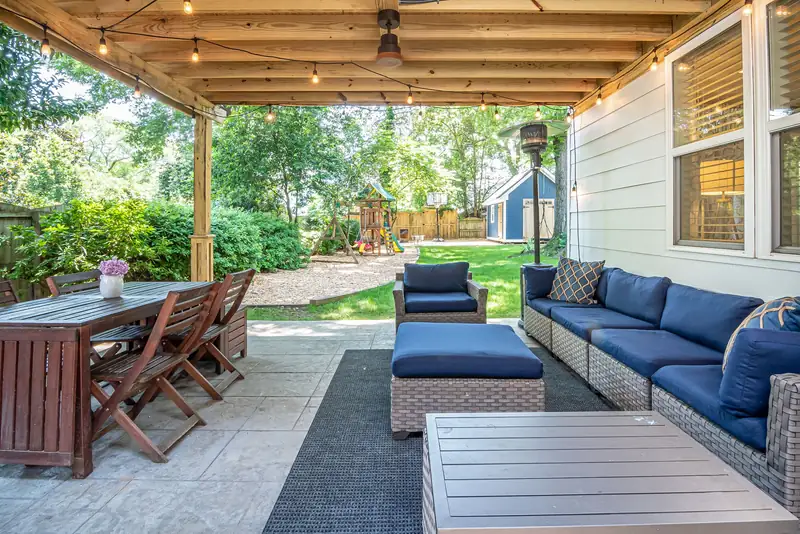
What Is a Salt Finish Patio, and How Does It Perform in Florida?
A salt finish patio is made by pressing coarse rock salt crystals into the surface of freshly troweled concrete, letting the slab cure, then washing the crystals out once the concrete has set, leaving a field of small round pits across the surface. The pitted texture adds grip underfoot without the cost of exposed aggregate or stamping, which is part of why it shows up often around pools and patios in warmer climates where a slip-resistant surface matters more than it would on a covered porch.
The technique works best on a patio that will not see heavy furniture dragged across it regularly, since the pitted surface can hold grit that scratches furniture feet over time. A sealed salt finish resists staining about as well as any other sealed decorative concrete, and the pits do not trap water the way an unsealed exposed aggregate finish can.
What Does a Stained Concrete Patio Look Like, and How Long Does the Color Last Outdoors?
A stained patio uses an acid or water-based stain applied to cured concrete rather than color mixed into the batch, producing a mottled, variegated look closer to natural stone than the flat, uniform tone of integral color. National pricing for staining existing concrete runs $3 to $15 per square foot, depending on the stain type and how many colors are layered. Acid stains react chemically with the concrete and do not fade the way a surface coating can, but the sealer over the top still wears under UV and foot traffic the same way it does on stamped concrete, so the sealer, not the stain itself, is usually what needs attention first.
What Patio Shapes Work Well With an Irregular Yard or a Pool Cage?
A patio panel poured roughly square, with its length no more than one and a half times its width, cracks less predictably than a long, narrow or L-shaped panel, the same joint-layout principle contractors follow on any flatwork, driveways included (src nrmca-cip6). An L-shaped or wraparound patio that follows a pool cage's footprint usually needs its control joints planned around that shape rather than laid out on a simple grid, since each inside corner is a point where cracking tends to start without a joint nearby to relieve it.
A patio that steps around an existing tree, a utility pad or a property line does not have to follow a straight edge. A curved border costs more in forming and finishing time than a straight one, but it avoids the awkward notches a rigid rectangle can create on an irregular lot.
Where Can a Concrete Patio Extend From the House?
A back patio most often extends straight off a rear slider or French door, but a side extension off a kitchen or garage wall works well for a grilling station or a secondary sitting area that does not compete with the main backyard space. Extending a patio to meet an existing paver patio or pool deck, rather than leaving a gap of grass between two paved areas, is a common request on an older Florida home where the pool deck and the house were never tied together in the first plan.
Our guide to extending a patio under a screen enclosure covers the framing and drainage side of stretching a patio to the edge of an existing cage, and our concrete patio page covers the thickness and joint spec behind any extension.
Concrete Patio Finish Options Compared
| Finish | Market price range | Note |
|---|---|---|
| Plain broom | $6–$13 per sq ft installed | Budget baseline; no decorative upkeep |
| Salt finish | Close to plain broom, modest premium | Pitted texture, extra grip, not a coating |
| Stained | $3–$15 per sq ft to stain existing concrete | Mottled, variegated look; reacts with the concrete |
| Stamped | $8–$19 per sq ft installed | Most decorative option; needs sealer upkeep |
Figures are Florida market ranges, not quotes.
Where Do Patio Finish Choices Run Into HOA Rules?
A stain or integral color choice can run into the same kind of HOA review a driveway color does, and a patio extension that adds impervious square footage can trigger a county permit review even where the original slab did not need one. Our guide to HOA approval for pavers and concrete and our Orange County and Orlando permit guide cover what each review typically looks at.
Our concrete patio cost guide breaks pricing down by finish and size, and our stamped concrete vs. pavers comparison is worth a look if the choice is between a decorative concrete patio and a paver one rather than between finishes on the same slab.
Frequently asked questions
Is a salt finish patio more slippery than a broom finish when wet?
No, generally less so. The pitted texture left once the salt crystals wash out gives a salt finish extra grip compared with a smooth trowel finish, though it is not as aggressively textured as exposed aggregate.
Does staining concrete cost more than coloring it with integral color?
It depends on the number of colors and layers. A simple one-color stain on an existing slab often costs less than ordering integral color at the time of the pour, but integral color tends to hold its tone more evenly over years of UV exposure than a surface stain.
Can an L-shaped patio be poured without extra cracking risk?
It can, as long as control joints are planned around each inside corner rather than laid out on a straight grid, since an L-shaped panel is more prone to cracking at the inside corner than a simple rectangle is.
Can a concrete patio be poured in a curve instead of a straight edge?
Yes. A curved form costs more in labor to build and finish than a straight one, but it is a common way to route a patio around a tree, a utility pad or an irregular property line without an awkward notch.
Do I need a permit to extend an existing concrete patio?
It depends on the jurisdiction and how much square footage the extension adds. Our permit guides for Orange County, Sarasota County and the other counties in our service area cover what each building department currently requires.