
A Low-Maintenance Backyard Plan for Florida (Turf, Pavers and Concrete)
A low-maintenance Florida backyard plan zones a lot into a hardscape anchor, a sized turf area and a smaller planting zone, replacing the lawn area that demands the most mowing and watering. As of October 2026, both regional water management districts limit lawn watering by schedule, not by area, so cutting turf-grass square footage cuts watering demand directly while synthetic turf and hardscape draw no water at all.
By the Opera Concrete & Pavers estimating team · Updated October 1, 2026
What Does a Low-Maintenance Backyard Plan Actually Cut Out?
A low-maintenance Florida backyard plan replaces the parts of a yard that demand the most routine time, mowing, edging and watering turf grass, with synthetic turf, paver or concrete hardscape and a smaller bed of plants matched to the site, rather than trying to reduce upkeep on the same amount of lawn. It does not mean no planting at all; a yard with zero live plants reads flat and loses the shade and screening a few well-placed trees and shrubs still provide. The goal is fewer square feet that need a mower, an edger and a sprinkler zone, not fewer square feet that need any attention whatsoever.
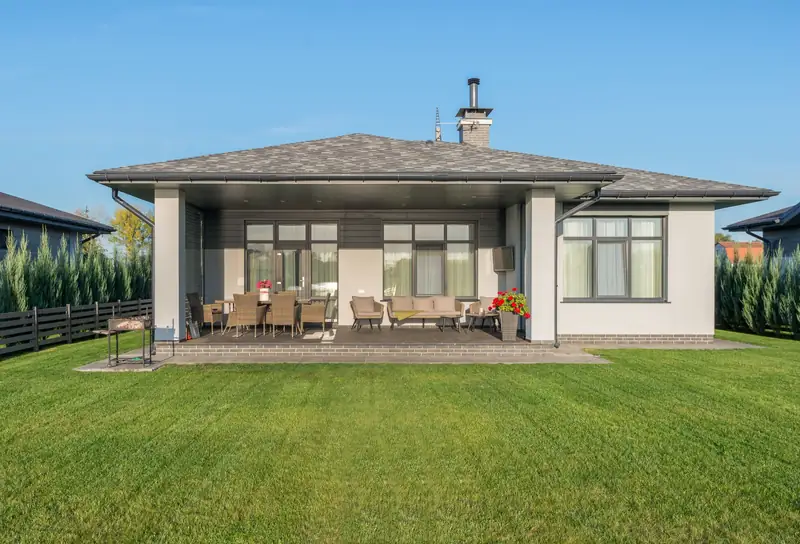
How Do You Zone a Yard Into Turf, Hardscape and Planting?
The most workable low-maintenance layouts split a backyard into three zones rather than blending turf and planting beds across the whole lot: a hardscape zone for the patio, path and any fire pit or seating area; a turf zone sized to where bare feet and pets actually use open lawn; and a planting zone kept to borders, foundation beds and a few specimen trees rather than spread thin across the yard. Planting pulled to the edges also keeps irrigation zones simple, since beds along a fence line or the house can run on one drip zone while the open turf area needs none at all, rather than scattering individual beds that each need their own watering schedule across an otherwise synthetic lawn.
How Does Florida-Friendly Landscaping Fit a Low-Maintenance Plan?
The University of Florida's Florida-Friendly Landscaping program sets out nine principles for the state's climate and soils, starting with "right plant, right place," choosing species suited to a site's sun, shade and water availability rather than fighting the site to keep an unsuited plant alive, through watering efficiently and reducing stormwater runoff (UF/IFAS, Florida-Friendly Landscaping, Nine Principles). A yard built around those principles for its remaining planted beds, paired with turf and hardscape for the rest, tends to need less routine input across the board than a lawn-only yard with a handful of mismatched ornamentals scattered through it.
Does Cutting Lawn Area Actually Reduce Watering Under Current Restrictions?
Yes, directly, since both water management districts covering our service areas currently limit how often and how long a lawn can be watered rather than how much total area exists to water. The St. Johns district's year-round schedule for the Orlando area caps each irrigation zone at about three-quarters of an inch per run, and several Orlando-area counties currently sit under a stricter once-a-week emergency order on top of that baseline (SJRWMD watering restrictions). The Southwest Florida district's current order for Sarasota and Manatee runs through March 2027 and limits watering to one day a week within narrow overnight windows (SWFWMD district water restrictions). A smaller turf-grass footprint means fewer zones competing for those limited watering windows, and the synthetic turf or hardscape replacing the rest of the lawn draws no water at all.
What Role Does Hardscape Play in a No-Mow Yard?
A paver or concrete patio, path and a seat wall or planter edge do more than give the yard a place to sit; they set the hard boundary a turf or planting zone butts against, which keeps the layout crisp instead of a lawn or turf edge that drifts and blurs into beds over a season or two without a physical edge holding the line. A generously sized patio, planned as the anchor the rest of the yard is zoned around rather than an afterthought carved out of leftover space, usually does more to cut routine upkeep than any single planting or turf decision does on its own. Our paver patio ideas guide and our concrete patio ideas guide cover layout options for that anchor space.
How Much of the Yard Can Reasonably Go Hardscape or Turf?
Most residential zoning caps how much of a lot can go impervious regardless of what a homeowner would prefer, so a low-maintenance plan has to work within that ceiling rather than around it; one Sarasota-area jurisdiction we checked caps combined driveway, parking and turnaround impervious area at 40 percent of the required front or street-side yard alone, separate from the rest of the lot (City of Orlando, Ordinance 2022-45). Artificial turf counts as pervious under Florida's 2026 turf rule when it is built to the rule's permeable base standard, which is part of why it often fits inside a stricter impervious-surface limit in a way a poured patio of the same footprint would not.
Low-Maintenance Backyard Zones Compared
| Zone | Typical material | What it replaces |
|---|---|---|
| Hardscape anchor | Pavers or concrete patio, path, seat wall | A mowed lawn area used for seating, dining or a fire pit |
| Turf zone | Artificial turf, sized to actual foot traffic | The portion of lawn that mainly needs mowing, not walking on |
| Planting zone | Borders, foundation beds, a few specimen trees | Scattered beds that each need their own watering and weeding |
A yard that keeps these three zones distinct generally needs fewer separate maintenance routines than one that blends them.
Frequently asked questions
Does a low-maintenance backyard mean no plants at all?
No. A yard with zero live plants loses shade and screening that only trees and shrubs provide, and most low-maintenance plans keep a planting zone, usually at the borders and foundation beds, while cutting back the lawn area that needs routine mowing and watering.
Does less lawn area really save water under current restrictions?
Yes, directly. Both water management districts covering Greater Orlando and Sarasota-Manatee currently limit watering frequency and duration rather than total area, so a smaller turf-grass footprint competes for fewer of those limited watering windows, and synthetic turf or hardscape draws no water at all.
How much of a backyard can be turned into patio or turf?
It depends on local zoning, which typically caps how much of a lot can go impervious regardless of preference. Artificial turf built to Florida's 2026 turf rule generally counts as pervious, which is part of why it often fits inside a stricter impervious-surface limit better than a poured patio of the same footprint.
What is Florida-Friendly Landscaping, and does it apply to a low-maintenance plan?
It is a University of Florida program built around nine principles for the state's climate and soils, starting with matching plants to a site's actual sun, shade and water conditions. A low-maintenance yard that applies those principles to its remaining planted beds, alongside turf and hardscape for the rest, tends to need less routine care than a lawn-only yard with mismatched plantings.
Should the patio or the planting plan come first in a yard redesign?
The patio or other hardscape anchor is usually worth planning first, since it sets a physical edge the turf and planting zones butt against. Planning planting beds first and fitting hardscape into whatever space is left tends to produce a more fragmented layout.