
Paver Driveways · Bradenton, FL
Paver Driveway Installation in Bradenton
Expect to pay $10–$30 per sq ft installed for a paver driveway in Bradenton, a market range current as of October 2026 that holds whether the job is new work or a tear-out. The finished square footage still has to clear the city's impervious surface ratio, and on a lot near Palma Sola Bay, salt air shapes which base and edge-restraint hardware holds up best.
By the Opera Concrete & Pavers estimating team · Updated October 1, 2026
Get a free estimate
Tell us about the project and we'll call to set up a free site visit.
Say you have an 18 x 40 ft two-car paver driveway, 720 sq ft, on a West Bradenton lot a few blocks from Palma Sola Bay
Say you have an 18 x 40 ft two-car paver driveway, 720 sq ft, on a West Bradenton lot a few blocks from Palma Sola Bay. Figure $10–$30 per sq ft: $7,200 to $21,600 across the full range, tightening to about $8,640 to $14,400 inside the typical $12–$20 band depending on paver type and base depth. Because the lot sits in unincorporated West Bradenton rather than inside the city line, the access and drainage permit comes from Manatee County rather than the city's zoning office, and because the bay is close by, the edge restraint spec steps up a grade from what an inland Bradenton lot would need.
Pavers don't get a pass on the impervious cap
Bradenton's LUR §3.2 defines impervious surface broadly enough to catch a paver driveway the same way it catches poured concrete: "building footprint, paved drives, paved terraces, impervious decks, swimming pools, and other impervious surfaces" Bradenton LUR §3.2 Schedule 3.2.2.1 (max % impervious). The district caps run from 50% in R-1 up to 70% in R-3, UV and R-4, and the city's own worksheet totals a lot's existing coverage against the proposed addition Bradenton Impervious Coverage Calculation Worksheet. Going from two bays to three on a tight R-1 lot is the kind of change that can tip a parcel over its cap, so the worksheet is worth running before the paver order goes in, not after, since LUR §2.2.1's zoning permit asks for the same figure Bradenton LUR §2.2 Requirements for permits and approvals.
Why the bedding sand layer is exactly one inch, not an estimate
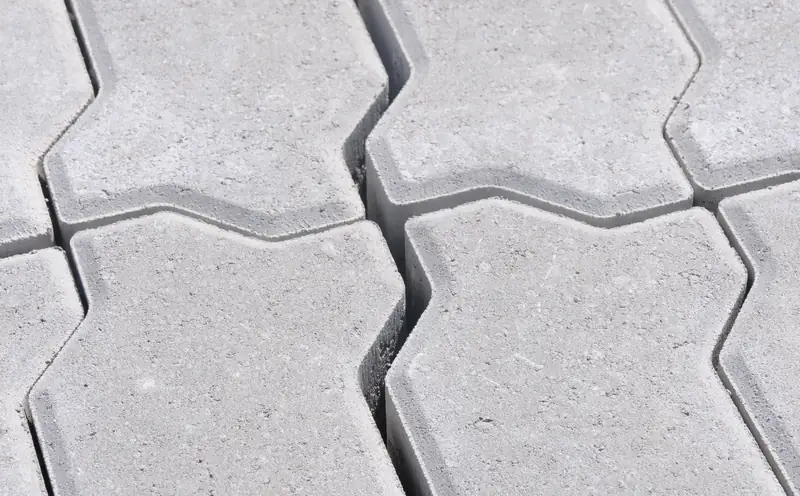
Between the compacted aggregate base and the pavers themselves sits a layer of bedding sand, screeded to a nominal 1 inch before it's ever compacted. That number isn't a rough guide: too little and the pavers rock on the base; too much and the layer compacts unevenly once traffic starts rolling over it. The joints between individual units are set at no more than one-eighth of an inch, tight enough that the field locks together once dry joint sand is swept in. On a Bradenton driveway laid course by course, keeping that bedding layer consistent across the whole field is one of the steps that separates a flat surface from one with visible waves within a year.
Building a paver base on wet flatwoods ground
Myakka and Pomello, two soils found across Manatee County, sit at opposite ends of the drainage spectrum: Myakka holds a seasonal high water table less than a foot and a half deep for part of most years, while Pomello drains somewhat better, with water typically a foot and a half to four feet down NRCS OSD Myakka NRCS OSD Pomello. ICPI's paver spec calls for at least 6 inches of compacted base on well-drained ground, 2 to 4 inches more where the soil runs wet or weak, which on a Myakka lot is closer to the rule than the exception. On a lot bordering Palma Sola Bay, we also favor edge restraints and fastener hardware rated for salt exposure, since FDOT's structures manual puts anything within 2,500 feet of salt water carrying 2,000 ppm chloride or more in its marine-environment category FDOT Structures Design Guidelines Vol. 1, §1.3.2 environmental classification.
What a 98 percent Proctor reading actually means for a Bradenton driveway
ICPI calls for the compacted subgrade and the aggregate base under a driveway to reach at least 98 percent of standard Proctor density, tested against ASTM D698, with vehicular areas held to the stricter modified Proctor instead. That number comes from a plate compactor working the base in lifts of 4 to 6 inches, not one pass over the whole excavation. Skipping a lift, or compacting a lift that's too thick, is how a base looks finished on the surface and still settles under Bradenton traffic within a season. The spec also sets a surface tolerance of plus or minus three-eighths of an inch over 10 feet, tighter than it sounds once pavers sit on top of it.
A sunken paver driveway is almost never a sinkhole
Most dips in a paver driveway trace back to the base underneath: a spot that never reached full compaction, a wet area that settled differently than the rest of the lot, or bedding sand that migrated once water found a path through a joint. True sinkhole activity is a separate geological process, and claims for it concentrate heavily in a handful of counties, Hernando, Pasco and Hillsborough chief among them, with Orange County also appearing on the state's list of counties with the most reported claims. For a driveway in or near Bradenton, a localized dip after a rainy season is far more likely to be ordinary base settlement than ground collapse, though a sudden, sharply defined depression is worth a second look regardless of which county it's in.
Why compaction happens in lifts, not one pass
Aggregate base doesn't get compacted as one thick layer; it goes down and gets compacted in lifts of about 4 to 6 inches at a time, run over with a plate compactor heavy enough to do the job, around 7,000 pounds of compaction force. A 6-inch driveway base is at least one full lift, often closer to two depending on the starting grade, and each one gets its own pass before the next layer goes on top. Pressing the whole depth at once from the surface doesn't reach the bottom of the base the same way, which is how a Bradenton driveway ends up solid on top and soft two inches down, a flaw that doesn't show until a season of traffic and rain finds it.
Sealing a paver driveway: no fixed clock, but a real one
ICPI's own spec doesn't give a number of years between sealer applications, noting only that it depends on use, climate and the sealer's own quality, with acrylic sealers typically holding up for what the spec calls a few years before recoating is worth it. Climate does real work in that sentence for a Bradenton driveway: both service areas sit close to the 50-inch mark for annual rainfall, concentrated heavily in a rainy season, and that much water and sun exposure wears a sealer faster than a drier region would. Watching the surface for fading sheen or water that stops beading is a better guide than a calendar, since the spec itself won't give a firm date.
Frequently asked questions
Do pavers count the same as concrete for Bradenton's impervious limit?
Yes. LUR §3.2 defines impervious surface broadly enough to include paved drives regardless of material, so a paver driveway draws from the same percentage cap as a poured one would on the same lot.
Does a paver driveway near Palma Sola Bay need different hardware?
It's worth it. FDOT's own structures guide puts anything within 2,500 feet of salt water carrying 2,000 ppm chloride or more in its marine-environment category, which describes much of the shoreline along the bay, so we spec edge restraints and fasteners rated for salt exposure on those lots.
Is the paver driveway permit different in West Bradenton than inside the city?
Yes. West Bradenton is unincorporated Manatee County, so the driveway goes through the county's access and drainage permit rather than the city's zoning permit and Public Works curb cut review that apply inside the Bradenton city line.
Sources
- Census Bureau PEP, City and Town Population Totals, Vintage 2025 (July 1, 2025)
- Census Reporter, Bradenton FL (ACS 2020-2024 5-yr, B25035)
- City of Bradenton
- Bradenton LUR §4.1 Land alterations (access, sidewalks)
- Bradenton LUR §2.2 Requirements for permits and approvals
- Bradenton LUR §3.2 Schedule 3.2.2.1 (max % impervious)
- Bradenton LUR §5.1 Residential buildings (retaining walls)
- Bradenton Driveway/Sidewalk Affidavit & Indemnification (12/2024)
- Bradenton Impervious Coverage Calculation Worksheet
- Bradenton Building and Permitting Division
- Manatee County LDC §1004.2 Access and Drainage Permit
- Manatee — Request a Driveway or Culvert Permit
- Manatee — What Does Not Require a Permit (6-16-26)
- Manatee County - Modified Phase III water shortage restrictions
- SWFWMD District Water Restrictions
- FEMA - Features of Flood Insurance Rate Maps in Coastal Areas
- FDOT Structures Design Guidelines Vol. 1, §1.3.2 environmental classification
- NRCS OSD EauGallie
- NRCS OSD Immokalee
- NRCS OSD Felda
- NRCS OSD Myakka
- NRCS OSD Pomello
- Florida Administrative Code — Rule 62-308.100, Synthetic Turf (effective May 19, 2026)
- Florida Statutes §125.572 — synthetic turf on single-family lots
- F.S. 720.3045 (2026) Installation, display, and storage of items
- Florida Climate Center - Bradenton 1991-2020 normals
- NRMCA CIP 12 Hot Weather Concreting
- NRMCA CIP 6 Joints in Concrete Slabs on Grade
- City of Bradenton, Floodplain Management Program
- Wikipedia, West Bradenton, Florida
- Wikipedia, Palma Sola Bay
Ready for a price on your project?
Request a free estimate
Tell us about the project and we'll call to set up a free site visit.