
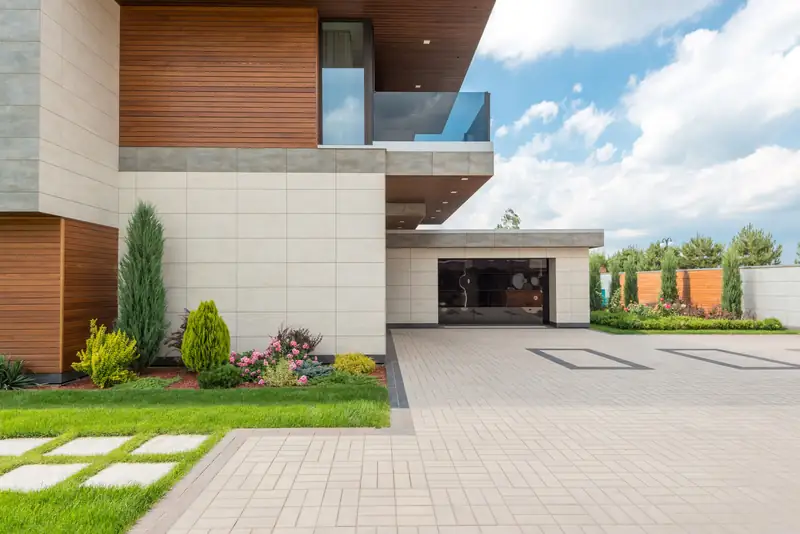
Paver Driveways · Palmetto, FL
Paver Driveway Installation in Palmetto
Palmetto homeowners pricing a paver driveway see $10–$30 per sq ft installed as of October 2026, whether the lot sits downtown or along the newer waterfront at Riviera Dunes. The permit rule stays the same either way: anything touching the street needs the city's right-of-way approval first.
By the Opera Concrete & Pavers estimating team · Updated October 1, 2026
Get a free estimate
Tell us about the project and we'll call to set up a free site visit.
Newer ground at Riviera Dunes, older ground downtown
Riviera Dunes, a waterfront community that began development in 1998 on a reclaimed 214-acre dolomite mine along the Manatee River, sits on a very different footprint than Palmetto's older downtown grid Palmetto, Florida. A wider motor-court paver driveway common on a newer Riviera Dunes lot still answers to the same Sec. 25-2 right-of-way rule at the street as a narrower apron on an older downtown block Palmetto Code Sec. 25-2, and the city's own form sets the same 48-hour notice and 30-day completion window for either one Palmetto Right-of-Way Use Permit.
Building a paver driveway over an old concrete slab
An existing concrete driveway can sometimes serve as the structural base for a new paver surface instead of being demolished, but it changes the build in ways worth planning for. The slab has to be sound, without the kind of cracking or settlement that would telegraph through a bedding sand layer, and its drainage has to be checked since a solid slab doesn't absorb water the way a compacted aggregate base does. Adding pavers plus bedding sand on top also raises the finished grade, which matters at a garage threshold or anywhere the driveway meets a Palmetto sidewalk or the street. Skipping demolition can save a step, but only on a slab that earns the shortcut.
Say a 16 x 38 ft paver driveway with a side motor court on a Riviera Dunes lot comes to 608 sq ft
Say a 16 x 38 ft paver driveway with a side motor court on a Riviera Dunes lot comes to 608 sq ft. At $10–$30 per sq ft, figure $6,080 to $18,240 across the full range, tightening to about $7,296 to $12,160 inside the typical $12–$20 band depending on paver thickness and pattern. Because the lot sits on reclaimed, newer-graded ground rather than the original downtown fill, the base compaction gets checked against the softer spots a mine-site reclamation can leave behind, and the apron at the street still needs the same right-of-way filing a downtown Palmetto driveway would.
Compacting a paver base over wet ground
ICPI calls for about 6 inches of compacted aggregate on ground that drains freely, with 2 to 4 more inches added where the subgrade stays wet. Two soils common around Manatee County fall into that second group: EauGallie keeps groundwater inside 18 inches of grade for one to four months most years, and Felda does the same for two to six months NRCS EauGallie soil series NRCS Felda soil series. Pouring the standard 6-inch base on either one is how a paver driveway ends up rutting under a parked car within a season or two.
What happens when joint sand washes out before it sets
Dry joint sand has to be swept in and compacted to actually lock a paver field together, and until that happens it's just loose material sitting in an eighth-inch gap. A heavy downpour that hits before the compaction pass, a real risk during a wet season that runs roughly late May through mid-October, can wash that sand partway out of a Palmetto driveway before it ever gets the chance to set. The result isn't just cosmetic: without sand holding the joints, individual pavers can shift and rock under tire loads, which accelerates wear at the exact spots where the sand is thinnest. Re-sanding a washed-out joint is a straightforward fix, but it's one more trip that careful sequencing avoids.
Ridge sand versus flatwoods: two different subgrades under Palmetto driveways
Central Florida and the Suncoast sit on two very different subgrade types. Ridge sands such as Candler and Astatula drain excessively, with a water table that can sit 80 inches or deeper, about as forgiving a subgrade as pavers ever see. Flatwoods soils such as Myakka, Florida's official state soil, or Smyrna and EauGallie hold a water table within 18 inches of the surface for part of most years. A driveway base built the same way on both will perform differently: the sandy ridge lot drains the base almost on its own, while the flatwoods lot needs the extra depth the spec allows for wet ground. Knowing which one sits under a given Palmetto address changes the base plan before anything gets dug.
The order a paver driveway actually goes in
The sequence doesn't vary much from job to job: excavate to the planned depth, compact the subgrade, place and compact the aggregate base in lifts, screed the bedding sand, lay the pavers course by course, cut units at the borders, install edge restraint, then sweep in and compact the joint sand. Each step depends on the one before it holding up, which is why a Palmetto crew that rushes the base to reach the visually satisfying part, laying pavers, usually pays for it later in an uneven field. Nothing about the order is optional, even though only the last two steps are visible once the driveway is done and swept clean.
What efflorescence needs from you: nothing
The whitish bloom that can show up on new concrete pavers within the first couple of months doesn't call for a cleaner, a sealer, or a change in routine, because ICPI's spec is clear that it doesn't affect the structural performance of the pavers at all. It tends to fade on its own with normal weather and traffic, and scrubbing at it or sealing over it early can trap it rather than help it clear, so the honest advice for a Palmetto driveway showing this in its first season is to keep up the normal sweeping and let it wear off. Treating it as a maintenance problem instead of a normal early-life process is the only real mistake available here.
Frequently asked questions
Does a paver driveway at Riviera Dunes need a different permit than one downtown?
No. Both answer to the same Code Sec. 25-2 right-of-way permit for the portion touching the street, regardless of which part of Palmetto the lot sits in.
Does a paver driveway need extra base depth on Palmetto's wetter lots?
On EauGallie or Felda ground, yes, typically 2 to 4 more inches of compacted base than a free-draining lot needs, since groundwater on both soils sits inside 18 inches of grade for part of a typical year.
How wide can a paver driveway be in Palmetto?
The published city code doesn't set a maximum width for a residential apron the way some neighboring jurisdictions do; the Right-of-Way Use Permit application and a call to Public Works confirm what a specific lot and street can support.
Sources
- Palmetto Code §25-2 Permit required for use of street or ROW
- Palmetto Right of Way Use Application/Permit (rev. 2019)
- Palmetto Building Department
- Palmetto Code §10-46 Seawall/retaining wall permit required
- Palmetto Code §29-207 Stormwater fee
- Manatee County - Modified Phase III water shortage restrictions
- SWFWMD District Water Restrictions
- FEMA - Features of Flood Insurance Rate Maps in Coastal Areas
- FDOT Structures Design Guidelines Vol. 1, §1.3.2 environmental classification
- NRCS OSD Immokalee
- NRCS OSD EauGallie
- NRCS OSD Felda
- Florida Administrative Code — Rule 62-308.100, Synthetic Turf (effective May 19, 2026)
- Florida Statutes §125.572 — synthetic turf on single-family lots
- F.S. 720.3045 (2026) Installation, display, and storage of items
- NWS Tampa Bay Thunderstorm Climatology Quick Reference
- Census Reporter, Palmetto FL (ACS 2020-2024 5-yr, B01003/B25035)
- Wikipedia, Palmetto, Florida
- Wikipedia, Snead Island
Ready for a price on your project?
Request a free estimate
Tell us about the project and we'll call to set up a free site visit.