
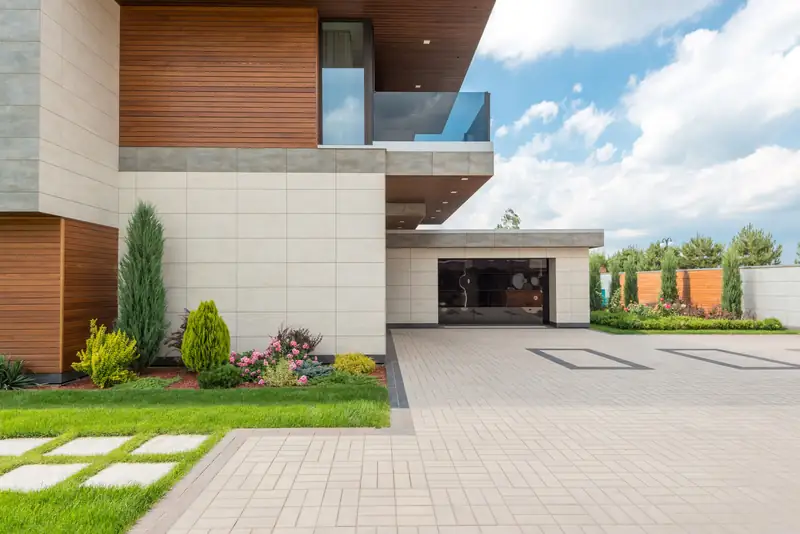
Paver Driveways · Lakewood Ranch, FL
Upgrading a Builder-Grade Driveway to Pavers in Lakewood Ranch
A paver driveway in Lakewood Ranch runs $10–$30 per sq ft installed as of October 2026. Most driveways here left the builder as plain gray concrete, so a paver driveway is usually a material change on a home built since 2014 rather than new construction, and a material change is exactly what the community's Modification Request Form exists to review.
By the Opera Concrete & Pavers estimating team · Updated October 1, 2026
Get a free estimate
Tell us about the project and we'll call to set up a free site visit.
Why swapping concrete for pavers needs its own sign-off
The Country Club/Edgewater Village homeowners' manual lists changing the material of a residential driveway or walkway as one of the items that requires a Modification Request Form (Lakewood Ranch Town Hall, CEVA Homeowners’ Manual 2022). Community Association Services processes that form regardless of which village the lot sits in, but the exact paperwork differs: Country Club and Edgewater share one form, Greenbrook and Summerfield-Riverwalk another (Lakewood Ranch CEVA Modification Request Form; Lakewood Ranch GBVA-SRVA Modification Request Form). Our Lakewood Ranch ARC guide walks through submitting the right one.
Why 6 inches of base isn't automatic under a driveway near Lakewood Ranch
ICPI's own spec sets a residential driveway base at a minimum of 6 inches of compacted aggregate over well-drained soil, while a patio or walkway only needs about 4 inches. That minimum isn't the end of the math: on wet or poorly drained ground, the same spec calls for 2 to 4 inches more before the base is considered done. Around Lakewood Ranch, which number applies depends on what's actually under the topsoil, not on habit. A crew that quotes 6 inches for every lot skipped the step where someone checks the soil, and that's the step that keeps a driveway from settling at the edges a year later.
What a Manatee inspector checks on a paver driveway
On the Manatee side, the subgrade is cut 6 inches deep so the compacted base plus the paver equal that same 6 inches, width stays within the 12-to-24-foot range, 30 feet for a street-facing three-car garage, and flares at the roadway add 3 feet to each side and run 8 feet long (Manatee County, Inspections Required for Paver Driveways). Neither the county inspection nor the village paperwork substitutes for the other; both have to clear before the base goes down.
A driveway built to carry more than a sedan
A standard residential paver driveway is built around the loads a car puts on it, but a boat trailer, an RV, or a loaded work truck asks more of the same surface. ICPI's spec response is layered: a thicker 80 mm paver instead of the usual 60 mm, a base compacted to the stricter modified Proctor standard used for vehicular areas rather than the pedestrian number, and edge restraint that can actually hold the field together under a turning tire. None of those changes are visible once the job is finished, part of why they're easy to skip on a Lakewood Ranch quote that never asks what the driveway will actually carry. Specifying the load up front is cheaper than rebuilding a surface that wasn't built for it.
Converting a builder-grade driveway to pavers, worked out in square feet
Say a plain-concrete driveway original to a 2015-built home measures 500 square feet and the owner wants pavers instead. At $10–$30 per sq ft installed, that job runs between $5,000 and $15,000, narrowing to roughly $6,000 to $10,000 in the typical $12–$20 band depending on the paver and base thickness. Because the material is changing, the Modification Request Form has to clear Community Association Services before the old slab comes out; starting demolition ahead of that approval is the kind of sequencing mistake that turns a straightforward upgrade into a committee conversation after the fact.
What rain does to a paver job mid-install
A paver driveway under construction is vulnerable to rain at a few specific points: an open excavation can fill and soften the exposed subgrade, a freshly screeded bedding sand layer can wash or rut before pavers cover it, and loose joint sand swept in but not yet compacted can migrate or wash out in a hard downpour. Orlando and Sarasota-Bradenton both average close to 50 inches of rain a year, much of it landing in a rainy season that runs roughly late May through mid-October, so a Lakewood Ranch schedule built during those months has to plan around afternoon storms rather than hope around them. Covering exposed sand and timing the joint-sand step for a dry stretch isn't optional scheduling, it's part of the process.
What happens when joint sand washes out before it sets
Dry joint sand has to be swept in and compacted to actually lock a paver field together, and until that happens it's just loose material sitting in an eighth-inch gap. A heavy downpour that hits before the compaction pass, a real risk during a wet season that runs roughly late May through mid-October, can wash that sand partway out of a Lakewood Ranch driveway before it ever gets the chance to set. The result isn't just cosmetic: without sand holding the joints, individual pavers can shift and rock under tire loads, which accelerates wear at the exact spots where the sand is thinnest. Re-sanding a washed-out joint is a straightforward fix, but it's one more trip that careful sequencing avoids.
Sealing a paver driveway: no fixed clock, but a real one
ICPI's own spec doesn't give a number of years between sealer applications, noting only that it depends on use, climate and the sealer's own quality, with acrylic sealers typically holding up for what the spec calls a few years before recoating is worth it. Climate does real work in that sentence for a Lakewood Ranch driveway: both service areas sit close to the 50-inch mark for annual rainfall, concentrated heavily in a rainy season, and that much water and sun exposure wears a sealer faster than a drier region would. Watching the surface for fading sheen or water that stops beading is a better guide than a calendar, since the spec itself won't give a firm date.
Frequently asked questions
Can I replace a plain concrete driveway with pavers in Lakewood Ranch?
Yes, but changing the driveway's material is one of the items Country Club/Edgewater Village's own guidelines flag for a Modification Request Form, processed by Community Association Services before the work starts.
What does a Manatee County inspector check on a new paver driveway?
A 6-inch grade cut so the compacted base plus the paver equal 6 inches, a width between 12 and 24 feet (30 feet for a street-facing three-car garage), and flares that add 3 feet to each side at the roadway.
Which village's form do I use for a driveway material change?
It depends on the address: Country Club and Edgewater share one form, Greenbrook and Summerfield-Riverwalk another, and the rest of the community uses a generic version. Confirming which association covers your lot comes before submitting anything.
Sources
- Census Reporter, Lakewood Ranch CDP FL (ACS 2020-2024 5-yr, B01003/B25035)
- Census Reporter geography parents, Lakewood Ranch CDP
- Census 2024 Gazetteer, Florida places
- Lakewood Ranch / Schroeder-Manatee Ranch, About Us
- Lakewood Ranch Town Hall, CEVA Homeowners' Manual 2022
- Lakewood Ranch CEVA Modification Request Form
- Lakewood Ranch GBVA-SRVA Modification Request Form
- Manatee County LDC §1004.2 Access and Drainage Permit
- Manatee Driveway and Culvert Application (2022)
- Manatee — Request a Driveway or Culvert Permit
- Manatee — Inspections Required for Paver Driveways
- Manatee — What Does Not Require a Permit (6-16-26)
- Manatee County LDC §511.16 Swimming Pools, Spas, Screen Enclosures
- Sarasota County Code §124-48 Right-of-Way Use Permit
- Sarasota County Code §98-3 Driveway culvert / ROW use permit fees
- Sarasota County Code §124-255 Additional Provisions (culverts)
- Sarasota County Code §22-63 (retaining walls > 4 ft engineered)
- Sarasota County Building (search excerpt; 403 to direct fetch)
- SWFWMD District Water Restrictions
- Manatee County - Modified Phase III water shortage restrictions
- NRCS OSD Myakka
- NRCS OSD EauGallie
- NRCS OSD Immokalee
- Florida Administrative Code — Rule 62-308.100, Synthetic Turf (effective May 19, 2026)
- Florida Statutes §125.572 — synthetic turf on single-family lots
- F.S. 720.3045 (2026) Installation, display, and storage of items
Ready for a price on your project?
Request a free estimate
Tell us about the project and we'll call to set up a free site visit.