
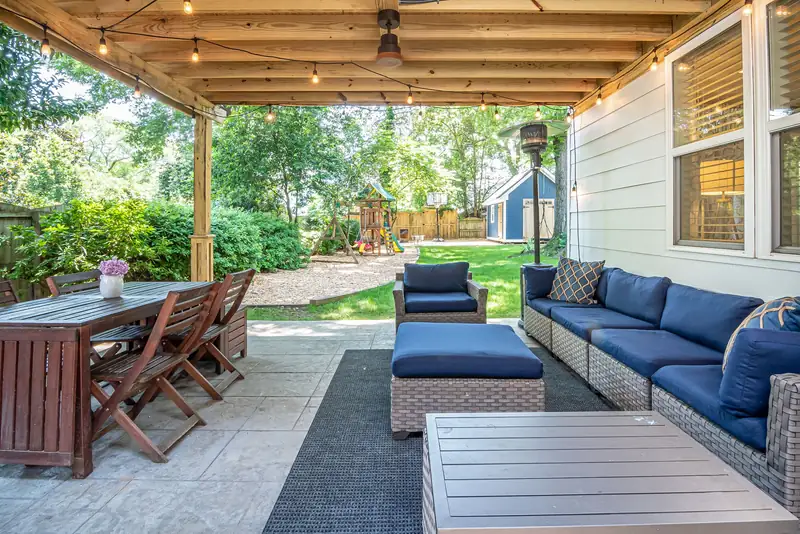
Concrete Patios · St. Cloud, FL
Concrete Patios for St. Cloud Backyards
A concrete patio in St. Cloud is priced at $6–$13 per sq ft installed as of October 2026, Florida's going range for the work. The city's Building Division files a patio slab under “Residential Other – Concrete Pad,” a category that does need a permit, unlike the pavers exemption that covers a driveway or sidewalk.
By the Opera Concrete & Pavers estimating team · Updated October 1, 2026
Get a free estimate
Tell us about the project and we'll call to set up a free site visit.
A patio pour sits on the permit-required side of the city's list
St. Cloud's permit page groups a concrete pad, a subdivision or retaining wall, and a pool or spa together as items that do need a Building Division permit, separate from the “No Permit Required” category that covers a paver driveway reseal (City of St. Cloud, Permit Information). A backyard patio addition typically falls under that pad category, since it adds new impervious area rather than resurfacing something already there. Confirming the scope with the Building Division before pricing avoids finding out mid-job that a survey or site plan was expected too.
Ridge Sand Under a Patio Still Needs Shallow Lifts
The sand ridge soils under parts of St. Cloud, Candler, Astatula and Tavares among them, drain so well that the water table can sit more than 80 inches down, yet that same looseness means a compactor's plate can push material sideways instead of locking it in place. Under a patio, where the base only needs to carry foot traffic and outdoor furniture rather than a vehicle, it is still worth wetting loose ridge sand enough to bind it and compacting in shallow lifts rather than one deep pass. Skipping that step on a sandy lot shows up later as a soft spot under one corner of the slab, often near wherever foot traffic concentrates, like a step down from a door.
St. Cloud's housing runs newer than several nearby Orlando-unit towns
The median St. Cloud home dates to 2003, per five-year Census estimates (Census Reporter, St. Cloud, FL), noticeably newer than the 1992 median seen across several cities closer to Orlando. That younger stock means fewer original 1980s or 1990s patios are due for replacement here; the more common job is an addition, extending an existing lanai or slab outward rather than tearing one out. A stamped or decorative finish on that kind of addition has to tie its control joints into whatever pattern the original pour already used.
Routing a Control Joint Around a Column Instead of Through It
Control joints on an open slab can run in a simple grid, but a lanai's support columns break that grid up, and a joint that would otherwise cross right through a post has to be routed around it instead. Panel-shape guidance still applies at every column: each section stays close to square, with the length no more than about one and a half times the width, rather than tapering into a long sliver next to a post. On a St. Cloud patio with four or more columns, that means planning the joint layout around the columns before the pour, not sawing a standard grid afterward and hoping it lines up.
A patio addition on a newer St. Cloud lot, worked out in square feet
Say a home built around the city's 2003 median year adds a 15 by 14 foot patio off the back of the house, 210 square feet, extending an existing lanai pad. That footage, run through $6–$13 per sq ft installed, comes to about $1,260 to $2,730 before a decorative finish changes the number. Because the original slab is closer to two decades old than four, the new pour usually ties into a subgrade that hasn't shifted much, which keeps the transition joint between old and new concrete simpler than it would be on an older lot.
When a Patio's Paperwork Crosses the Notice of Commencement Line
A direct contract over $2,500 requires a Notice of Commencement recorded and posted before work starts, and a modest St. Cloud patio poured on open ground can sometimes land under that line on its own. Add a lanai's footers, a larger footprint or an outdoor kitchen's built-in features, though, and the same job can cross both the $2,500 lien-law threshold and the $5,000 mark where the permitting authority wants a copy of the notice filed before the first inspection. Scoping the paperwork alongside the design, rather than after a contract is signed, keeps a patio project from hitting a recording requirement nobody budgeted time for.
A Shaded Patio Can Discolor Before the First Year Is Out
A patio that sits in shade most of the day, whether from a lanai roof, the house itself or mature trees, stays damp longer after each rainy-season storm than an open, sun-exposed slab, and algae or mildew can take hold on a shaded St. Cloud patio within the first year if the finish choice did not account for that exposure. A plain broom finish holds more surface moisture in its texture than a sealed, stained or exposed-aggregate surface does, which makes the finish decision made before the pour part of how the patio ages, not just how it looks on day one. That tradeoff is worth raising at the planning stage, before concrete that cannot easily change finish is already down.
Checking Where the Downspout Actually Lands Today
A downspout that was aimed fine when the landscaping was last redone can drift or get knocked out of position over the years, and checking where it actually discharges today, not where it was pointed when the St. Cloud patio was poured, is worth doing at least once a year. A head draining straight onto a compacted patio edge wets that same strip of base every time it rains, which works against the base the same way standing water from poor grading would, just more predictably and over a longer stretch of time. Redirecting a drifted downspout costs almost nothing and protects years of base work that is otherwise sound.
Frequently asked questions
Does a concrete patio need a permit in St. Cloud?
Yes. The Building Division files a patio under the “Residential Other – Concrete Pad” category, one of the items on its permit-required list, unlike the paver exemption that covers a driveway or sidewalk resurfacing.
Are St. Cloud's original patios old enough to need replacing?
Often not yet. With the city's median home dating to 2003, a lot of the original patio slabs are closer to two decades old than four, so an addition extending the existing pad is more common than a full tear-out and repour.
Does extending an existing patio require a new survey?
The Building Division reviews new impervious area the same way it reviews a fresh pad, so a site plan showing the addition relative to the property line is typically part of that review, worth confirming before pricing.
Sources
- City of St. Cloud — Permit Information
- City of St. Cloud — Public Works Fees
- Census Bureau PEP, City and Town Population Totals, Vintage 2025 (July 1, 2025)
- Census Reporter, St. Cloud, FL (ACS 2020-2024 5-yr, B25035)
- NRCS OSD Smyrna
- NRCS OSD Myakka
- NRCS OSD Basinger
- Osceola County — Parking Ordinance, Ch. 22 Art. II (Sec. 22-50.6)
- Florida Administrative Code — Rule 62-308.100, Synthetic Turf (effective May 19, 2026)
- Florida Statutes §125.572 — synthetic turf on single-family lots
- Florida Statutes §720.3045 — items not visible from the frontage or an adjacent parcel
- Toho Water Authority, Watering Days and Times
- Toho Water Authority, St. Cloud Utility Integration News Release
- Wikipedia, St. Cloud, Florida
Ready for a price on your project?
Request a free estimate
Tell us about the project and we'll call to set up a free site visit.