
Concrete Patios · Parrish, FL
Concrete Patio Installation in Parrish
A concrete patio in Parrish runs $6–$13 per sq ft installed as of October 2026. A simple slab added behind a brand-new home follows the county's same non-structural exemption as a patio poured on a parcel that predates the newer subdivisions around it.
By the Opera Concrete & Pavers estimating team · Updated October 1, 2026
Get a free estimate
Tell us about the project and we'll call to set up a free site visit.
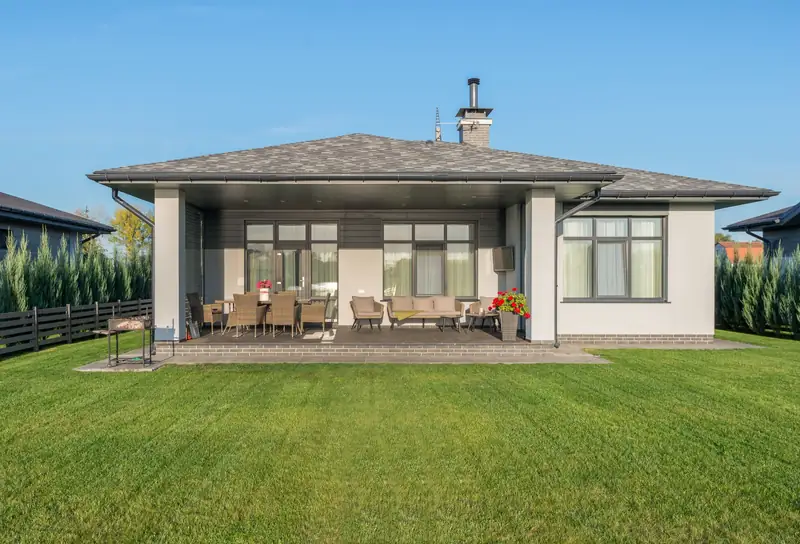
Say a 14 x 20 ft lanai patio addition behind a recently built Parrish home comes to 280 sq ft
Say a 14 x 20 ft lanai patio addition behind a recently built Parrish home comes to 280 sq ft. At $6–$13 per sq ft, that comes to $1,680 to $3,640 across the full range, narrowing to about $1,960 to $2,800 inside the typical $7–$10 band for a broom finish. Because the slab is freestanding and poured on grade, it lands on the county's no-permit list the same way an identical patio would on a decades-older lot, though the rear-yard grading still gets checked against whatever retention pond or buffer the subdivision's original site plan set up.
Reading the county's no-permit list on a new lot
Manatee County's current no-permit guidance names a "non-structural concrete/paver patio" directly as work that skips a building permit, while a "concrete slab with footers" sits on the opposite side of the list and does need one Manatee no-permit list. That split doesn't care whether the home behind the patio closed last year or thirty years ago; a freestanding slab poured on grade, not tied structurally into the house, is the detail that matters, and Development Services at 941-748-4501 ext. 3800 sorts out a borderline case either way.
Weathering Class Changes the Psi a Covered Lanai Needs
Florida's residential code sets different minimum strengths for exterior flatwork depending on weathering exposure, 2,500 psi at the lightest category, climbing to 3,000 and 3,500 psi as exposure gets more severe, the same table that governs porches and carports. Which category a Parrish patio falls into, open to the sky versus covered by a lanai roof, is not something we assume from the job site; it is a classification the local building official applies, and getting the psi right starts with confirming that classification rather than defaulting to whichever number sounds safest. A patio built to a higher strength than its exposure calls for is not a mistake, but it is money spent on margin nobody required.
Grading a patio around a new subdivision's stormwater layout
Many of Parrish's newer master-planned sections, including North River Ranch and Seaire, are built around retention ponds and conservation buffers as part of the overall stormwater design, so a patio addition on one of those lots often has a rear-yard grading plan already set by the original site plan rather than a blank slate. Felda soil, common in low spots across the area, keeps a water table within about a foot of grade for part of the year NRCS Felda soil series, which still shapes slope and perimeter drainage even on a lot built within the last few years.
A Downspout Can Undermine a Base Before It's Even Poured
A downspout that empties straight onto the footprint of a planned Parrish patio is a base problem before it is ever a finish problem. Florida's rainy season pushes real volume through a gutter system, Orlando averages about 51.45 inches of rain a year and Sarasota-Bradenton about 49.05, and a corner of subgrade that gets soaked every time it rains compacts differently than the rest of the pad around it. Extending the downspout, adding a splash block or routing water to a swale before the base goes down costs little compared with finding out later that one corner of the patio settled because it never had a fair chance to compact evenly with the rest.
A Patio Sloped Toward the House Finds the Sliding Door First
A patio that slopes even slightly toward the house instead of away from it sends every storm straight at whatever is closest, a sliding glass door, a lanai threshold, a foundation wall, rather than out into the yard where it belongs. On flatwoods soils already holding water near the surface for part of the year, a Parrish patio with the wrong fall does not just puddle, it keeps that water sitting against the house through an entire rainy season instead of one storm. The fix almost always traces back to grading decided at the subgrade stage, not the finish, which is why checking the fall before the forms go up matters more than checking it after the pour.
Starting Early When the House Itself Blocks the Morning Shade
A patio built close to the back of a Parrish house often sits in the house's own shadow through mid-morning, which shifts the riskiest window for a hot pour later in the day than it would be on an open driveway facing the street. Hot-weather guidance still calls for avoiding the hottest stretch of the day and starting early enough that finishing and the first hours of curing happen before heat and evaporation peak, but starting early on a shaded patio sometimes means watching the sun angle as much as the clock. Reading the site's actual shade pattern, not just a generic start time, is part of planning the pour day.
Timing New Landscaping Around a New Patio's Watering Exemption
New landscaping planted around a freshly poured Parrish patio usually qualifies for a temporary watering exemption, daily for the first 30 days and then every other day for the next 30 under the Orlando-area rules, or a similar new-plant schedule under the Sarasota side's current restrictions, rather than the standard once- or twice-a-week limits that apply to established beds. Timing new sod or shrubs around the patio to go in right after the pour, while that exemption window is open, gets new plants established without the irrigation overspray that a fully restricted schedule can leave on fresh concrete edges. Checking which district's rules apply to a specific address is worth doing before the planting date, not after.
Frequently asked questions
Does a patio on a new Parrish home need a permit?
Not if it's a freestanding, non-structural slab poured on grade; the county's no-permit list treats that the same way regardless of how recently the home was built. A slab with footers, or one tied into the house, needs a permit.
Does a new subdivision's retention pond affect where I can put a patio?
It can shape the rear-yard grading and slope, since many newer Parrish sections route stormwater to ponds and buffers as part of the original site plan, even though it doesn't change whether the patio itself needs a permit.
Who do I call to confirm a patio permit question in Parrish?
Manatee County Development Services, at 941-748-4501 ext. 3800, settles a borderline case before pricing or scheduling the pour.
Sources
- Manatee County LDC §1004.2 Access and Drainage Permit
- Manatee — Request a Driveway or Culvert Permit
- Manatee Driveway and Culvert Application (2022)
- Manatee — Inspections Required for Paver Driveways
- Manatee — What Does Not Require a Permit (6-16-26)
- Manatee County LDC §511.16 Swimming Pools, Spas, Screen Enclosures
- Manatee County - Modified Phase III water shortage restrictions
- SWFWMD District Water Restrictions
- FEMA Flood Map Service Center
- NRCS OSD Myakka
- NRCS OSD EauGallie
- NRCS OSD Felda
- Florida Administrative Code — Rule 62-308.100, Synthetic Turf (effective May 19, 2026)
- Florida Statutes §125.572 — synthetic turf on single-family lots
- F.S. 720.3045 (2026) Installation, display, and storage of items
- Census Reporter, Parrish CCD, Manatee County FL (ACS 2020-2024 5-yr, B01003/B25035)
- Wikipedia, Fort Hamer Bridge
- USGS Water Data, Gamble Creek at County Road 675 near Parrish FL (Station 02300017)
- USF Water Atlas, Gamble Creek
- Your Observer, Big projects to keep an eye on in Parrish
Ready for a price on your project?
Request a free estimate
Tell us about the project and we'll call to set up a free site visit.